

Scientists analyzing data from NASA's Cassini mission have discovered new, complex organic molecules in the icy plumes erupting from Saturn's moon, Enceladus. The findings, based on material collected directly from the moon's subsurface ocean, provide strong evidence of advanced chemical processes occurring within this distant world and bolster its status as a prime location to search for life beyond Earth.
Key Takeaways
- New analysis of data from NASA's Cassini spacecraft identified previously undetected complex organic molecules on Enceladus.
- These molecules were found in ice grains ejected from the moon's hidden global ocean through powerful jets.
- The discovery suggests the presence of active, complex chemical reactions that could be precursors to biological processes.
- This evidence strengthens the scientific case for a future mission dedicated to exploring Enceladus for signs of life.
An Ocean World Hidden Beneath Ice
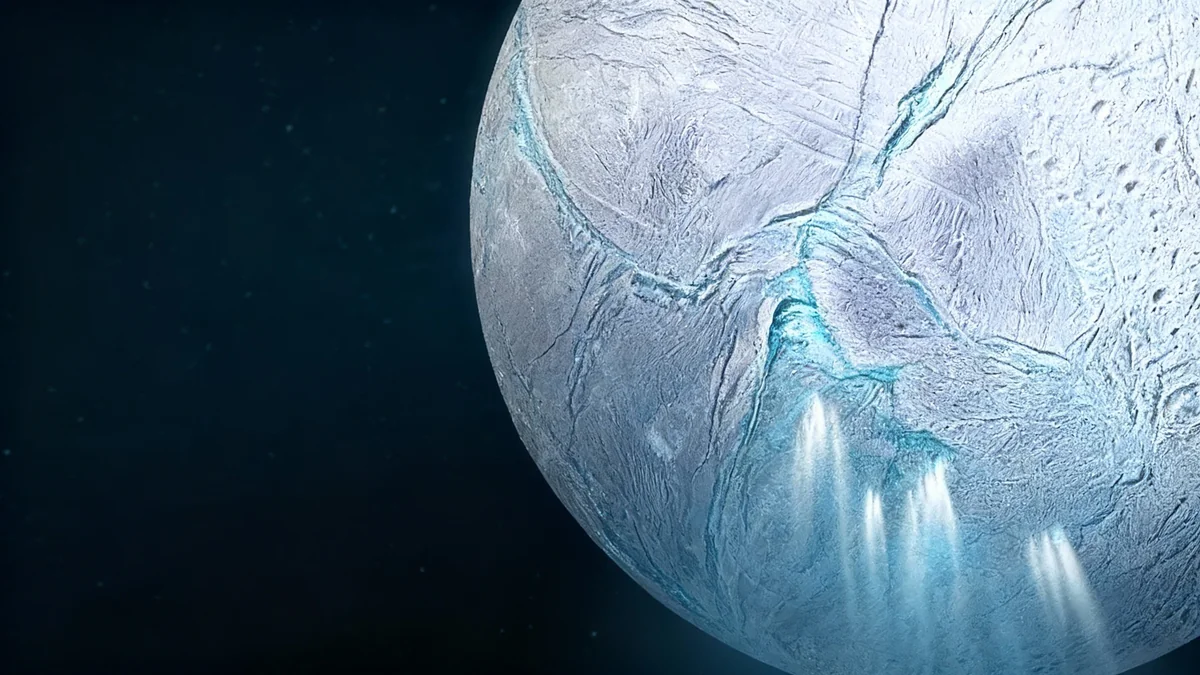
Enceladus, one of Saturn's most intriguing moons, is covered by a thick crust of ice. In 2005, the Cassini spacecraft confirmed that this frozen shell conceals a vast, global ocean of liquid water. This discovery immediately positioned Enceladus as a location of significant astrobiological interest.
Further observations revealed dramatic plumes of water vapor and ice particles erupting from large cracks, known as "tiger stripes," near the moon's south pole. These jets shoot material from the underground ocean deep into space, creating Saturn's faint E ring.
The Cassini-Huygens Mission
The Cassini-Huygens mission was a collaborative project involving NASA, the European Space Agency (ESA), and the Italian Space Agency. Launched in 1997, it spent 13 years orbiting Saturn, transforming our understanding of the planet and its moons before its mission concluded in 2017.
Revisiting Archived Mission Data
A team of scientists decided to reexamine data collected nearly two decades ago. While Cassini regularly sampled ice grains from Saturn's E ring, this material had been exposed to the harsh environment of space for long periods, potentially altering its chemical composition.
The researchers focused on a specific flyby from 2008 when Cassini passed directly through one of the fresh plumes. During this encounter, the spacecraft's Cosmic Dust Analyzer (CDA) instrument was struck by newly ejected ice grains traveling at approximately 18 kilometers per second.
The Importance of High-Speed Impacts
The extreme velocity of these impacts was critical to the new discovery. According to lead author Nozair Khawaja of Freie Universität Berlin, the speed of the collision played a key role in what the instrument could detect.
"At lower impact speeds, the ice shatters, and the signal from clusters of water molecules can hide the signal from certain organic molecules," Khawaja explained. "But when the ice grains hit CDA fast, water molecules don’t cluster, and we have a chance to see these previously hidden signals.”
This unique dataset provided a direct and unaltered sample of the ocean's chemistry, offering a pristine snapshot of the processes happening beneath the ice.
New Chemical Building Blocks Discovered
After years of careful analysis, the research team successfully identified the chemical signatures hidden within the high-velocity impact data. Their findings, published in the journal Nature Astronomy, confirmed the presence of organic molecules previously seen in the E ring, proving they originated from within Enceladus.
More importantly, the team discovered entirely new types of organic compounds never before detected at Enceladus. These included aliphatic compounds, ethers, and molecules containing nitrogen and oxygen. These are significant because on Earth, similar molecules participate in the chemical reactions that form amino acids, the fundamental building blocks of proteins and life.
What Was Found?
The analysis revealed molecular fragments including aliphatic compounds, (hetero)cyclic esters/alkenes, ethers, and compounds containing nitrogen and oxygen. These types of molecules are involved in many biological processes on Earth.
"These molecules we found in the freshly ejected material prove that the complex organic molecules Cassini detected in Saturn’s E ring are not just a product of long exposure to space, but are readily available in Enceladus’s ocean,” stated co-author Frank Postberg.
Strengthening the Case for Habitability
The presence of these complex organic molecules adds another crucial piece to the puzzle of Enceladus's potential habitability. Scientists have already confirmed that the moon possesses three key ingredients considered necessary for life:
- Liquid Water: A global subsurface ocean.
- An Energy Source: Evidence points to hydrothermal vents on the ocean floor, similar to those on Earth that support rich ecosystems.
- The Right Chemicals: Key elements like carbon, hydrogen, nitrogen, oxygen, phosphorus, and sulfur have been detected, along with these newly found complex organics.
This latest discovery demonstrates that the chemistry inside Enceladus is advanced enough to create the precursor molecules needed for life as we know it. "There are many possible pathways from the organic molecules we found in the Cassini data to potentially biologically relevant compounds, which enhances the likelihood that the moon is habitable," said Khawaja.
Paving the Way for Future Exploration
These results from archived Cassini data provide invaluable guidance for future space missions. The European Space Agency is already studying a potential mission concept designed to return to Enceladus with modern instruments specifically built to search for biosignatures.
Planetary scientists have identified Enceladus as a top-priority target for a future large-class mission. The plan would involve flying through the plumes again and possibly landing near the south pole to analyze surface material directly.
Nicolas Altobelli, an ESA project scientist for Cassini, highlighted the enduring value of the mission's data. "It’s fantastic to see new discoveries emerging from Cassini data almost two decades after it was collected. It really showcases the long-term impact of our space missions."
Whether a future mission finds life or not, the exploration of Enceladus promises to provide profound insights into the conditions that allow life to arise. As Khawaja noted, even confirming the absence of life in such a seemingly habitable environment would raise fundamental questions about its origins.