


The year 2025 will be remembered in the annals of space exploration as one of profound contrasts. It was a year marked by the high-stakes drama of astronauts stranded in orbit, groundbreaking discoveries from new cosmic observatories, and the steady, unceasing march of private enterprise beyond Earth's atmosphere. From a mission that stretched from eight days to nine months to the discovery of a hidden moon, the past year has reshaped our understanding of human resilience and the universe itself.
This year brought renewed public attention to the risks and rewards of spaceflight, highlighting the complex interplay between government agencies like NASA and commercial partners such as SpaceX and Blue Origin. At the same time, robotic explorers and powerful new telescopes continued their silent work, sending back data that could rewrite textbooks.
Key Takeaways from 2025 in Space
- Stranded in Orbit: The eight-day test flight for NASA astronauts Butch Wilmore and Suni Williams on Boeing's Starliner turned into a 286-day mission, requiring a rescue by SpaceX.
- New Discoveries: The Vera C. Rubin Observatory came online, spotting over 2,000 new asteroids, while the Webb Telescope found a previously unknown moon orbiting Uranus.
- Commercial Space Growth: Space tourism saw high-profile flights, including an all-female crew, and private companies expanded their roles in supporting the International Space Station.
- Geopolitical Tensions Rise: Space has increasingly become a domain for international competition and potential conflict, with discussions of lunar nuclear reactors and anti-satellite weapons.
The Unplanned Nine-Month Mission
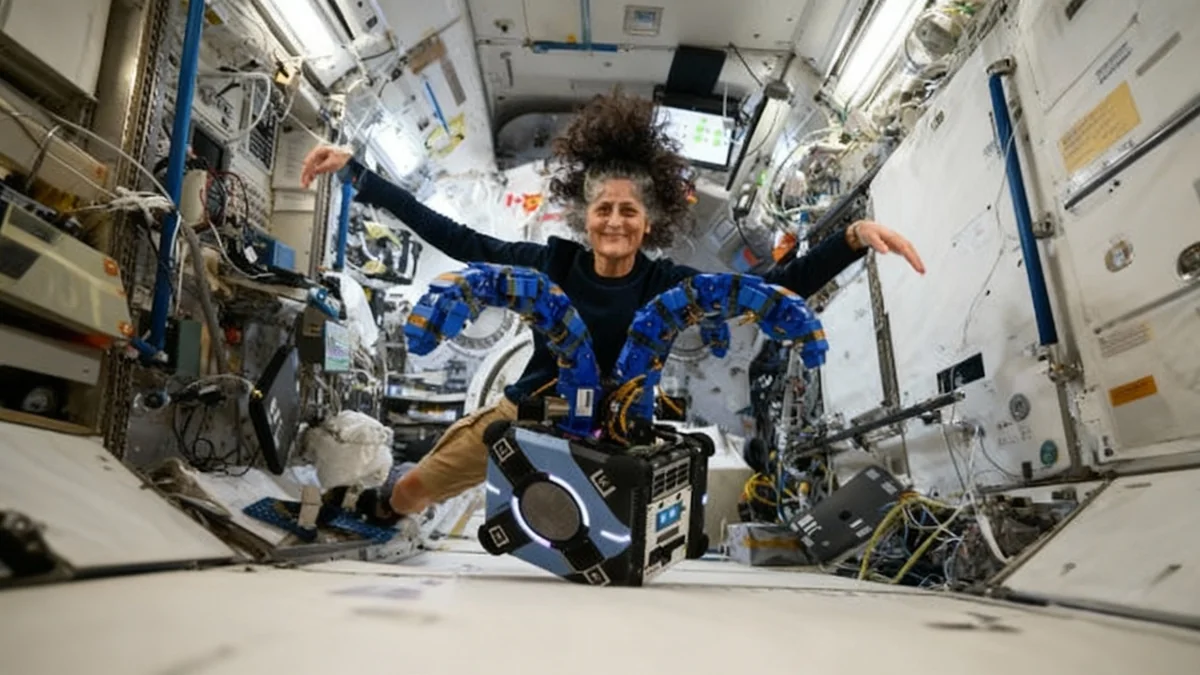
The story that captivated the world in 2025 was undoubtedly that of NASA astronauts Butch Wilmore and Sunita "Suni" Williams. Their mission, a crewed flight test of Boeing's Starliner spacecraft, was scheduled to be a brief, eight-day trip to the International Space Station (ISS) in June 2024. However, technical issues with the Starliner vehicle left them in orbit for 286 days.
The extended stay transformed the two veteran astronauts into household names, bringing a human face to the inherent dangers of space travel. Their eventual return to Earth in March 2025 was not aboard the Starliner, but on a SpaceX Crew-9 Dragon capsule, a decision that underscored the shifting dynamics in the commercial space sector.
The Long Road Home
While in orbit, Williams and Wilmore continued their work on the ISS, but their situation highlighted the challenges of long-duration spaceflight on the human body. Medical experts closely monitored their health, preparing for the difficult readjustment to Earth's gravity.
Dr. Luca Pizza of Mass General's Space Medicine Division explained the physiological impact. "The heart doesn’t have to push against gravity, so the heart gets weaker," he noted. "The body’s gotten used to not pumping the blood so hard... It’s got to relearn all those things."
Upon their splashdown off the coast of Florida, they were immediately met by a team of doctors. Their recovery is expected to take months, a stark reminder of the physical price of living in microgravity.
A Hometown's Vigil
Back on Earth, Williams' hometown of Needham, Massachusetts, held its breath for nine months. Her family and community followed every update. "We’re both very, very excited to have her back on Earth safely," said her sister, Deena, during the long wait. The town erupted in cheers when news of the safe splashdown arrived, with a watch party at The Common Room celebrating her return.
A Year of Remarkable Discoveries
While human drama unfolded on the ISS, robotic eyes turned toward the cosmos revealed stunning new secrets. 2025 was a banner year for astronomical observation, thanks to both new and existing technologies.
A New Moon and a Cosmic Visitor
The James Webb Space Telescope added another discovery to its impressive list: a new moon orbiting Uranus. The tiny satellite, only about 6 miles wide, was designated S/2025 U1. It joins the planet's 28 other known moons, all of which are traditionally named after characters from the works of William Shakespeare and Alexander Pope.
Astronomers were also treated to a rare sight as 3I/ATLAS, only the third-ever confirmed interstellar object, passed through our solar system. First spotted by a NASA-funded telescope in Chile, the comet's trajectory confirmed it originated from beyond our sun's gravitational pull before continuing its journey into deep space.
The Rubin Observatory Opens its Eyes
Perhaps the most significant technological debut of the year was the Vera C. Rubin Observatory in Chile. Housing the largest digital camera ever built, its mission is to conduct a decade-long survey of the sky. In its initial operations, it has already identified 2,104 previously unseen asteroids. The observatory is expected to map approximately 20 billion galaxies, fundamentally changing our cosmic catalog.
The Expanding Frontier of Commercial Space
The privatization of space continued its rapid acceleration in 2025. Commercial companies are no longer just launching satellites; they are flying tourists, ferrying astronauts, and planning the future of orbital habitats.
Celebrities and Newcomers in Orbit
Blue Origin's New Shepherd rocket made headlines in April by launching an all-female crew that included pop star Katy Perry and TV personality Gayle King. The suborbital flight took them past the Karman line, the recognized edge of space, for a brief experience of weightlessness.
The year also marked milestones for inclusivity and international cooperation. Blue Origin sent the first paraplegic person to space, while Houston-based Axiom Space chartered a flight that brought the first astronauts from India, Poland, and Hungary to the ISS.
"Butch and Sonny are the two most positive people in the astronaut office. They’re always smiling. They’re so experienced, they’re pros."
New Ambitions and Rising Tensions
As access to space becomes more common, the ambitions of nations and the potential for conflict are growing in tandem. The final frontier is increasingly seen as a strategic domain for both scientific leadership and national security.
A New Race to the Moon
NASA announced ambitious plans to place a nuclear reactor on the Moon to power future Artemis missions and a potential long-term human presence. The goal is not just scientific; it is also strategic. China and Russia have announced a joint venture to build their own lunar nuclear reactor, signaling a new space race centered on controlling resources and establishing infrastructure on the Moon.
The Moon is viewed as a critical stepping stone for eventual missions to Mars, as its low gravity makes it an ideal staging point for deep-space journeys.
The Final Frontier as a Battlefield
Unfortunately, space has also emerged as a new arena for terrestrial conflicts. Concerns grew over the development of anti-satellite weapons, with one U.S. official likening the threat to a "Cuban Missile Crisis in space." These developments, coupled with incidents like the alleged hijacking of a Ukrainian satellite broadcast, show that orbit is no longer an exclusively peaceful domain for scientific cooperation.
As 2025 comes to a close, it leaves a complex legacy: a year of human endurance, breathtaking discovery, commercial opportunity, and escalating geopolitical stakes in the vast expanse above our world.