
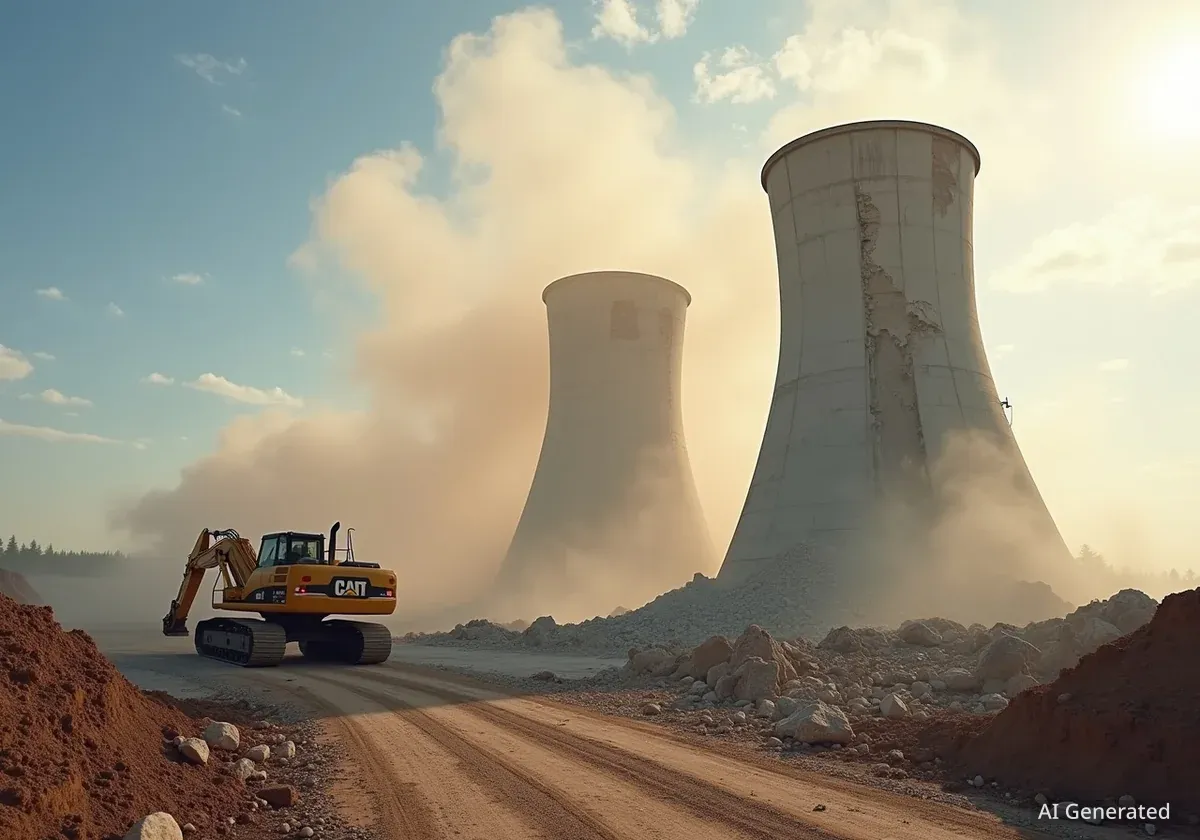

HUNTSVILLE, Ala. – The skyline at NASA's Marshall Space Flight Center was permanently altered on Saturday as two iconic structures from the Apollo and Space Shuttle eras were brought down in a controlled demolition. The Dynamic Test Stand and the adjacent "T-Tower," both National Historic Landmarks, were leveled as part of a long-term modernization plan, sparking a debate about progress and preservation.
The demolition, which occurred on the morning of January 10, 2026, sent vibrations throughout the Huntsville area. These structures were instrumental in testing the Saturn V rocket that carried astronauts to the Moon and later, the Space Shuttle, ensuring their structural integrity before their historic flights.
Key Takeaways
- Two National Historic Landmarks, the Dynamic Test Stand and the "T-Tower," were demolished at NASA's Marshall Space Flight Center.
- The structures were critical for testing the Saturn V rocket and the Space Shuttle, playing a key role in the Apollo program and lunar missions.
- The demolition is part of a wider modernization effort by NASA to remove 25 obsolete facilities, citing high rehabilitation and maintenance costs.
- The decision has been met with disappointment from historical preservation officials and former NASA engineers who worked on the sites.
A Legacy Reduced to Rubble
For decades, the towering steel lattices of the Dynamic Test Stand and the T-Tower were symbols of Huntsville's identity as the "Rocket City." Their removal marks the end of a significant chapter in American space exploration. The decision was part of NASA's initiative to streamline operations and remove aging infrastructure that is costly to maintain.
The Dynamic Test Stand, a colossal 360-foot structure, was famous for its rigorous vibration tests. It subjected both the 363-foot-tall Saturn V rocket and the Space Shuttle orbiter to intense shaking that simulated the violent forces of a launch. This critical step was necessary to verify that the vehicles could withstand the journey into orbit.
Nearby, the smaller T-Tower was used to test the propulsion systems of the spacecraft, running them through a series of demanding trials. For former engineers like Bob Gaffin, who served as the chief engineer on the Dynamic Test Stand during the mid-1960s, the demolition is a profound loss.
"I will have a hard time getting over it at first. I didn’t think they’d ever come down," Gaffin stated. He emphasized the importance of the work done there, adding, "The Saturn V and shuttle would not have flown, and we would not have made it to the Moon had it not been for the work done on those two stands."
Gaffin’s sentiment reflects a deep connection many in the community feel to these structures. For him, they represent a formative part of his career and life at Marshall. "It’s part of my life, you know? It’s where I started off at Marshall," he said.
The Cost of Progress
NASA officials have framed the demolition as a necessary step forward. The agency's modernization plan targets 25 facilities deemed obsolete. Maintaining these aging structures, according to NASA, would run into the millions of dollars, a cost that does not align with current budgetary priorities.
Despite their status as National Historic Landmarks, federal law allows the agency that erects such structures to also dismantle them. The Alabama Historical Commission engaged in discussions with Marshall Space Flight Center for over a year and a half, hoping for an alternative outcome.
Preservation Efforts and Federal Law
Under Section 106 of the National Historic Preservation Act, federal agencies are required to consider the effects of their projects on historic properties. However, it does not prevent demolition. In this case, NASA fulfilled its obligations by documenting the structures and consulting with historical bodies, but ultimately determined that removal was the most viable option.
Eric Sipes, Assistant State Archeologist with the Alabama Historical Commission, expressed his frustration with the decision.
"We are deeply disappointed and disheartened by Marshall Space Flight Center’s decision to demolish these structures," Sipes said. He noted that the commission was informed that NASA had explored options for rehabilitation, including offering the structures to private entities, but found no interested parties.
This situation highlights a broader challenge: balancing the preservation of historic sites with the practical needs and financial constraints of modern government agencies. Sipes pointed out the gravity of the loss, stating, "Out of a handful of national historic landmarks that are located in Alabama, four of them are at Marshall and three are slated for demolition."
A Personal Connection to History
The impact of the demolition extends beyond official records and into the personal lives of Huntsville residents. For local engineer Derek Rose, the test stands were a daily reminder of his family's contribution to the space race. His father worked as an iron worker on the very structures that are now gone.
"It’s one of the most recognizable landmarks in Huntsville," Rose explained. Driving to work on Redstone Arsenal, he would often see the towers and feel a sense of pride. "I will point it out to my children and tell them that their grandfather once worked on that test stand," he said, noting how his father's work inspired his own career path in engineering.
This personal connection illustrates how these structures were more than just concrete and steel; they were woven into the fabric of the community and the aspirations of generations.
Preserving the Memory
To mitigate the loss, the Alabama Historical Commission requested that NASA create detailed 3D digital models of the landmarks. NASA complied, and these models, along with extensive digital photographs housed in the Library of Congress, will serve as a permanent record. Auburn University is also involved in creating digital imaging. A few significant artifacts from the structures will be preserved and displayed at the U.S. Space & Rocket Center.
The Future of Marshall Space Flight Center
The removal of the Dynamic Test Stand and T-Tower is a clear signal of NASA's forward-looking strategy. The agency is focused on current and future missions, such as the Artemis program, which aims to return humans to the Moon and eventually send them to Mars. Modernizing its facilities is seen as essential to supporting these ambitious goals.
The third National Historic Landmark at Marshall slated for demolition is the Neutral Buoyancy Simulator, a large water tank where astronauts trained for spacewalks by simulating microgravity. Its removal will further erase the physical remnants of a bygone era of space exploration.
While the decision is rooted in practicality, the emotional and historical cost is undeniable. For those who built, worked in, or simply grew up in the shadow of these towers, their absence leaves a void that digital models and museum artifacts can only partially fill. The debate over their demolition underscores the ongoing tension between honoring a celebrated past and building a new future.