
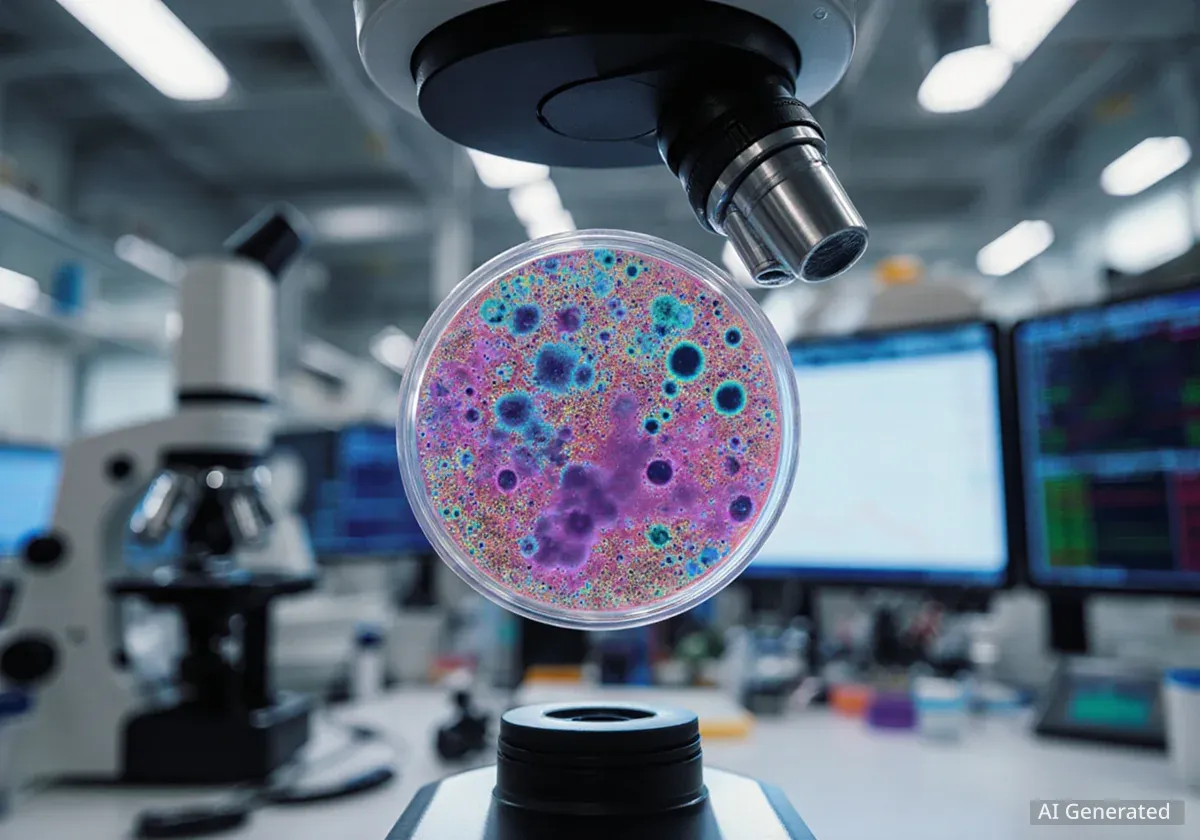
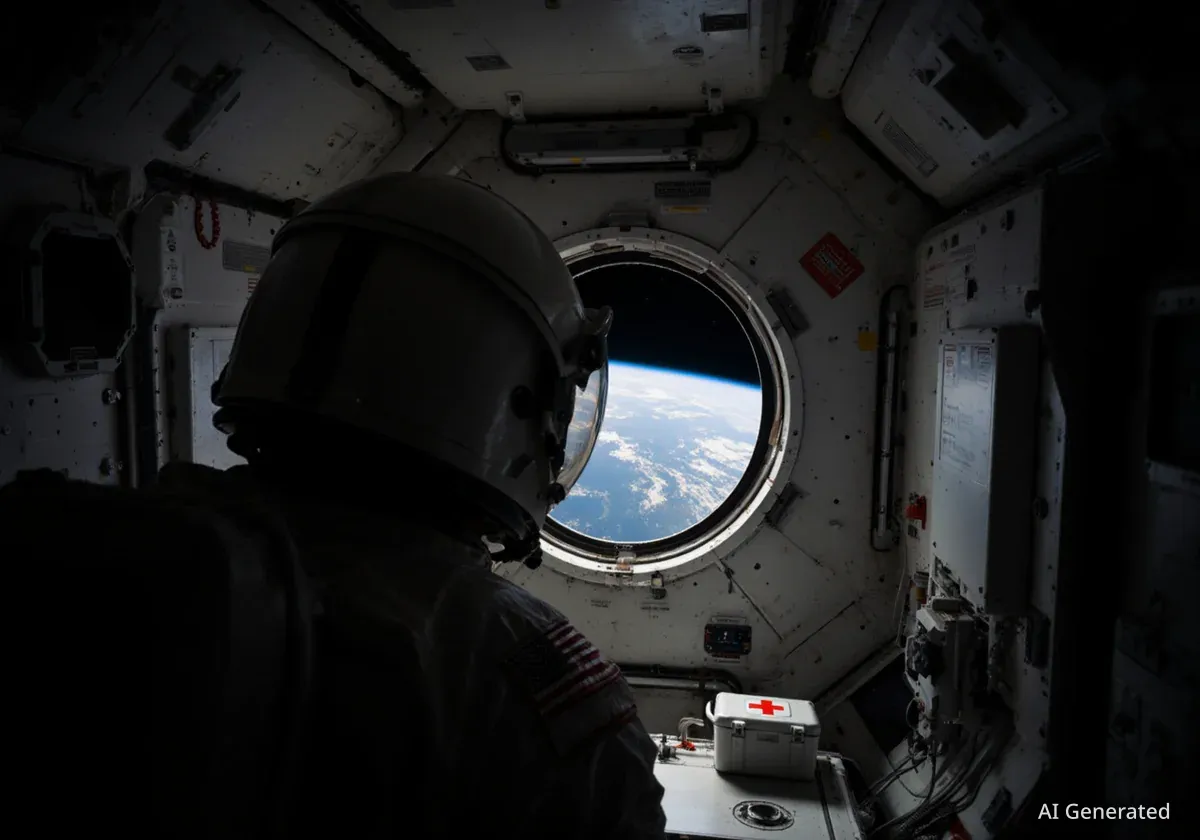


An experiment conducted aboard the International Space Station has produced a new version of a bacteria-killing virus that is more effective at destroying treatment-resistant pathogens. By adapting to the unique stresses of microgravity, these viruses underwent genetic changes that enhanced their ability to infect and eliminate bacteria, offering a potential new tool in the fight against superbugs back on Earth.
Key Takeaways
- Viruses sent to the International Space Station evolved to become more efficient at killing bacteria.
- Microgravity forced the viruses, known as bacteriophages, to develop genetic mutations to overcome the lack of fluid mixing in space.
- Upon returning to Earth, these space-adapted viruses successfully destroyed a strain of E. coli known for being resistant to treatment.
- This discovery could lead to new methods for creating more potent bacteriophages to combat antibiotic-resistant infections.
A Microbial War in Orbit
Scientists are in a constant search for new ways to combat dangerous bacteria, especially as antibiotic resistance grows. A recent study, detailed in the journal PLOS Biology, took this search to an unconventional laboratory: the International Space Station (ISS).
The experiment involved placing a common virus, bacteriophage T7, in an environment with its primary target, the bacterium Escherichia coli. Bacteriophages are viruses that specifically infect and destroy bacteria, making them a subject of intense research for medical applications. The goal was to observe how the timeless battle between virus and bacteria would unfold in the unique conditions of microgravity.
What Are Bacteriophages?
Bacteriophages, or "phages," are the most abundant life forms on Earth. They are natural predators of bacteria. For every bacterium, there are an estimated 10 phages. This natural rivalry is being explored by scientists as a potential alternative to antibiotics, a field known as phage therapy.
Researchers ran parallel experiments, one on the ISS and a control group on Earth. On the ground, the T7 viruses infected and destroyed the E. coli within two to four hours. However, in space, the process initially took much longer, exceeding four hours.
Adapting to a Weightless World
The initial slowdown in infection rates in space was attributed to the physical environment. On Earth, gravity helps stir fluids, increasing the chances of a virus encountering a bacterium. "Under normal gravity, fluid motion continually stirs the environment, increasing the chances that viruses and bacteria will meet," explained Ester Lázaro, an astrobiologist not involved in the study.
In the microgravity of the ISS, this natural mixing is almost nonexistent. This lack of movement meant the viruses and bacteria had to find new ways to interact. To survive and propagate, the bacteriophages were forced to adapt to this new, challenging environment.
Over the course of the experiment, the viruses began to change. Genetic analysis revealed that the space-faring phages developed mutations. These mutations resulted in subtle but significant shifts in the shape and structure of their outer membranes, effectively making them better at grabbing onto and infecting their bacterial prey without the aid of gravity-driven motion.
Initial Infection Times:
Earth: 2 to 4 hours
Space (initially): Over 4 hours
The delay in space was caused by the lack of natural fluid mixing, which forced the viruses to evolve.
A Potent Weapon Forged in Space
The most significant discovery occurred when the space-evolved viruses were brought back to Earth. Scientists tested their newfound abilities against a different strain of E. coli, one notorious for causing stubborn urinary tract infections and showing resistance to traditional bacteriophage treatments.
The results were striking. The viruses that had adapted to microgravity were able to successfully infect and kill this treatment-resistant strain of bacteria. The environmental stress of space had unintentionally forged a more powerful biological weapon.
"A simple microgravity experiment exposes these mutations that have much higher efficacy against pathogens," said Srivatsan Raman, the study's senior author and a chemical and biological engineer at the University of Wisconsin–Madison. He described the outcome as "really quite promising."
This suggests that exposing viruses to novel environmental stressors could be a new method for "training" them to become more effective. By forcing them to overcome new challenges, scientists may be able to accelerate their evolution and create phages capable of targeting the most dangerous superbugs.
Implications for Future Medicine
The findings open an exciting new chapter in phage therapy. Instead of relying solely on finding naturally occurring phages, researchers could potentially engineer more potent versions by simulating unique environmental stresses, like microgravity, in a lab.
Evelien Adriaenssens, a researcher at the Quadram Institute in England who was not part of the study, noted the importance of testing known organisms in new settings. "T7 is one of our iconic model organisms, so there’s a lot known about this bacteriophage," she stated. "It was cool to see that if you go into a different environment, there’s still new knowledge that comes up."
While the research is still in its early stages, it presents a creative and unexpected approach. The silent, weightless environment of space may have provided the key to unlocking a new generation of weapons to fight an escalating war against drug-resistant bacteria on our own planet.