
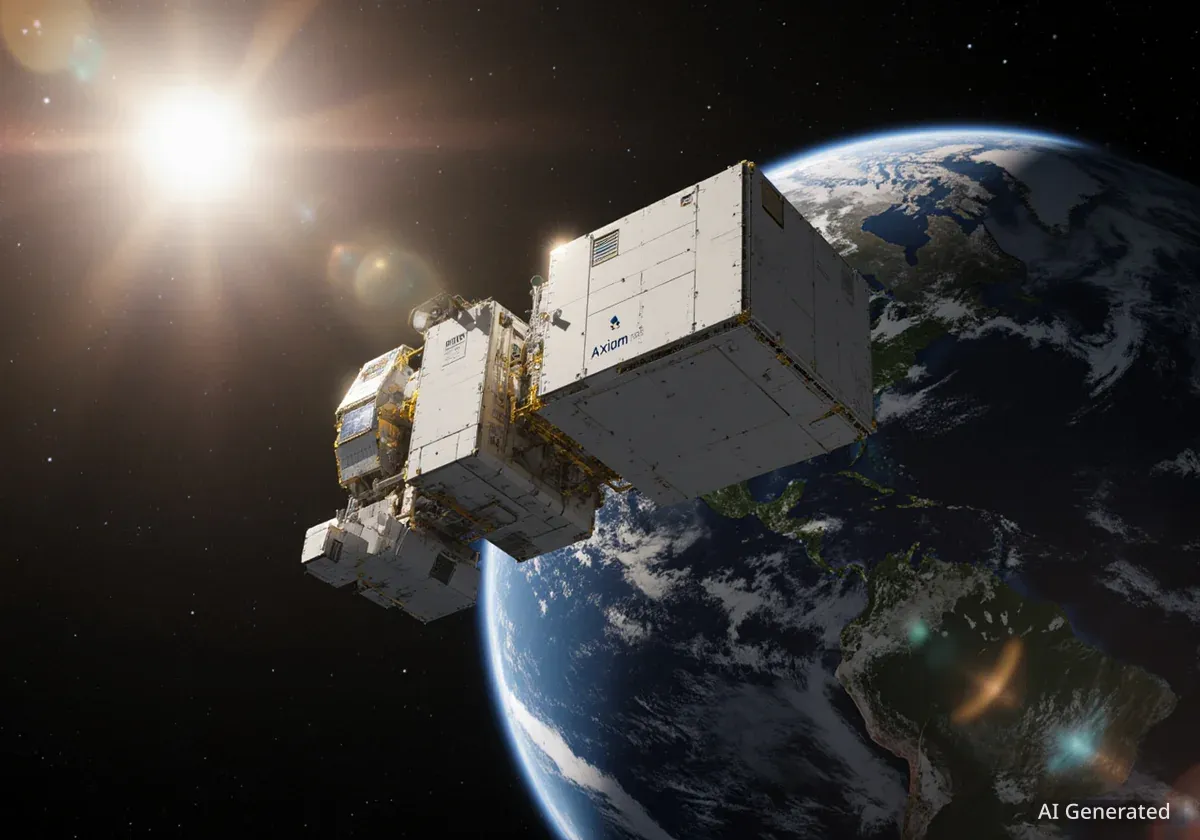


HOUSTON – Axiom Space has successfully raised $350 million in new financing, a significant step toward building the world's first commercial space station. The funding is designated to accelerate the development of Axiom Station, the planned successor to the International Space Station (ISS), and to produce advanced spacesuits for future lunar missions.
The investment round, co-led by Type One Ventures and the Qatar Investment Authority (QIA), signals strong confidence in the company's role in the future of the low-Earth orbit economy. This capital injection will support critical infrastructure and technology as the era of the ISS draws to a close.
Key Takeaways
- Major Funding: Axiom Space announced a $350 million financing round from institutional and strategic investors.
- Dual Focus: The funds will be used to develop Axiom Station, the commercial replacement for the ISS, and to manufacture AxEMU spacesuits for NASA's lunar missions.
- Investor Confidence: The round was co-led by Type One Ventures and Qatar Investment Authority (QIA), highlighting international belief in the commercial space sector.
- Strategic Position: Axiom is positioning itself as the primary provider of orbital infrastructure and human spaceflight services as the ISS approaches retirement.
Pioneering the Post-ISS Era
With the International Space Station scheduled for decommissioning around 2030, the race to establish a commercial presence in low-Earth orbit is intensifying. Axiom Space has emerged as a key player, working to ensure continuous human access to space for research, manufacturing, and exploration.
The company's primary project, Axiom Station, is designed to be a modular platform that will initially attach to the ISS before separating to become a free-flying orbital outpost. This new funding is crucial for maintaining the project's development timeline and ensuring a smooth transition from the publicly funded ISS to a commercially operated model.
"The continued backing of strategic partners and world-class institutional investors like QIA reinforces the strength of our vision as we lead the transition to a commercial space economy in low-Earth orbit," said Kam Ghaffarian, Axiom Space Founder and Executive Chairman.
Ghaffarian, who also participated in the funding round, emphasized his commitment to building what he terms "humanity's future off planet." The investment underscores a broader market shift towards companies capable of building the essential infrastructure for this new economic frontier.
Next-Generation Spacesuits for the Moon
Beyond its space station ambitions, a portion of the $350 million will be allocated to the production of the Axiom Extravehicular Mobility Unit (AxEMU). These are the next-generation spacesuits Axiom is developing under a contract with NASA.
The AxEMU suits are vital for the success of the Artemis program, which aims to return American astronauts to the Moon for the first time in over 50 years. The suits are designed to provide increased flexibility, greater protection, and more advanced technology compared to the decades-old designs currently in use.
The AxEMU Spacesuit
Under its NASA contract, Axiom Space is tasked with delivering a complete system for spacewalking on the lunar surface. This includes not only the suits but also training and life support systems, marking a significant step in the privatization of critical space exploration hardware.
This dual-track approach—building both a habitat and the suits needed to explore outside it—positions Axiom as a comprehensive service provider for the future of human spaceflight, both in Earth's orbit and beyond.
Building the Orbital Economy
Investors see Axiom Space as more than just a hardware manufacturer. The company's strategy involves creating an entire ecosystem in orbit that supports various commercial activities.
Key Commercial Opportunities:
- Microgravity Research: Providing a platform for pharmaceutical, materials science, and biomedical research that can only be conducted in space.
- In-Space Manufacturing: Enabling the production of high-value products like fiber optics, semiconductors, and 3D-printed biological tissues.
- Orbital Data Centers: Exploring the potential for secure and efficient data processing and storage in space.
- Human Spaceflight Services: Continuing to fly private and government astronauts to orbit for tourism, research, and national missions.
Tarek Waked, Founding General Partner at Type One Ventures, highlighted this broader vision in a statement.
"Axiom Space isn’t just building hardware, it’s building the backbone of humanity’s next era in orbit," Waked explained. "Their rare combination of execution, government trust, and global partnerships positions them as the clear successor-architect for life after the ISS."
The Growing Commercial Space Market
The global space economy is projected to grow to over $1 trillion by 2040. Companies like Axiom Space are at the forefront, transitioning key space activities from government-led initiatives to commercially viable enterprises. This shift is expected to lower costs, increase access to space, and foster innovation across multiple industries.
The latest funding round also included participation from 1789 Capital, 4iG, and LuminArx Capital Management, among others. Financial giant J.P. Morgan served as the sole placement agent for the transaction, indicating the high level of institutional interest in the venture.
As Axiom Space moves forward with this new capital, its progress will be closely watched by governments, scientists, and businesses worldwide. The successful deployment of Axiom Station and the AxEMU spacesuits will not only define the company's future but also shape the next chapter of human activity in space.