
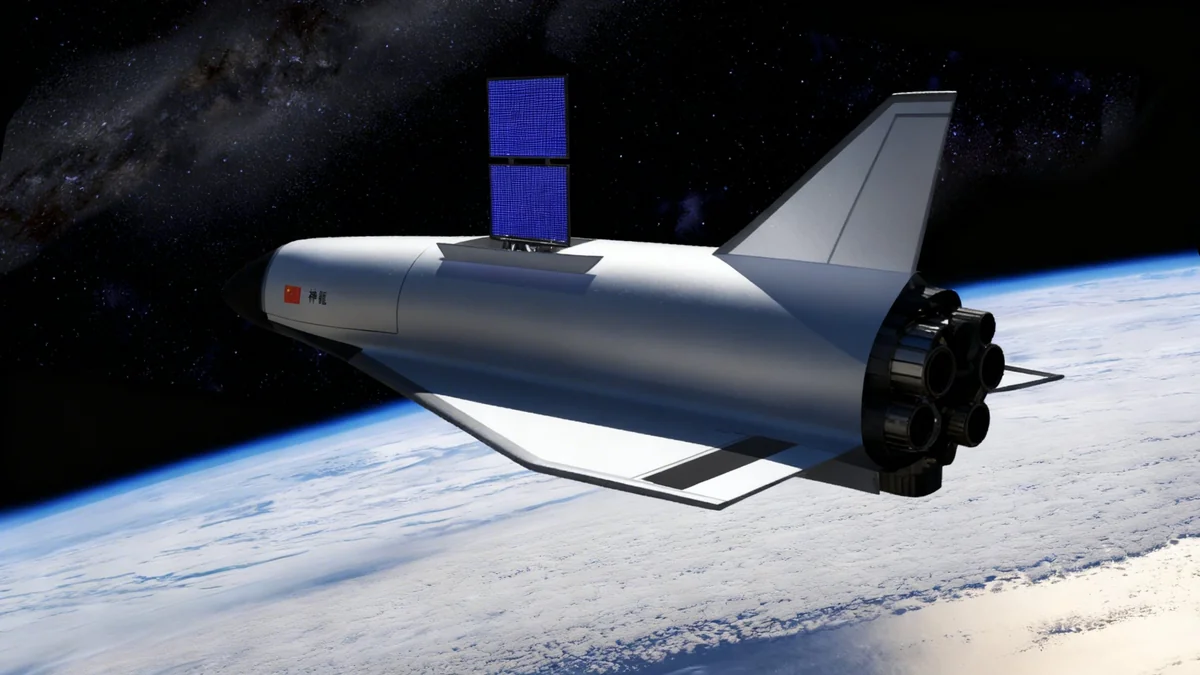


China's reusable and highly secretive space plane, known as Shenlong or "Divine Dragon," has embarked on its fourth mission, once again raising questions across the global space community about its purpose and capabilities. The robotic vehicle launched from the Gobi Desert, continuing a program that has demonstrated increasingly complex maneuvers with each flight.
While Beijing maintains the project is for peaceful purposes and testing reusable space technologies, international observers point to its sophisticated orbital activities. Unlike its American counterpart, the X-37B, the Shenlong has a documented history of deploying objects in orbit and performing close-proximity operations, a skill set with significant dual-use potential.
Key Takeaways
- China's reusable Shenlong space plane is on its fourth orbital mission, which began on February 6.
- The program is characterized by official secrecy, with China stating its purpose is to test reusable technologies for peaceful space use.
- Shenlong has demonstrated advanced capabilities, including deploying smaller satellites and performing rendezvous and proximity operations (RPOs).
- These activities differentiate it from the U.S. X-37B and raise concerns about potential military applications, such as satellite inspection or interference.
A Pattern of Increasing Complexity
The Shenlong program has evolved rapidly since its debut. Its first mission in September 2020 lasted only two days. Subsequent flights showed a significant leap in endurance and capability. The second mission in 2023 lasted 276 days, and the third concluded after 266 days in orbit.
During these missions, tracking data from military and amateur observers revealed that Shenlong was not merely circling the Earth. On each of its previous flights, the space plane released at least one smaller object into orbit. These objects have been observed broadcasting signals and, in some cases, demonstrating independent propulsion.
This pattern suggests a focus on mastering rendezvous and proximity operations, or RPOs. These are maneuvers that allow one spacecraft to approach, match orbit with, and operate near another object. This technology is critical for a range of future space activities.
What are Rendezvous and Proximity Operations (RPOs)?
RPO refers to the ability of a spacecraft to get very close to another object in orbit. This skill is fundamental for future space applications, including:
- Satellite Servicing: Refueling, repairing, or upgrading existing satellites to extend their lifespan.
- Debris Removal: Capturing and de-orbiting space junk to clear orbital pathways.
- On-Orbit Assembly: Building larger structures, like space stations, in orbit.
- Inspection: Examining friendly or potentially hostile satellites.
Comparison with the U.S. X-37B
The Shenlong is often compared to the U.S. Space Force's X-37B, an autonomous space plane that has also conducted multiple long-duration, classified missions. Both vehicles resemble a miniature space shuttle and are designed for reusability. However, their observed behaviors in orbit show key differences.
The U.S. military has consistently described the X-37B as a technology testbed. Publicly available tracking data has not shown the X-37B performing the same kind of RPO maneuvers or satellite deployments that have been attributed to Shenlong. According to analysis from the Secure World Foundation, the X-37B has generally orbited far below most operational satellites and has not been observed approaching other space objects.
Shenlong's demonstrated ability to deploy and then interact with other objects sets it apart. These maneuvers, which include close approaches and potential docking or capture operations, indicate a different set of mission priorities that appear to be more interactive and assertive.
Mission Durations Compared
- Shenlong Mission 1 (2020): 2 days
- Shenlong Mission 2 (2023): 276 days
- Shenlong Mission 3 (2024): 266 days
- X-37B (Longest Mission): 908 days
Dual-Use Technology and Security Concerns
The capabilities being tested by Shenlong are inherently dual-use. While RPOs are essential for peaceful activities like satellite repair and debris removal, they are also foundational for potential anti-satellite (ASAT) weapons. A spacecraft that can approach, inspect, and grab another satellite for servicing could theoretically do the same to disable an adversary's spacecraft.
This potential has not gone unnoticed by international security experts. Victoria Samson, the chief director of space security and stability for the Secure World Foundation, noted that developing RPO skills is a clear interest for major space powers, including China, Russia, and the United States. Mastery of this technology is increasingly seen as a prerequisite for achieving space superiority.
The secrecy surrounding both the Shenlong and X-37B programs complicates the situation. Without transparency, observers are often left to consider worst-case scenarios. While neither space plane is considered an effective platform for deploying weapons from orbit to the ground, their potential for on-orbit activities remains a subject of intense speculation and concern.
"I think a little more transparency would help fill in some of the blanks, because otherwise, people tend to just imagine the worst-case scenario," Samson stated, highlighting the need for more openness to reduce international tensions.
The Future of Orbital Operations
As China continues to advance its Shenlong program, it is clear that the nation is investing heavily in the technologies that will define the next era of space activity. The ability to manipulate, service, and interact with objects in orbit will be crucial for both commercial and military dominance.
The ongoing fourth mission of the Shenlong will be monitored closely by global space-tracking networks. Any new maneuvers, deployments, or changes in its orbital pattern will be analyzed for clues about its ultimate purpose. For now, the "Divine Dragon" remains one of the most capable and mysterious objects circling our planet, a symbol of China's growing ambitions in space.