
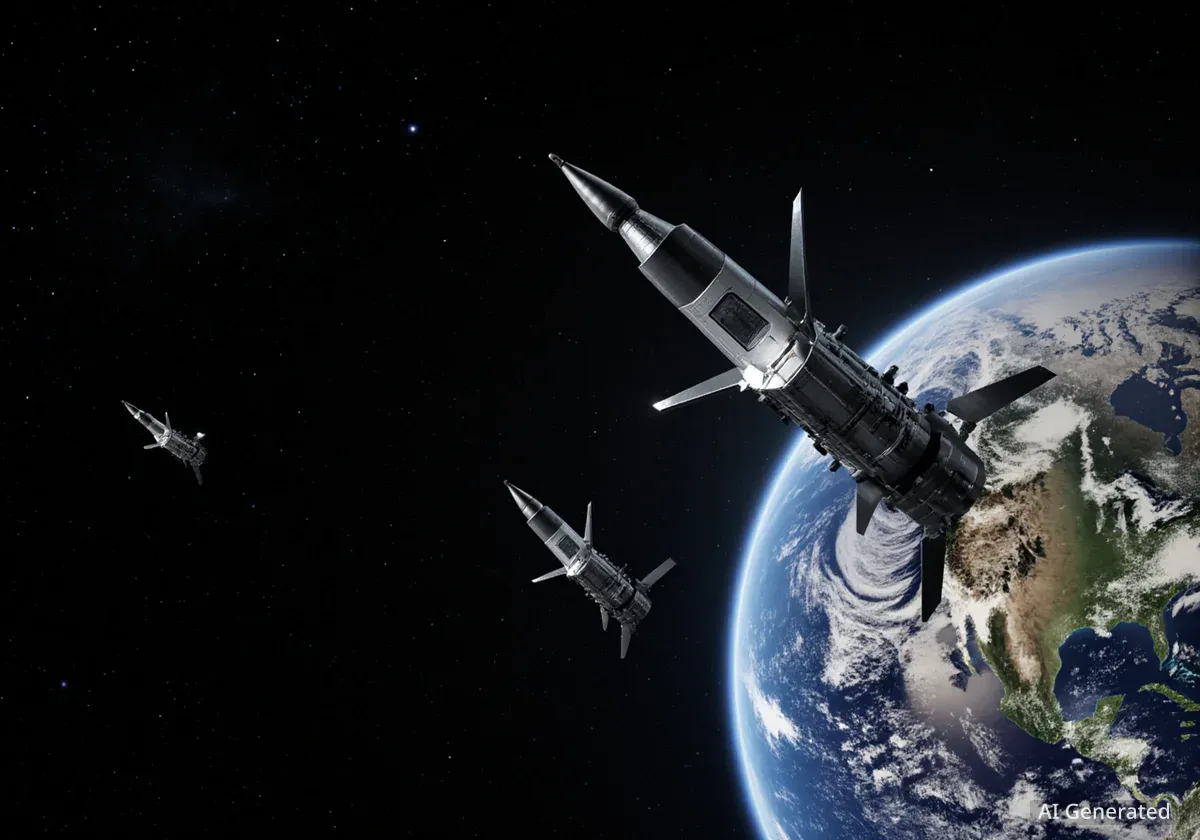



The head of Canada's military space division has issued a stark warning about the potential deployment of nuclear weapons in space by Russia, describing such a scenario as "cataclysmic." The concern centers on anti-satellite capabilities that could cripple global infrastructure reliant on space-based technology.
Brig.-Gen. Christopher Horner, Commander of 3 Canadian Space Division, emphasized that a nuclear detonation in orbit would have devastating consequences for modern life. This comes amid growing international apprehension regarding the weaponization of space and highlights Canada's strategic push for sovereign space capabilities.
Key Takeaways
- Canada's top military space official warns a nuclear weapon detonated in space would be "cataclysmic."
- Such an event could wipe out critical GPS and communication satellite networks globally.
- The warning aligns with concerns from international partners, including NATO leadership.
- Canada is investing $182.6 million to develop its own sovereign satellite launch capability to ensure access to space.
- The initiative aims to bolster national security and tap into the growing multi-billion dollar space economy.
The Gravity of the Threat
During a recent interview, Brig.-Gen. Horner outlined the severe implications of an orbital nuclear detonation. He explained that the very foundations of modern society are now tied to assets in space.
"Everything that we have come to rely on from a communications platform level or from a GPS level — if [Russia] were to deploy a capability like that and then detonate it — would be wiped out," Horner stated. This would not be a localized issue but a global crisis affecting everything from financial transactions and navigation to emergency services and daily communication.
"That would be cataclysmic," Horner said, underscoring the scale of the potential disruption.
These concerns are not isolated. Global leaders have voiced similar fears, pointing to international agreements designed to prevent such outcomes. A Russian deployment of this nature would directly violate the 1967 Outer Space Treaty, which explicitly prohibits placing weapons of mass destruction in orbit.
An International Arms Race in Orbit
The discussion around space weaponization has intensified over the past few years. Tensions were visible at the United Nations two years ago when Russia vetoed a U.S.-drafted Security Council resolution. The resolution called on all nations to prevent an arms race in outer space.
At the time, Russian officials dismissed the resolution, while American diplomats suggested the veto raised questions about what Russia might be concealing. Despite these diplomatic clashes, Russian President Vladimir Putin has publicly stated that his country is "categorically against the deployment of nuclear weapons in space."
The Outer Space Treaty of 1967
Formally known as the Treaty on Principles Governing the Activities of States in the Exploration and Use of Outer Space, including the Moon and Other Celestial Bodies, this treaty forms the basis of international space law. A key provision in Article IV bans signatories from placing nuclear weapons or any other weapons of mass destruction in orbit around Earth.
Horner noted that the magnitude of the threat is why there has been a significant international outcry. He advocated for a diplomatic approach, positioning Canada as a key player in de-escalation efforts.
"From a military perspective, I only offer that advice [that] we really should put pressure on them not to put a nuclear weapon in space, because that would be a horrendously terrible thing for so many reasons," he advised.
Canada's Push for Sovereign Space Access
In response to the volatile geopolitical landscape and the increasing reliance on space, Canada is taking concrete steps to secure its own interests. The 2025 federal budget includes a significant investment to create a domestic launch capability.
The government has allocated $182.6 million over three years to the Department of National Defence. The goal is to establish a system allowing Canada to launch its own commercial and military satellites from Canadian soil, a capability it currently lacks.
The Growing Space Economy
The global space economy is expanding rapidly, with projections valuing it at over $1 trillion by 2030. Having a sovereign launch capability would allow Canada to capture a larger share of this lucrative market, supporting domestic innovation and economic growth.
Brig.-Gen. Horner described this as a necessary step to "give Canada its assured access to space." Without it, the country remains dependent on a small number of international launch providers, such as SpaceX and Blue Origin.
The Risk of Being Left Behind
Horner warned that a limited number of launch providers coupled with rising global demand could create a bottleneck. In such a scenario, nations or companies with the most resources could dominate launch schedules, potentially delaying critical Canadian satellite deployments.
"And then it will cost Canadians more to then find a pathway to have SpaceX, or Blue Origin or Rocket Lab, or someone like that launch," he explained. A domestic spaceport would mitigate this risk, ensuring Canada can prioritize its national security and economic needs.
Several commercial projects are already in development across the country, racing to become Canada's first operational spaceport.
Leveraging Canada's Existing Strengths
While a launch site is still in the future, Horner was quick to praise the nation's existing expertise in the aerospace sector. He highlighted the significant intellectual capital present in the country's technology hubs.
"We've incredible companies that can conceive, design and build satellites, in Montreal and Toronto, here in Ottawa — there is incredible intellectual capital and property in this country that is world-leading," Horner said.
Developing a launch capability is seen as the final piece of the puzzle. It would complete what Horner called the "economic circle or economic chain of space," allowing Canada to manage the entire lifecycle of its satellite programs, from conception and manufacturing to launch and operation. This end-to-end sovereignty is viewed as essential for navigating the challenges of the 21st century.