




A global conflict extending into orbit would not begin with a dramatic explosion, but with a silent, digital disruption. Experts in space policy and cybersecurity paint a picture of a first week defined by cyberattacks, targeted blinding of satellites, and a desperate struggle to control the ultimate high ground, with devastating consequences for life on Earth.
The initial 48 hours would likely involve sophisticated cyber warfare aimed at creating widespread chaos and plausible deniability. Before any physical weapon is deployed, the primary objective would be to dismantle an adversary's ability to see, communicate, and navigate.
Key Takeaways
- The first phase of a space war would be dominated by non-kinetic attacks, such as GPS spoofing and DDoS attacks on ground stations.
- Directed-energy weapons like lasers would be used to temporarily or permanently disable reconnaissance satellites.
- Commercial satellite constellations, such as those operated by SpaceX, would become critical military infrastructure and prime targets.
- The ultimate victor may be determined by the ability to protect ground infrastructure and rapidly replace lost satellites.
- A kinetic conflict in space risks creating a massive debris field, potentially rendering low-Earth orbit unusable for generations due to the Kessler Syndrome.
The Silent Opening Salvo
The first shots of a modern space war would be lines of code, not missiles. According to Scott Shackelford, a professor and cybersecurity expert at Indiana University, the conflict would start with a “glitch” rather than a “bang.”
Massive, coordinated Distributed Denial-of-Service (DDoS) attacks would target the ground stations that command and control satellite networks. Simultaneously, sophisticated “spoofing” of GPS signals would manipulate location data, sending everything from military drones to commercial shipping off course.
“The goal would be to blind the adversary,” Shackelford's analysis suggests. The immediate effect on Earth would be paralyzing. Global supply chains could freeze, financial markets relying on high-frequency trading would halt, and essential navigation services would become unreliable, sowing distrust and confusion on a global scale.
From Disruption to Destruction
Within three to four days, the conflict would escalate from digital interference to physical, yet non-destructive, attacks. This phase would exploit legal and ethical gray areas in international law. Directed-energy weapons, such as powerful lasers, would likely be used to “dazzle” or permanently blind the optical sensors on reconnaissance satellites.
This escalation would directly involve the commercial sector. Companies like SpaceX, which operates the Starlink constellation and a military-focused version called StarShield, are no longer just private entities. Their networks are now considered essential military infrastructure.
The Blurred Lines of Modern Warfare
The reliance on private companies for critical space infrastructure creates complex legal challenges. An attack on a commercial satellite owned by a company like SpaceX could be interpreted as an act of war against its host nation. The 1967 Outer Space Treaty, the foundational document for space law, was not designed for a scenario where private corporations are frontline assets in a global conflict.
This raises a critical question that would need to be answered in the first week of such a war: When does an attack on a private asset trigger a military response from a nation-state?
The Kinetic Phase and Its Consequences
By the end of the first week, if deterrence fails, the conflict could turn kinetic. The use of anti-satellite (ASAT) missiles, launched from the ground or other satellites, would mark a dramatic and dangerous turning point.
Wendy Whitman Cobb, a space policy expert, explains that such attacks are intimately linked to operations on the ground. The objective would be to destroy an enemy's space-based systems to prevent them from locating and destroying terrestrial targets.
However, the consequences of kinetic strikes are catastrophic and long-lasting.
“Kinetic attacks create dangerous debris that could then hit other satellites, disabling or destroying them,” Cobb warns. A single destroyed satellite can generate thousands of pieces of shrapnel traveling at orbital velocities, each capable of destroying another spacecraft.
This is the foundation of the Kessler Syndrome, a theoretical chain reaction where collisions create more debris, leading to more collisions. Such an event could render critical orbits, particularly Low Earth Orbit (LEO), unusable for decades or even centuries, effectively trapping humanity beneath a self-made prison of shrapnel.
The Kessler Syndrome Threat
The Kessler Syndrome, proposed by NASA scientist Donald J. Kessler in 1978, describes a scenario where the density of objects in Low Earth Orbit becomes high enough that collisions between objects could cause a cascade. Each collision generates space debris, which increases the likelihood of further collisions, potentially making space exploration or the use of satellites infeasible for generations.
The Decisive Battle on Earth
While the conflict plays out among the stars, the winner might be decided on the ground. Peter W. Singer, a strategist and senior fellow at New America, argues that the true center of gravity for space operations remains on Earth.
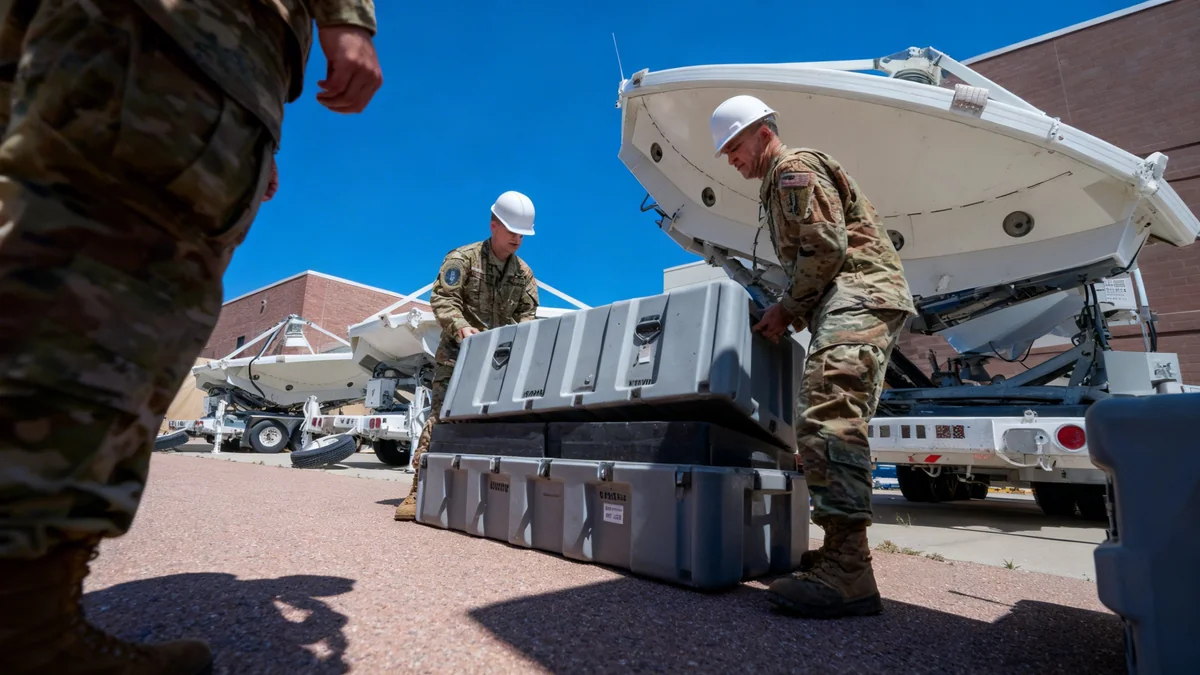
The ground stations, fiber optic nodes, and undersea cables that transmit data from space are vulnerable targets. A space war would likely see conventional military and special operations forces conducting raids on this critical infrastructure around the globe, from South America to Antarctica.
Furthermore, victory would depend on resilience. The ability to quickly recover from an attack and replenish lost assets will be crucial.
“The victor of the next war in space won’t necessarily be the side with the largest or most expensive satellites,” Singer’s analysis concludes. Instead, it will be the nation that masters reusable rocket technology and maintains a robust satellite production and logistics chain, allowing it to replace its orbital assets faster than the enemy can destroy them. The conflict would be a dynamic battle of attrition, where the fight on Earth determines the outcome in orbit.