
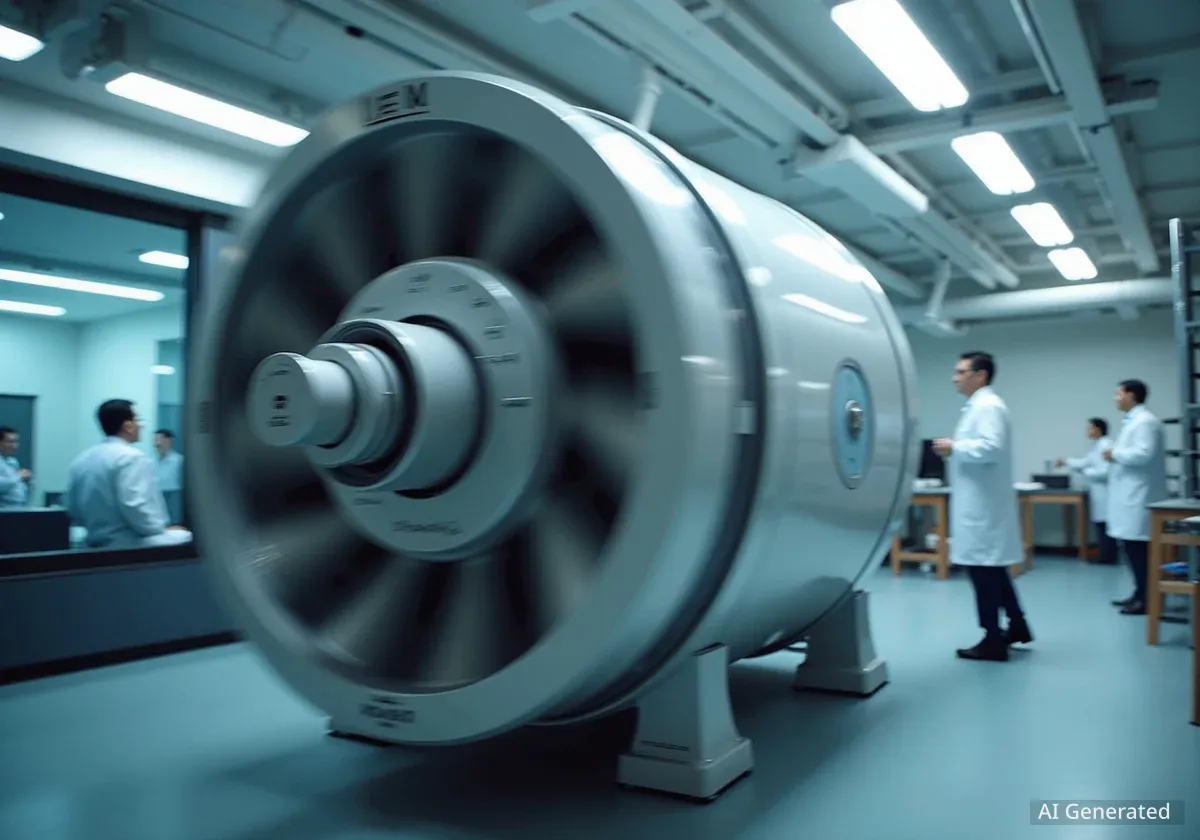

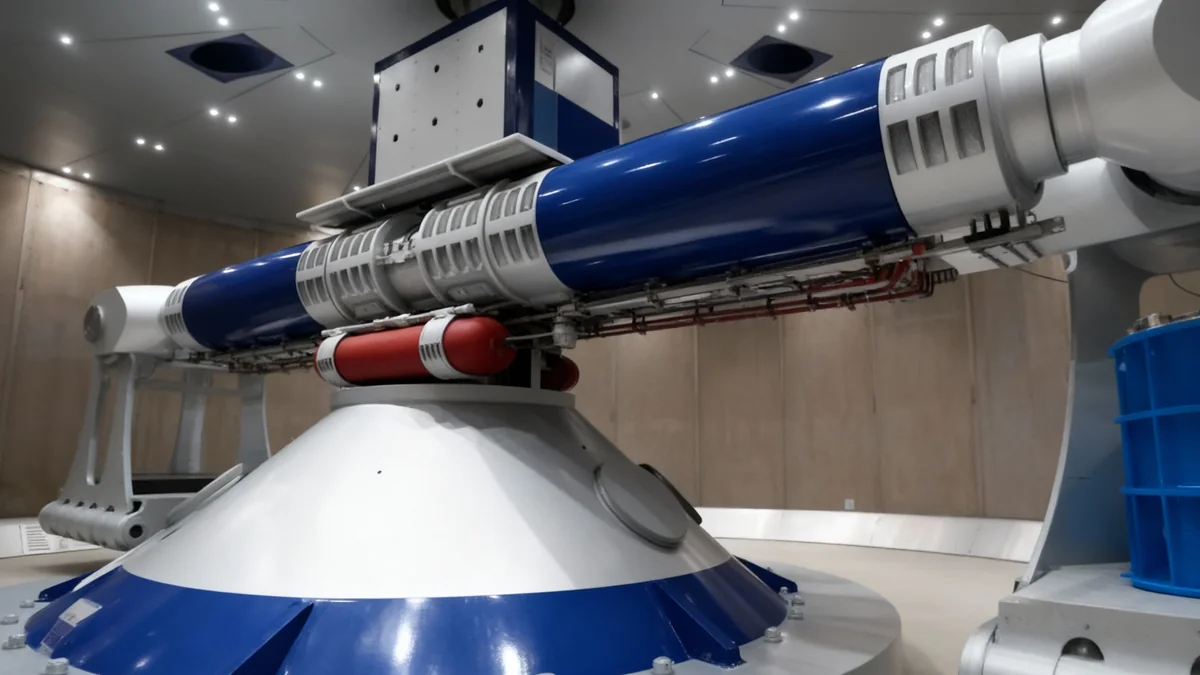
Researchers at Zhejiang University in China have developed a new hypergravity centrifuge, the CHIEF 1900, creating the most powerful simulated gravitational forces on Earth. This machine is designed to test materials and fundamental physics under conditions that cannot be replicated anywhere else, opening new possibilities for engineering and scientific discovery.
The device surpasses its predecessor, the CHIEF 1300, and is capable of subjecting objects to thousands of times the force of Earth's gravity. This technology has direct applications in assessing the structural integrity of large-scale construction projects, such as dams and skyscrapers, particularly in earthquake-prone regions.
Key Takeaways
- Zhejiang University has built the CHIEF 1900, the world's most powerful hypergravity centrifuge.
- The machine can simulate extreme gravitational forces, essential for testing materials used in massive infrastructure projects.
- Hypergravity research also allows scientists to test fundamental principles of physics, including aspects of Einstein's theory of general relativity.
- The forces generated are far beyond human survivability, highlighting the extreme nature of these experiments.
Understanding Hypergravity and Its Simulation
Every moment, we experience the constant pull of Earth's gravity, a force measured as 1g. This is the standard acceleration that keeps us grounded. While we might briefly feel slightly stronger forces in an accelerating car or an elevator, these are minor fluctuations.
Hypergravity refers to environments where the force of gravity is significantly higher than 1g. On Earth, these conditions do not exist naturally. To study their effects, scientists must create them artificially. Roller coasters can generate several gs for a few seconds, and fighter pilots endure up to 9gs, but these are temporary and limited.
The Principle of Equivalence
A core concept from Albert Einstein's theory of general relativity, the principle of equivalence, states that the effects of gravity are indistinguishable from the effects of acceleration. This is why you feel pressed into your seat when a car speeds up. A centrifuge uses this principle by spinning objects at high speeds, creating a constant acceleration that perfectly mimics an intense gravitational field.
The most effective method for simulating sustained, high-level gravity is a centrifuge. By rapidly rotating an object in a large arm, a centrifuge generates a powerful outward force, known as centrifugal force. This force creates a constant acceleration that acts just like gravity, allowing researchers to observe how materials and physical systems behave under extreme stress.
The CHIEF 1900 A New Frontier in Research
The new device at Zhejiang University, named CHIEF 1900, represents a significant leap forward in this field. It builds on the success of the previous record-holder, the CHIEF 1300, which was unveiled just last year.
The power of these machines is measured in g-tonnes, a unit that combines the mass of the object being tested with the gravitational force applied. The CHIEF 1900 has a capacity of 1,900 g-tonnes. This means it can take a 1,000-kilogram object and subject it to an astonishing 1,900 times the force of Earth's gravity.
What Does 1,900g Feel Like?
To put this in perspective, a person weighing 75 kilograms (165 pounds) would feel as if they weighed 142,500 kilograms (over 314,000 pounds) under 1,900g of force. Such conditions are instantly fatal for any biological organism.
This immense power allows for more detailed and larger-scale experiments than ever before. Scientists can now build more complex models of structures and test them under forces that simulate decades of stress or the intense, sudden pressures of a catastrophic event.
Practical Applications in Engineering and Safety
While the concept of hypergravity may seem abstract, its applications are grounded in real-world safety and innovation. The primary use for machines like the CHIEF 1900 is in civil engineering and materials science.
Testing the Limits of Infrastructure
How will a newly designed dam hold up under the immense pressure of a full reservoir during an earthquake? Instead of relying solely on computer simulations, engineers can build a scaled-down model of the dam, place it in the centrifuge, and subject it to the equivalent forces.
This allows them to identify weak points and validate new construction materials and designs before they are used in projects that affect millions of lives. The tests can simulate various scenarios, including:
- Earthquake resistance: By varying the forces, researchers can model the intense shaking and stress a building or bridge would experience during a major seismic event.
- Soil and rock mechanics: The centrifuge can be used to study how different geological formations behave under extreme pressure, providing crucial data for tunneling and foundation construction.
- Material durability: New alloys, composites, and concrete mixtures can be tested to see how they withstand extreme forces, accelerating the development of stronger, lighter, and more resilient building materials.
Exploring the Frontiers of Physics
Beyond its engineering applications, the CHIEF 1900 is also a tool for fundamental physics research. Extreme gravity environments provide a unique laboratory for testing some of the most profound theories about the universe.
"By pushing the boundaries of what we can simulate on Earth, we can probe the very fabric of spacetime in ways that were previously impossible in a lab setting."
One of the predictions of Einstein's general relativity is that time passes more slowly in stronger gravitational fields. This effect, known as gravitational time dilation, is incredibly small on Earth but can be measured with highly precise atomic clocks. By placing these clocks in the centrifuge and subjecting them to thousands of gs, scientists can amplify the effect, allowing for more precise measurements and a deeper understanding of the relationship between gravity and time.
These experiments help refine our understanding of physics, which has implications for technologies that rely on precise timing, such as GPS systems. The ability to create a controlled high-gravity environment on Earth provides a valuable and cost-effective alternative to sending experiments into space.
The development of the CHIEF 1900 marks a new era in our ability to study the effects of extreme forces. From ensuring the safety of our tallest buildings to questioning the nature of time itself, the research conducted with this powerful machine will have impacts for decades to come.