
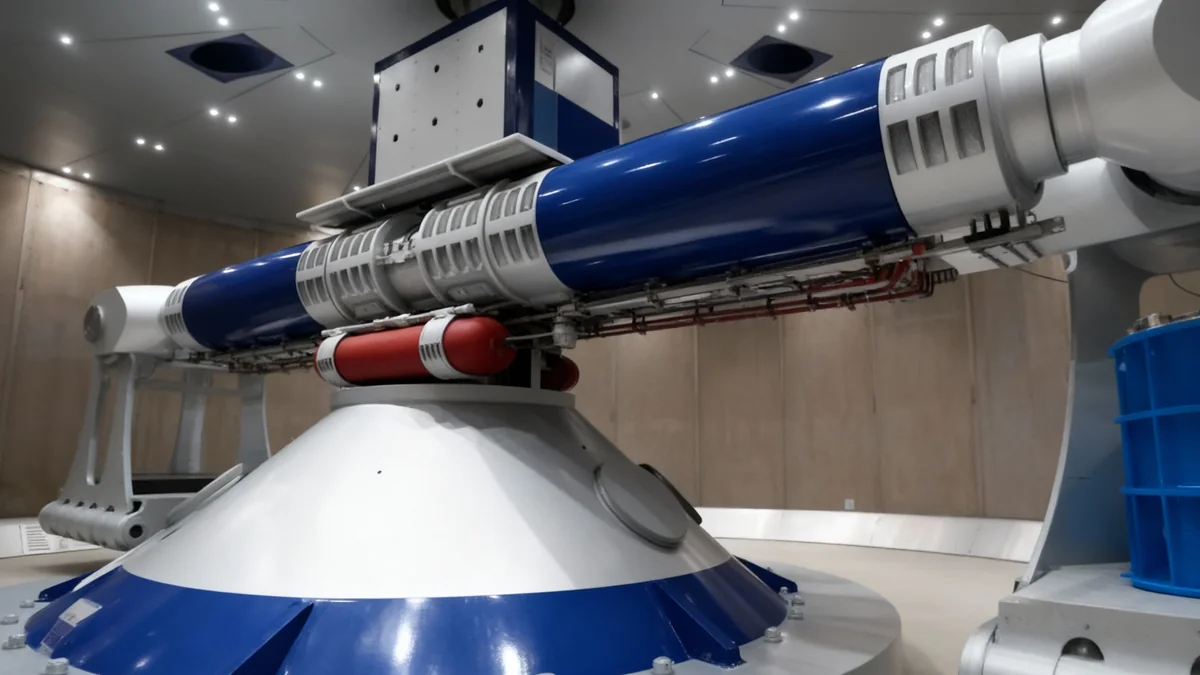

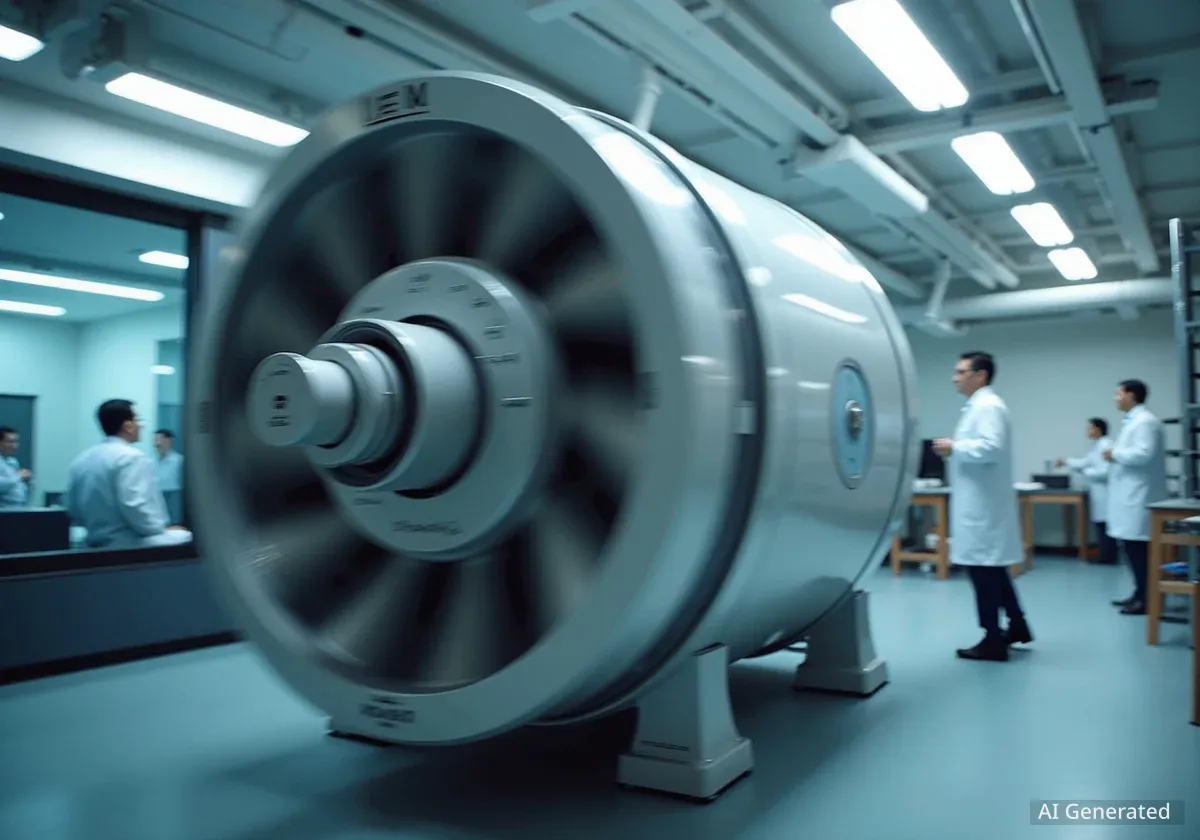
Chinese scientists have begun operating the world's most powerful centrifuge, a monumental machine capable of simulating extreme gravitational forces to study long-term geological and engineering problems in a fraction of the time. The device, known as CHIEF1900, represents a significant step forward in hypergravity research.
Developed by the Shanghai Electric Nuclear Power Group, the centrifuge can generate forces equivalent to 1,900 g-tons. This allows researchers to observe processes that would naturally take decades, centuries, or even millennia to unfold, effectively compressing time and space within a controlled laboratory environment.
Key Takeaways
- China has launched the CHIEF1900, now the world's most powerful hypergravity centrifuge.
- The machine can simulate forces up to 1,900 g-tons, surpassing the previous record of 1,200 g-tons held by a U.S. facility.
- It enables scientists to study long-term phenomena, like geological shifts or material degradation, in a matter of hours.
- The project was completed in five years and has applications in deep-sea engineering, seismic studies, and advanced materials science.
A New Era in Hypergravity Simulation
The field of hypergravity research has a new leader. The CHIEF1900 centrifuge, located near Zhejiang University in Hangzhou, has officially surpassed all previous records for centrifugal force. Its predecessor, the CHIEF1300, only began operations in September of the previous year, highlighting the rapid pace of technological development.
This new machine is designed to study how materials and systems behave under gravitational forces far exceeding those on Earth. By spinning massive objects at high speeds, it generates immense forces that can replicate conditions found deep underground or in large-scale engineering projects.
By the Numbers
The CHIEF1900's capacity of 1,900 g-tons eclipses the former record holder, a centrifuge operated by the U.S. Army Corps of Engineers in Vicksburg, Mississippi, which has a maximum capacity of 1,200 g-tons.
The ability to generate such extreme forces is crucial for understanding complex physical processes. Researchers can place models of dams, soil layers, or advanced materials into the centrifuge to test their resilience and behavior over time, but at a vastly accelerated rate.
Compressing Time and Space
The primary function of the CHIEF1900 is to manipulate the scales of time and space for scientific observation. Everything on our planet is subject to gravity and the centrifugal forces of its rotation. This machine multiplies those forces thousands of times over.
By doing so, it speeds up physical processes. For example, studying how a pollutant seeps through kilometers of soil over a thousand years is impossible in real-time. In the centrifuge, a small-scale model can replicate this process in just a few hours. The intense gravitational simulation forces the pollutant through the soil sample at a proportionally faster rate.
What is Hypergravity Research?
Hypergravity research uses centrifuges to create artificial gravity stronger than Earth's. This allows scientists to test the structural integrity of large objects like dams or buildings, study geological formations, and understand how extreme forces affect biological cells and advanced materials. It is a critical tool for predicting long-term outcomes in complex systems.
This capability allows scientists to validate computer models with physical experiments, leading to more accurate predictions about geological stability, the durability of infrastructure, and the long-term behavior of new materials.
Overcoming Extreme Engineering Hurdles
Building and operating a machine of this scale presented significant engineering challenges. The construction of the facility to house the centrifuge was completed in just one year, a testament to the project's rapid execution.
The immense speed required to generate 1,900 g-tons of force also produces extreme heat and mechanical stress on the machine's components. To manage this, engineers developed a sophisticated cooling system. It combines a vacuum environment with liquid coolant and high-speed ventilation to dissipate heat and ensure the structural integrity of the device during operation.
This innovative solution was critical to achieving stable and repeatable experimental conditions under such intense physical demands.
Wide-Ranging Scientific Applications
The CHIEF1900 is not a single-purpose device. It is equipped with six distinct experimental chambers, each tailored for a specific field of research. This versatility makes it a powerful asset for a wide range of scientific and industrial inquiries.
The dedicated research areas include:
- Seismic Geotechnics: Simulating the effects of earthquakes on soil, slopes, and foundations.
- Deep-Sea Engineering: Testing the durability of underwater structures and materials under immense pressure.
- Underground Environments: Studying the stability of tunnels and subterranean construction.
- Geological Studies: Modeling the formation of geological features and the movement of tectonic plates.
- Advanced Material Treatment: Investigating how new alloys and composites behave under extreme stress.
The insights gained from experiments in these chambers could lead to safer infrastructure, more efficient resource extraction, and breakthroughs in materials science. As the CHIEF1900 begins its operational life, the global scientific community will be watching to see what discoveries emerge from this unprecedented tool.