
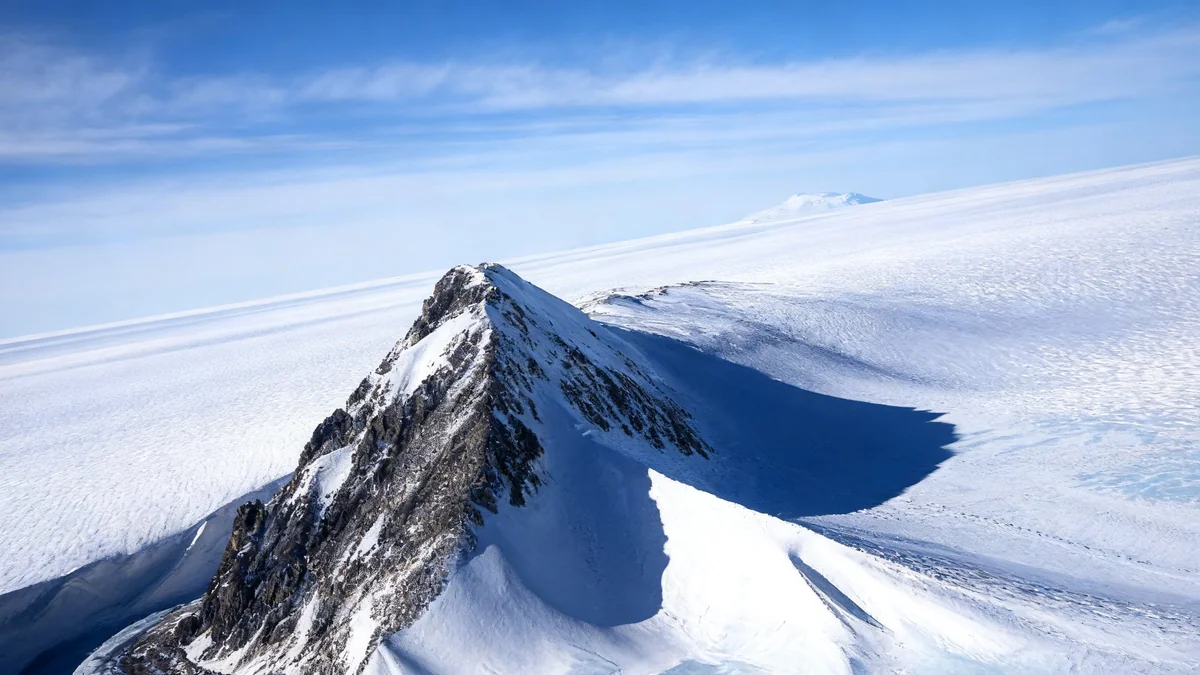

Deep beneath the vast ice sheets of Antarctica lies an immense region where Earth's gravitational pull is slightly weaker than the global average. This phenomenon, known as the Antarctic Geoid Low, is not a void or a hole, but a subtle signature of massive geological processes unfolding thousands of miles below the surface. New research is now using this gravity anomaly as a unique window, allowing scientists to look back in time and reconstruct 70 million years of our planet's dynamic inner life.
A team of geophysicists has developed advanced models to trace the history of this feature, revealing it as a persistent and evolving record of the slow, powerful currents of rock churning within Earth's mantle. Their findings provide new insights into how deep-Earth movements can shape the planet's surface and potentially influence long-term climate changes over geological timescales.
Key Takeaways
- A large area of low gravity, known as the Antarctic Geoid Low, exists deep beneath the Antarctic continent.
- Scientists have reconstructed the evolution of this gravity anomaly over the past 70 million years.
- The low is caused by the movement of hot, buoyant rock in Earth's mantle, not a literal hole.
- The feature appears to have intensified around 34 million years ago, coinciding with Antarctica's transition into an ice-covered continent.
- This research provides a model for understanding the interior dynamics of other planets like Mars and Venus.
Understanding the 'Gravity Hole'
The term "gravity hole" can be misleading. It does not describe a place where gravity is absent, but rather a large area where the gravitational force is subtly weaker. This variation is a direct result of the uneven distribution of mass deep within the Earth.
"What people call a 'gravity hole' is not a literal hole in the ground, and it's not a place where gravity disappears," explained Dr. Alessandro Forte, a professor of geophysics at the University of Florida and a co-author of the study. "It's a very broad, gentle low in Earth's gravity field."
How Gravity Varies
Earth's interior is in constant, slow motion. Hotter, less dense rock from the mantle gradually rises toward the surface, while cooler, denser slabs of ancient oceanic crust sink back down. This massive redistribution of material creates slight variations in the planet's gravitational field. The Antarctic Geoid Low is the most significant of these long-wavelength lows on the planet driven by mantle flow.
The effect on a person is imperceptible. A 90-kilogram (198-pound) individual would weigh only about 5 to 6 grams less in this region. For scientists, however, this anomaly is a profound clue about the planet's inner workings.
If Earth were a perfect sphere covered by a calm ocean, the water's surface would form a shape defined by gravity, known as the geoid. In the area of the Antarctic low, this theoretical sea level sits about 120 meters (394 feet) closer to the planet's center than the global average.
A 70-Million-Year Reconstruction
Since direct observation of the mantle's past is impossible, researchers used modern data to simulate its history. They began with seismic images of the mantle today, which are created by studying how earthquake waves travel through the planet. Using this present-day snapshot, they ran sophisticated physics-based models backward in time on supercomputers.
These simulations allowed the team to reconstruct how rock has flowed within the mantle over millions of years. This process required testing different assumptions about the properties of mantle rock, such as its viscosity—or its resistance to flowing.
"What surprised me most is how coherent the long-term story appears to be. The gravity low is not a random, short-lived feature," Dr. Forte stated. "In our reconstructions it persists through much of the last ~70 million years, but its strength and geometry evolve in ways that are consistent with major reorganizations of the flow of rocks deep beneath Antarctica."
This persistence is what makes the discovery significant. It shows that the gravity low is a long-lived feature, an enduring fingerprint of the planet's deep engine rather than a temporary geological quirk.
A Decade of Research
The study, published in the journal Scientific Reports, represents nearly a decade of collaborative work. The project was jointly led by first author Petar Glišović and involved a long-standing partnership with seismologists who developed the crucial imaging of Earth's interior.
A Potential Link to Antarctica's Ice Age
One of the most intriguing findings is a correlation in timing. The models show that the Antarctic gravity low appears to have intensified significantly around 34 million years ago. This is the same period when Antarctica began its transition from a temperate landmass into the permanently ice-covered continent we know today.
This timing raises a compelling question: could long-term changes in the gravity field have influenced the conditions that led to widespread glaciation? While the study does not establish a direct causal link, it presents a testable hypothesis.
How Could Gravity Affect Ice?
- Regional Sea Level: Changes in the geoid can alter the baseline for regional sea level. A deeper geoid low could subtly change how the ocean interacts with the edges of an ice sheet.
- Ice Sheet Stability: The boundary conditions where ice, land, and sea meet are critical for the stability of an ice sheet. Long-term shifts in this landscape could have played a role.
Dr. Forte emphasized that the glaciation of Antarctica was a complex event driven by multiple factors, including falling atmospheric carbon dioxide levels, shifting ocean currents, and tectonic plate movements.
"Our study shows how deep Earth dynamics can reshape the gravity field over geological time," he explained. "Whether that translated into a measurable influence on climate/ice is a separate question that requires additional coupled modeling and evidence. That, indeed, is the next project we are working on now."
A Window into Other Worlds
The research has implications that extend far beyond Earth. Gravity anomalies are key to understanding the interiors of other planets. On worlds like Mars and Venus, spacecraft tracking data has revealed similar variations in gravity, offering clues about their internal structure and geological history.
These anomalies hint at how heat escapes from a planet's core, how dense materials sink, and how buoyant materials rise over eons. On Mars, for example, gravity data has helped identify ancient volcanoes and buried water channels.
Earth remains unique because scientists can cross-reference gravity measurements with seismic data and the geological record. This allows for a much more detailed reconstruction of a planet's evolution through time. The study of the Antarctic Geoid Low serves as a powerful model for interpreting the more limited data available from other celestial bodies, helping us understand the fundamental processes that shape all rocky planets.