
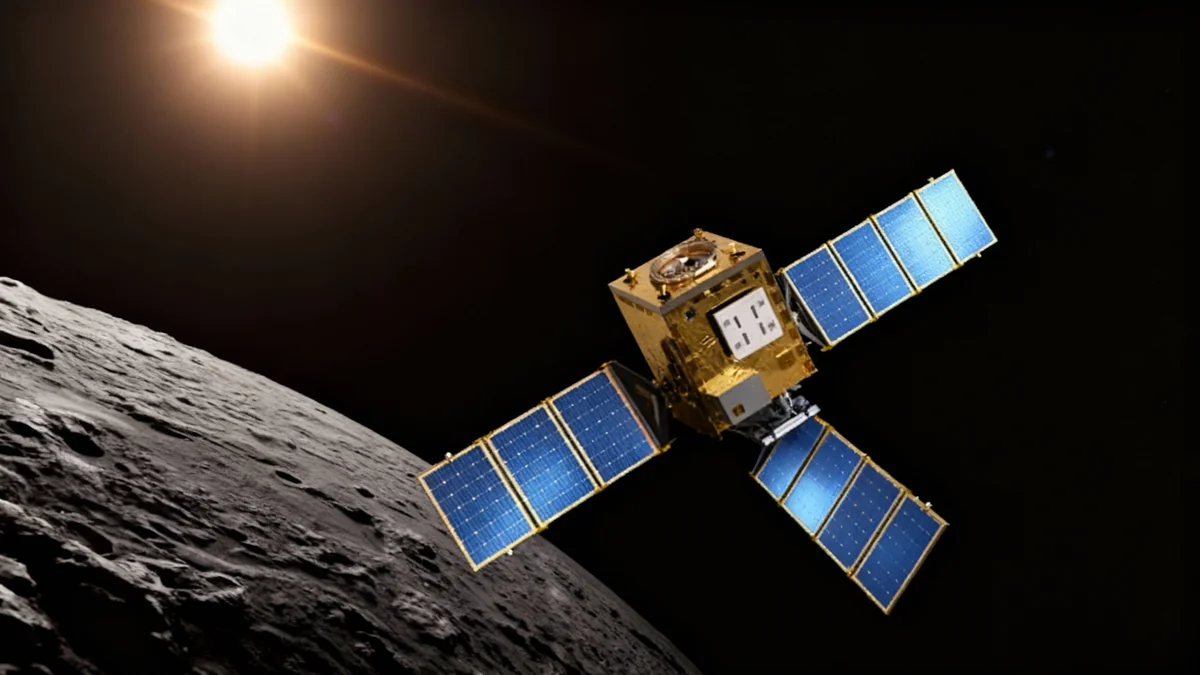

As hundreds of new missions to the Moon are planned over the next two decades, international space agencies and private companies are confronting a new challenge: what to do with satellites once they run out of fuel. Without an atmosphere to incinerate old hardware, experts are now proposing the creation of designated “graveyard zones” on the lunar surface to safely crash-land defunct spacecraft.
This strategy aims to prevent a chaotic accumulation of space debris that could threaten future lunar bases, scientific experiments, and historically significant sites like the Apollo landing footprints. The plan involves carefully selecting remote areas where controlled impacts would minimize risk and contain the resulting debris.
Key Takeaways
- Over 400 missions to the Moon are planned in the next 20 years, creating a need for a satellite disposal strategy.
- Unlike Earth, the Moon has no atmosphere to burn up defunct satellites upon re-entry.
- Experts propose establishing designated “graveyard zones” for controlled spacecraft crashes.
- The goal is to protect historic sites, scientific instruments, and future lunar infrastructure from uncontrolled impacts.
- Controlled crashes could also serve a scientific purpose by generating seismic data to study the Moon's interior.
A New Era of Lunar Activity
Humanity is entering a new, bustling era of lunar exploration. International efforts like the NASA-led Artemis program, which aims to establish a sustainable base camp, and the planned joint lunar station by China and Russia, signal a permanent return to the Moon. These ambitious projects will require a robust support network in orbit.
This network will consist of constellations of satellites providing essential services for navigation, positioning, and communication. The European Space Agency (ESA) is already developing its Moonlight constellation, with a test satellite, the Lunar Pathfinder, scheduled for launch next year. This surge in orbital hardware is unprecedented.
By the Numbers: The Lunar Boom
More than 400 missions to the Moon are anticipated over the next two decades. This includes orbital space stations like the Lunar Gateway and surface habitats like the Artemis Base Camp. This activity will be supported by a growing number of commercial and government satellites.
However, every satellite has a limited operational lifespan. Once they exhaust their fuel, they become uncontrolled objects in orbit. This raises a critical question of orbital management and end-of-life disposal that agencies are now working to solve before the lunar environment becomes dangerously cluttered.
The Problem of Lunar Debris
Around Earth, satellite operators have a straightforward method for disposing of defunct spacecraft in low orbit. They guide them back into the atmosphere, where friction causes them to burn up and disintegrate harmlessly. This option is not available at the Moon, which lacks any significant atmosphere.
Without atmospheric braking, lunar satellite operators face limited and challenging choices. One option is to use a satellite's remaining fuel to push it into a distant orbit around the Sun, but this is a costly maneuver that requires significant propulsion capabilities. Another idea involves moving satellites to a remote lunar “graveyard orbit,” but the Moon’s uneven gravitational field makes such orbits unstable and difficult to maintain long-term.
This leaves a third, more practical option: a controlled crash onto the lunar surface. However, an uncoordinated approach could be disastrous. An impact at speeds exceeding 1.2 miles per second (nearly 2 km/s) would create a crater tens of meters wide and eject a massive cloud of abrasive dust. Such an event could damage sensitive scientific instruments, obscure telescopes, or even threaten future human habitats.
Preserving Lunar Heritage
Beyond scientific hardware, uncontrolled impacts pose a threat to sites of immense cultural value. The landing sites of the Apollo missions, including the first human footprints, are considered historic landmarks. International agreements like the U.S. Artemis Accords advocate for the preservation of such heritage sites, making a managed disposal plan essential.
As Prof Ian Crawford of Birkbeck, University of London, noted, while not an immediate crisis, the risk grows with every new satellite launched. “The more lunar satellites there are, the greater the chance that some may crash into scientifically or culturally sensitive locations,” he explained. “We do need a plan going forward.”
Designating Lunar Graveyards
The leading solution emerging from international discussions is the establishment of designated spacecraft graveyards. This strategy involves identifying specific, remote regions on the Moon where defunct satellites can be intentionally crashed in a controlled manner.
Ben Hooper, a senior project manager at satellite manufacturer SSTL, described this as “the most practical solution.” He stated that designating specific regions as ‘impact zones’ would help limit the spread of human artifacts and preserve other areas for scientific work and future operations.
“Establishing graveyard zones on the moon is the most practical solution. Designating specific regions as ‘impact zones’ would limit the spread of human artefacts across the lunar surface, preserving other areas for scientific exploration and future operations.”
International bodies are already working to formalize these best practices. The United Nations’ Action Team on Lunar Activities Consultation (Atlac) and the Inter-Agency Space Debris Coordination Committee (IADC) are developing guidelines for lunar satellite disposal. The goal is to create a universally accepted framework that all space-faring nations and companies can follow.
Charles Cranstoun, head of the ESA’s Moonlight program, confirmed this approach for the agency's upcoming satellites. He explained that when the time comes, the spacecraft will be guided to crash into the surface “in specified zones” to avoid important sites.
A Scientific Opportunity from Debris
While the primary goal is waste management, some scientists see a unique opportunity in these controlled impacts. Each crash could be transformed into a valuable seismology experiment, helping researchers learn more about the Moon's internal structure.
John Zarnecki, an emeritus professor at the Open University, highlighted this potential benefit. By knowing the precise mass, speed, and impact location of a spacecraft, scientists can analyze the resulting seismic waves that travel through the Moon. This data provides a clearer picture of the lunar crust, mantle, and core.
“If you have an object of known mass, known geometry and known speed, and you know pretty much where it impacted, that’s a fantastic experiment in seismometry,” Zarnecki said. This approach could turn a logistical necessity into a source of valuable scientific insight, ensuring that even the end of a satellite's life contributes to our understanding of the Moon.
As humanity prepares for its next giant leap, managing the environmental impact on our celestial neighbor has become a central part of the plan. The creation of lunar graveyards represents a proactive step to ensure the Moon remains a pristine environment for science, exploration, and future generations.