
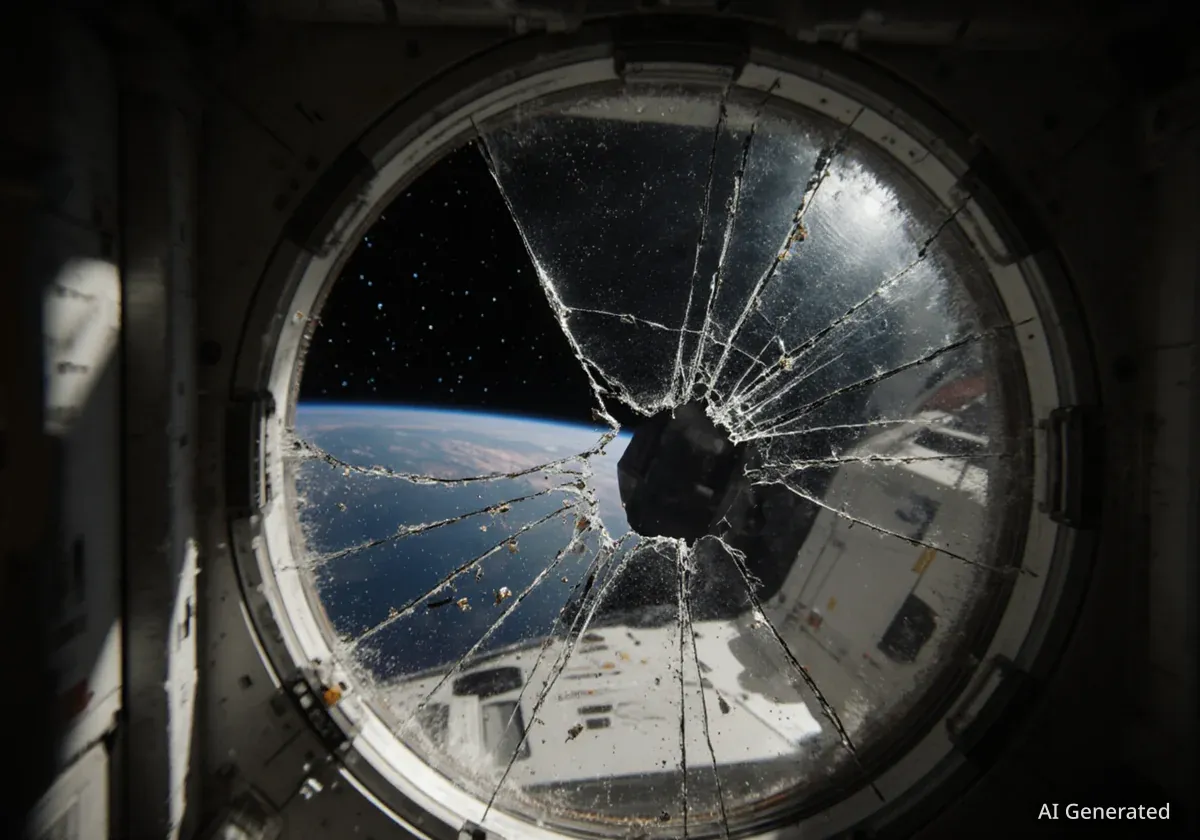


Chinese astronauts have revealed new details about a critical in-orbit emergency last year that left them temporarily stranded aboard the Tiangong space station. The three-person crew of the Shenzhou-20 mission discovered significant cracks in their return capsule's window just one day before their scheduled landing, prompting an unprecedented rescue and recovery operation.
The incident, believed to have been caused by a space debris strike, tested China's human spaceflight program's emergency response capabilities and required the crew to return to Earth in a different spacecraft.
Key Takeaways
- The Shenzhou-20 crew discovered cracks on their return capsule's viewport, likely from a space debris impact.
- Their return to Earth was postponed, and they used a replacement spacecraft, Shenzhou-21, for their journey home.
- China launched an uncrewed cargo mission, Shenzhou-22, with supplies and a special device to repair the damaged window.
- The original, damaged Shenzhou-20 capsule was later returned to Earth uncrewed after repairs in orbit.
An Unexpected Discovery in Orbit
The issue was first identified during final pre-return checks by mission commander Chen Dong. While inspecting the Shenzhou-20 return capsule, he noticed something unusual on the viewport.
"I spotted something like a triangular on the viewport," Chen Dong recalled in a recent interview. "My first thought was whether a small leaf had somehow stuck to the outside of the window. But then I quickly realized that couldn't happen because we were in space."
After alerting his crewmates, Chen Zhongrui and Wang Jie, the team began a more detailed investigation. Using specialized equipment available on the Tiangong space station, they worked to understand the extent of the damage. The crew utilized a 40-times magnification, pen-shaped microscope typically used for inspecting spacesuits.
"We could see very clearly the small cracks," Chen explained. "Several were relatively long, and one was shorter. We could also see that some of the cracks had penetrated through."
A Calm Response Under Pressure
Despite the potentially dangerous situation, the crew remained composed. Wang Jie, the mission's flight engineer who previously worked as an aerospace technician on the space station, expressed his confidence in the spacecraft's design and the ground team's expertise.
"I wasn't really nervous, actually," Wang stated. "The outermost layer of the viewport is a protective layer, and inside it there are two pressure-bearing layers, and we are safe as long as the cabin pressure doesn't change." He added that he trusted the ground team to conduct thorough analysis before making any decisions.
The Growing Threat of Space Debris
Millions of pieces of orbital debris, ranging from defunct satellites to tiny fragments from collisions, circle the Earth at high speeds. Even a small object can cause catastrophic damage to a spacecraft upon impact, making it one of the most significant threats to current and future space missions.
Ground Control Scrambles Emergency Response
On the ground, mission planners and engineers immediately activated what has been described as China's first emergency operation in its human spaceflight program. The China Manned Space Agency (CMSA) confirmed that all decisions were based on the principle of "putting the safety of astronauts first."
The primary decision was to postpone the Shenzhou-20 crew's return. Their damaged capsule was deemed unsafe for the intense heat and pressure of atmospheric reentry. A new plan was quickly formulated.
The solution involved launching an entirely new mission. The uncrewed Shenzhou-22 cargo spaceship was prepared and launched on November 25, 2025. This rapid response mission carried essential supplies, including food and medical equipment, but its most critical payload was a custom-built porthole crack repair device.
A Complex Rescue and Return
With the emergency plan in motion, the stranded Shenzhou-20 crew prepared for a different journey home. They would use the Shenzhou-21 spacecraft, which had been docked at the station after bringing their replacement crew to orbit. On November 14, 2025, Chen Dong, Chen Zhongrui, and Wang Jie safely returned to Earth in the borrowed capsule.
However, this left the new crew on the Tiangong station with the damaged Shenzhou-20 capsule. Once the Shenzhou-22 cargo ship arrived, the repair phase began. Astronauts installed the specialized device inside the Shenzhou-20 capsule, a measure designed to enhance its heat protection and sealing capabilities for its eventual return.
The Shenzhou-20 spacecraft ultimately spent a total of 270 days in orbit. This extended duration served as an unplanned but valuable test of its long-term docking capabilities, providing engineers with important data for future missions.
The Final Leg: An Uncrewed Landing
On January 19 of this year, the now-repaired and empty Shenzhou-20 return capsule successfully undocked from the space station and began its descent. It landed via parachute at the Dongfeng landing site in Inner Mongolia.
The recovery presented unique challenges. Xu Peng, the on-site commander, noted it was the first time a recovery mission was conducted during the region's coldest season. Frigid temperatures and strong winds tested both personnel and equipment.
"Since the Shenzhou-20 return capsule was not crewed, there was no astronaut to manually separate the parachute," Xu told state media. This meant the large parachute could drag the capsule across the ground in high winds, requiring the recovery team to reach it and cut the lines as quickly as possible.
A Test of Space Rescue Capabilities
The successful handling of the Shenzhou-20 incident has been noted by international observers. The ability to quickly launch a dedicated supply and repair mission demonstrated a significant level of operational readiness.
Jan Osburg, a senior engineer at the RAND corporation, commented on the event, noting that the Chinese program "demonstrated pretty good responsiveness, being able to launch a backup spacecraft within a few weeks."
Osburg drew a parallel with recent issues involving Boeing's Starliner capsule, emphasizing the universal importance of having robust space rescue capabilities. "Both cases underline the importance of having space rescue capabilities in place before something happens," he concluded. The incident, while harrowing for the crew, has ultimately provided China's space program with invaluable experience in handling unforeseen crises far from home.