

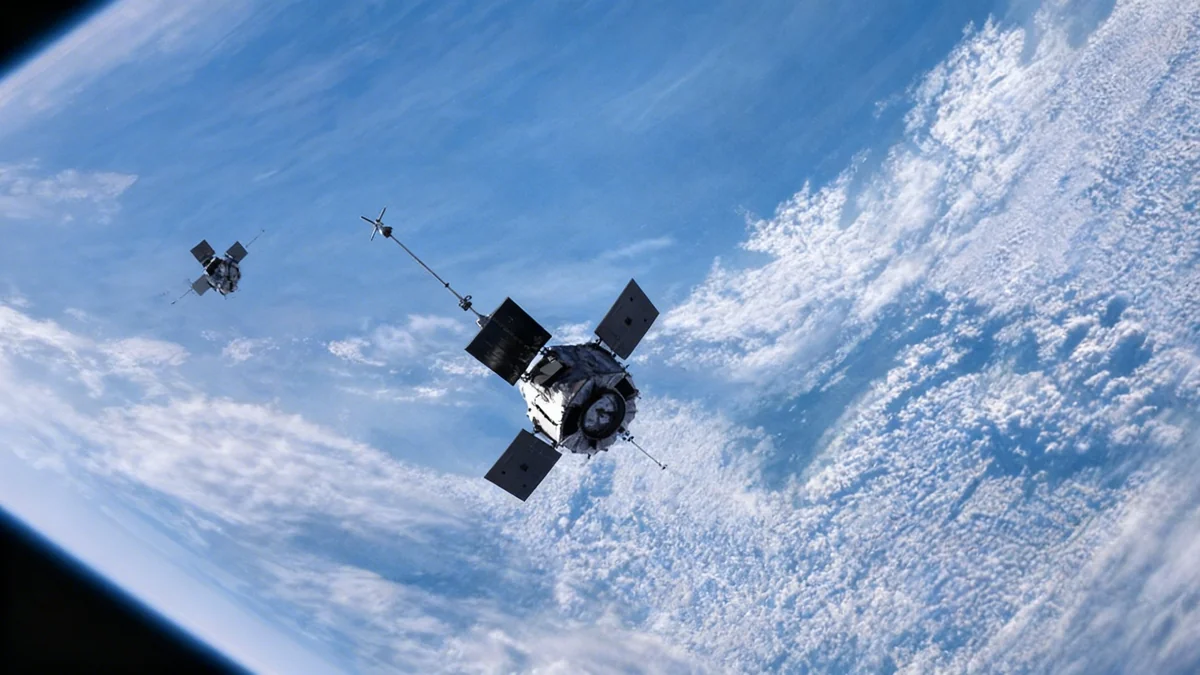

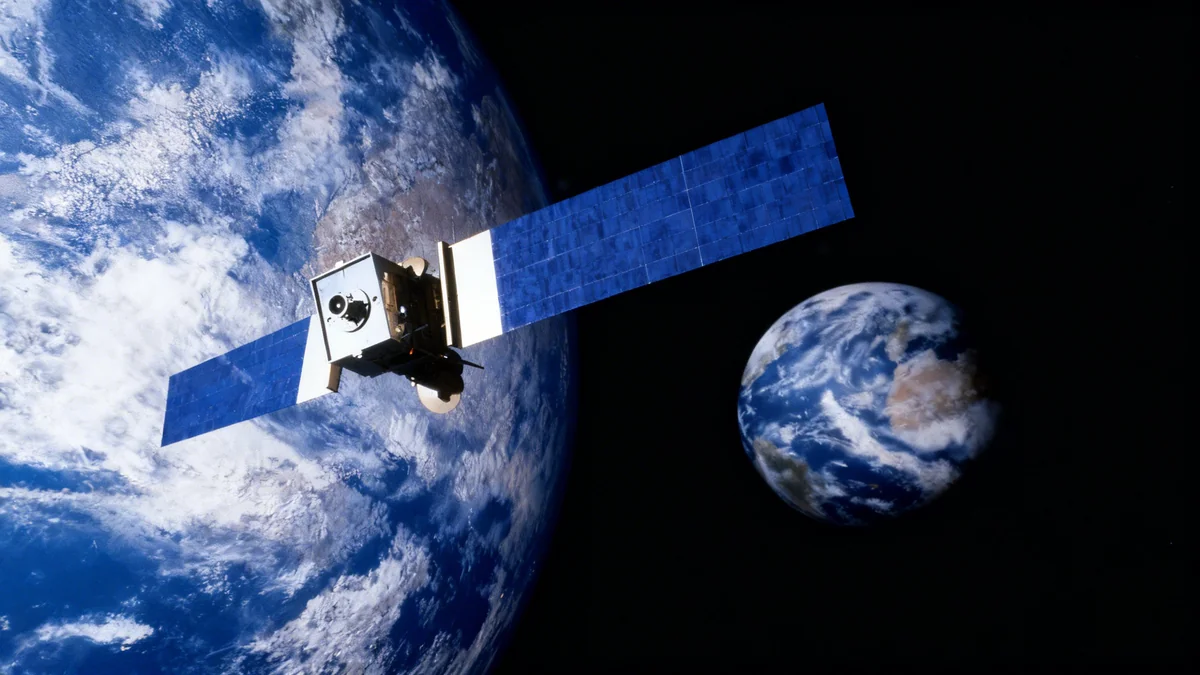

A small NASA team is working to prevent catastrophic collisions between the growing number of spacecraft orbiting the Moon. Last year, this team flagged a potential crash involving a private American lander and an Indian orbiter, highlighting the urgent need for a formal system of lunar traffic management as more nations and companies venture to our celestial neighbor.
The incident involved Firefly Aerospace's Blue Ghost lander and India's Chandrayaan-2, both operating at the same altitude. While the Moon's orbit may seem vast and empty, this event shows that the risk of collision is real and increasing.
Key Takeaways
- A NASA team called MADCAP acts as an unofficial traffic controller for spacecraft orbiting the Moon and Mars.
- In March 2025, a "red alert" was issued for a potential collision between Firefly's Blue Ghost and India's Chandrayaan-2.
- The number of close calls is rising, with 11 serious "response cases" handled by MADCAP last year alone.
- Without a formal system, the risk of creating a dangerous debris field around the Moon is growing.
The Unseen Danger in Lunar Orbit
For most people, the space around the Moon is a silent, empty void. In reality, it is becoming an increasingly busy environment. Currently, 11 active spacecraft from the United States, China, India, and Korea are circling the Moon, and that number is set to grow.
A specialized team at NASA's Jet Propulsion Laboratory has been quietly managing this traffic for 15 years. Known as MADCAP, which stands for Multimission Automated Deepspace Conjunction Assessment Process, this small group of six people serves as the de facto air traffic control for the Moon.
"The basic idea was to make sure that you knew where these other objects were so as to avoid any unintentional collisions," said David Berry, the lead for MADCAP.
Their work is critical because many missions choose similar orbits for scientific or operational reasons. Polar orbits, which pass over the Moon's north and south poles, are particularly popular because they allow spacecraft to observe the entire lunar surface over time. This creates predictable intersection points where paths can cross.
A Close Call for Blue Ghost
The need for this oversight became clear in March 2025. Firefly Aerospace's Blue Ghost lander, on a historic mission to become the first American spacecraft in over 50 years to successfully complete its mission on the lunar surface, faced a threat before it even landed.
What is a "Red Alert"?
In MADCAP's terminology, a "red alert" signifies a potential collision with a probability greater than one in 100,000. While the odds seem low, this threshold is serious enough to warrant coordination between spacecraft operators to assess the need for an avoidance maneuver.
As Blue Ghost settled into a circular orbit at an altitude of 100 kilometers (about 62 miles), it was on a potential collision course with India's Chandrayaan-2 orbiter, which was at the same height. The MADCAP team flagged a "red alert" nearly a week in advance.
Will Coogan, the chief engineer for Blue Ghost, expressed the team's initial surprise. "There’s only a few things in lunar orbit," he noted. "This seemed so unlikely to be an issue."
As the potential conjunction on March 1, 2025, approached, the alert persisted. MADCAP facilitated communication between the Firefly and Indian space agency teams. A decision had to be made: should one of the spacecraft fire its thrusters to change course? Such maneuvers are not without risk and consume precious fuel.
"Every time we do a maneuver, yeah, that also creates a risk," Coogan explained. "So do we think that we are creating or negating risk?" After more detailed analysis, the teams determined the spacecraft would pass each other at a safe distance, and no action was required. Blue Ghost landed safely on March 2.
A Pattern of Near Misses
The Blue Ghost incident was not an anomaly. The MADCAP team has managed several other high-stakes situations, demonstrating a clear and growing trend.
A Busy Month in Orbit
In the spring of 2023, MADCAP issued almost daily red alerts for close passes between four different lunar spacecraft: NASA's Lunar Reconnaissance Orbiter, India's Chandrayaan-2, Korea's Danuri, and a lander from the Japanese company ispace, Hakuto-R Mission 1.
Some past events required more direct action:
- 2021: India's Chandrayaan-2 spacecraft fired its thrusters to move out of the way of NASA's Lunar Reconnaissance Orbiter.
- Spring 2023: The team held three separate maneuver-coordination meetings in a single month to manage the traffic between four orbiters.
- Last Year: MADCAP handled a total of 11 "response cases," which are red alerts serious enough to require direct intervention and coordination.
These events underscore the problem of popular orbital altitudes. Many missions, including Blue Ghost, defaulted to a 100-kilometer orbit simply because it is a convenient round number. "There’s no reason we can’t be at 95 kilometers, or 105 kilometers," Coogan said. Slight adjustments in mission planning could significantly reduce future risks.
Building a Sustainable Future for Lunar Exploration
As NASA, China, and private companies accelerate their plans for lunar bases and sustained human presence, the issue of space traffic management becomes paramount. A single collision could create a field of high-velocity debris, endangering all current and future missions.
"We don’t want to create a debris field," Berry stated, emphasizing the long-term threat.
Currently, MADCAP's system relies on spacecraft operators voluntarily providing their trajectory data. Future systems could involve automated tracking from lunar-based assets, providing more precise and timely information.
Commercial companies are also stepping in to offer solutions. Firefly's next Blue Ghost mission will include an orbiter with a telescope. Jason Kim, Firefly's CEO, said this could be used to track other objects in lunar orbit. "We’ll be able to provide that as a commercial service and help with close fly-bys and tracking resident space objects around the moon," he said.
The near miss of the first Blue Ghost lander serves as a critical warning. As humanity returns to the Moon in force, establishing clear rules of the road is no longer an abstract concept but a practical necessity for ensuring the safety and sustainability of all lunar endeavors.