
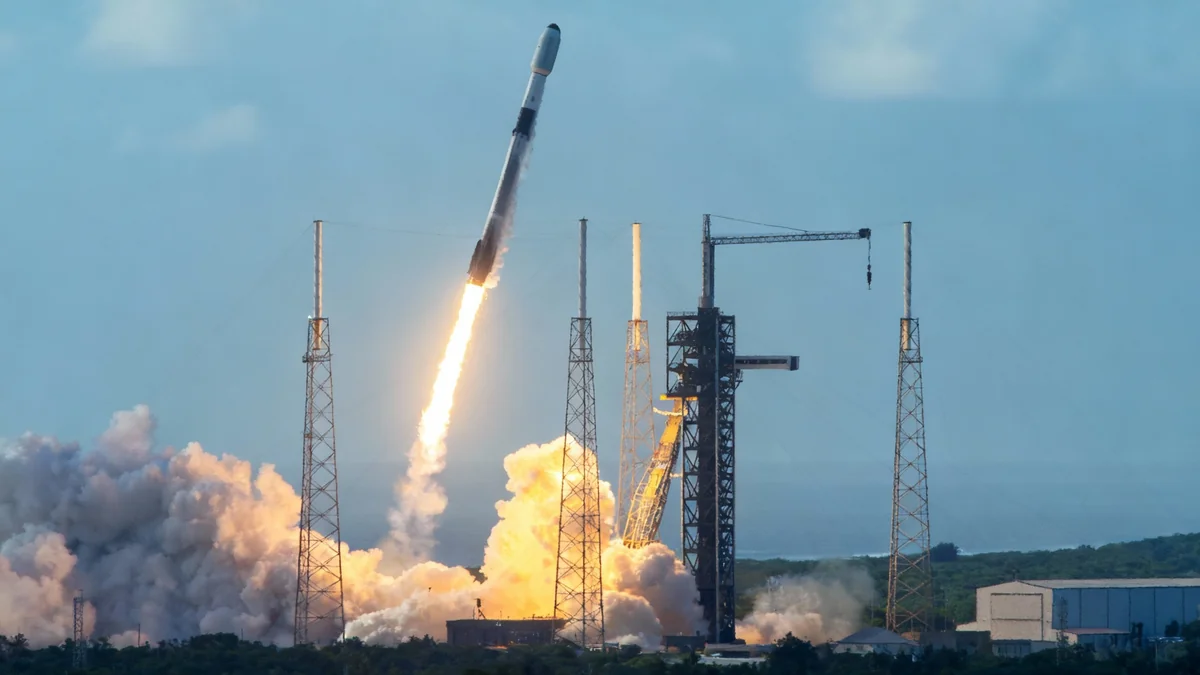



SpaceX is scheduled to launch its 139th mission of the year tonight from Florida, setting a new company record for annual launch frequency. The Falcon 9 rocket will carry a secure communications satellite for the Spanish military, lifting off from Cape Canaveral Space Force Station.
The four-hour launch window opens at 9:30 p.m. Eastern Time. This mission highlights the company's rapid launch pace, which has already surpassed its total for all of 2024.
Key Takeaways
- SpaceX is targeting its 139th launch of 2025 tonight, a new annual record for the company.
- The Falcon 9 rocket will carry the Spainsat NG-2 satellite, a military communications payload for Spain.
- The mission will use an expendable first-stage booster, which will not be recovered, to meet the payload's performance needs.
- This will be the 22nd flight for this particular Falcon 9 booster, demonstrating SpaceX's commitment to reusability.
A New Milestone in Launch Cadence
SpaceX is poised to break its own annual launch record with tonight's mission. The flight, designated as the 139th of 2025, demonstrates an unprecedented operational tempo for the aerospace company. This figure includes 133 Falcon 9 flights and five suborbital test flights of its next-generation Starship vehicle.
By comparison, SpaceX conducted a total of 138 launches in all of 2024, which was composed of 132 Falcon 9 missions, four Starship tests, and two Falcon Heavy flights. The accelerated pace in 2025 underscores the company's dominance in the global launch market and its ability to service a wide range of government and commercial clients.
The launch is scheduled from Cape Canaveral Space Force Station in Florida. SpaceX will provide a live webcast of the event, beginning approximately 15 minutes before the scheduled 9:30 p.m. EDT liftoff.
Mission Details: Spainsat NG-2
The primary payload for this record-setting flight is the Spainsat NG-2 satellite. This is the second and final satellite for the Spainsat Next Generation constellation, a program designed to provide advanced and secure communications for the Spanish Armed Forces and their international partners.
What is the Spainsat NG Constellation?
The Spainsat NG program is a public-private partnership between the Spanish Ministry of Defence and Hisdesat. It is designed to replace Spain's existing government communications satellites, Spainsat and Xtar-EUR. The new constellation will offer enhanced capabilities in X-band, military Ka-band, and UHF frequencies, ensuring secure communications for military operations on land, at sea, and in the air.
SpaceX also launched the first satellite in this series, Spainsat NG-1, earlier this year in January. The successful deployment of NG-2 will complete the constellation, significantly upgrading Spain's sovereign communications infrastructure. The satellite is expected to be deployed into a geosynchronous transfer orbit (GTO) about 36 minutes after liftoff.
An Unusual Mission Profile
In a departure from most Falcon 9 missions, the first-stage booster for this launch will not attempt a landing for recovery and reuse. Instead, it will fly in an expendable configuration. According to a mission description from SpaceX, this decision was made due to the "additional performance required to deliver this payload to orbit."
Geosynchronous transfer orbit is a high-energy destination that often requires more fuel, leaving less available for the complex maneuvers needed to land the booster. By forgoing the landing, the rocket can dedicate all of its performance to placing the heavy Spainsat NG-2 satellite into its precise target orbit.
A Veteran Booster's Final Flight
Despite being expended on this mission, the Falcon 9 first stage is a seasoned veteran. This will be its 22nd launch, a testament to the durability and reliability of SpaceX's reusable rocket technology. Its previous missions have included crewed flights, cargo resupply missions to the International Space Station, and numerous Starlink deployments.
While booster recovery has become a hallmark of SpaceX operations, expendable missions are still used for specific payloads that have demanding performance requirements. This flexibility allows the company to serve a broader range of the satellite market, from low Earth orbit constellations to heavy geostationary communications satellites.
The Broader Context of SpaceX's Growth
Achieving 139 launches before the end of October is a significant operational achievement. It reflects the maturity of the Falcon 9 launch system and the efficiency of SpaceX's launch processing and refurbishment operations. The company has effectively created a production line for space launches, dramatically lowering costs and increasing access to space for customers worldwide.
This relentless launch pace is not just about breaking records; it's about fundamentally changing the economics of spaceflight and enabling new possibilities, from global internet constellations to ambitious national security programs.
The high flight rate is largely driven by the deployment of SpaceX's own Starlink internet satellite constellation, but missions like the Spainsat NG-2 launch demonstrate the continued strong demand from government and military clients. As SpaceX continues to refine its operations and push the boundaries with its Starship program, the frequency of launches is only expected to increase in the coming years.