
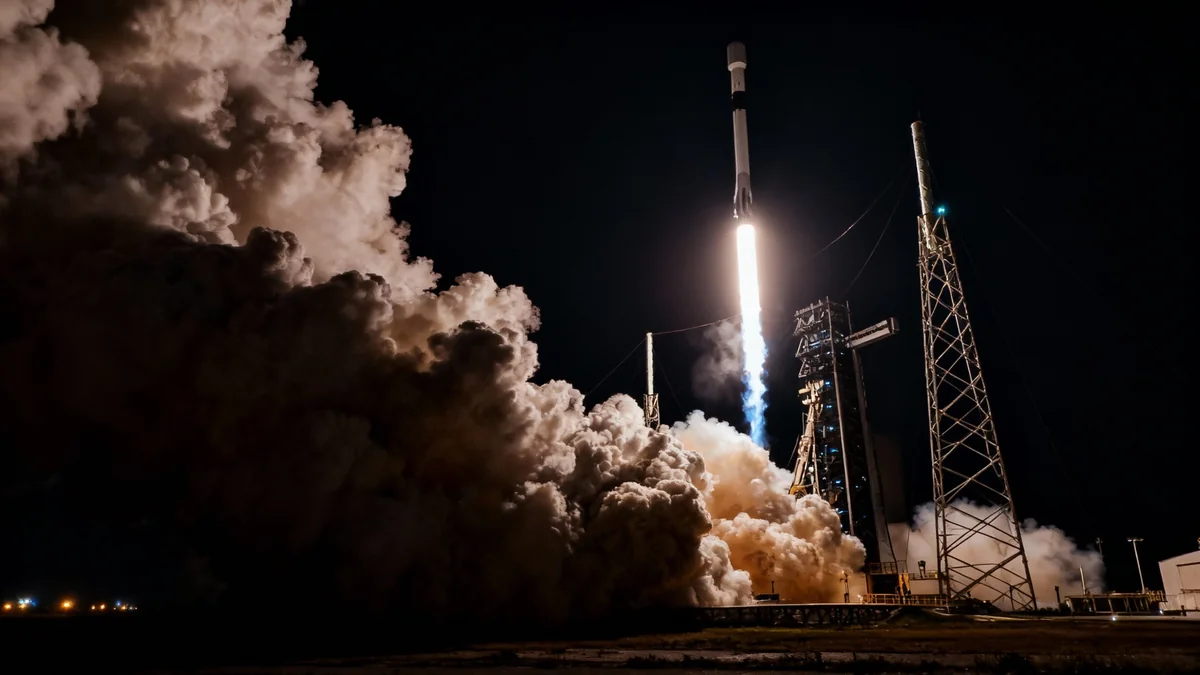


SpaceX has once again broken its own record for the most launches in a single year, following a successful mission from Florida's Space Coast on Monday night. The company sent a Falcon 9 rocket carrying 29 Starlink internet satellites into orbit, marking its 149th successful launch of 2025.
The mission, which lifted off from Cape Canaveral Space Force Station, not only adds to the growing Starlink megaconstellation but also underscores the rapid pace of SpaceX's launch operations, which continue to surpass previous benchmarks.
Key Takeaways
- SpaceX successfully launched 29 Starlink satellites on November 10, 2025.
- The mission was the 144th Falcon 9 launch of the year, a new record.
- Including Starship tests, this was SpaceX's 149th total launch in 2025, surpassing the 2024 record of 138.
- The Falcon 9's first-stage booster successfully landed on a drone ship for its third reuse.
Details of the Monday Night Launch
A Falcon 9 rocket illuminated the night sky over Florida, lifting off at 10:21 p.m. EST. Onboard were 29 Starlink satellites, the latest additions to the company's space-based internet service. The launch proceeded without any reported issues.
Following stage separation, the Falcon 9's upper stage continued its journey, successfully deploying the satellites into low Earth orbit approximately 65 minutes after liftoff. These satellites will now maneuver to their operational altitudes to join the thousands already providing internet coverage across the globe.
Booster Recovery and Reuse
A critical component of SpaceX's launch strategy is the recovery and reuse of its rocket boosters. In a now-routine demonstration of this capability, the first stage of the Falcon 9 rocket returned to Earth for a controlled landing.
Approximately 8.5 minutes after launching, the booster, designated 1096, made a precise vertical landing on the SpaceX drone ship "Just Read the Instructions," stationed in the Atlantic Ocean. This marked the third successful mission for this particular booster. Its previous flights include launching NASA's IMAP space-weather mission and a batch of Amazon's Project Kuiper broadband satellites.
The Importance of Reusability
SpaceX's ability to reuse its Falcon 9 first-stage boosters is a key factor in its high launch frequency and reduced operational costs. By landing and refurbishing boosters, the company can prepare for subsequent missions much faster than if it had to build a new rocket for every launch. This approach has fundamentally changed the economics of accessing space.
A Year of Unprecedented Activity
Monday's mission was a significant milestone for SpaceX, officially making 2025 its busiest year to date. The launch was the 144th Falcon 9 mission of the year, breaking the previous record of 132 set in 2024.
When including the five suborbital test flights of its next-generation Starship vehicle, the company's total launch count for 2025 now stands at 149. This surpasses the 2024 record of 138 total liftoffs with nearly two months still remaining in the year.
SpaceX Launch Cadence by the Numbers
- Total 2025 Launches: 149 (and counting)
- Falcon 9 Launches in 2025: 144
- Starlink-Dedicated Launches in 2025: 104
- Previous Annual Record (2024): 138 total launches
This relentless pace highlights SpaceX's dominance in the global launch market. The majority of these missions are dedicated to building out its own Starlink network.
Expanding the Starlink Network
The primary goal of this launch, like many before it, was to expand the Starlink megaconstellation. This mission was the 104th flight in 2025 dedicated solely to deploying Starlink satellites. SpaceX is building a vast network in low Earth orbit designed to provide high-speed, low-latency internet access to underserved and remote areas worldwide.
With each successful launch, the company adds more capacity and coverage to its network, which already serves millions of customers in dozens of countries. The consistent addition of satellites is crucial for maintaining service quality and expanding its global footprint.
As SpaceX continues to push the boundaries of launch frequency, the growth of the Starlink constellation is expected to accelerate further, continuing to reshape the landscape of global internet connectivity.