
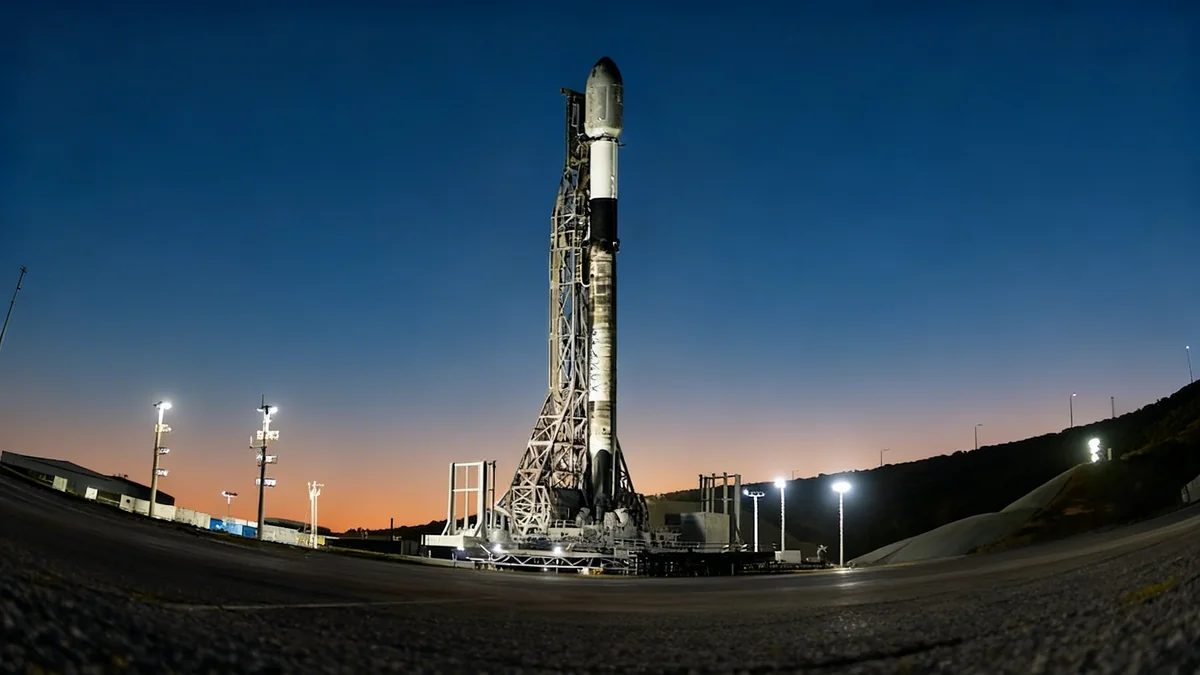


SpaceX is set to achieve a major operational milestone with the launch of its 600th Falcon 9 rocket. The historic flight, designated Starlink 17-13, is scheduled to lift off from Vandenberg Space Force Base in California on Saturday, February 14, 2026, carrying a new batch of internet satellites into orbit.
This mission underscores the rapid launch pace and reusability that have become hallmarks of the company's operations. The launch occurs just hours after a separate SpaceX mission successfully delivered a crew of astronauts to the International Space Station, highlighting a busy and productive period for the aerospace firm.
Key Takeaways
- Major Milestone: The upcoming mission will be the 600th launch of a Falcon 9 rocket since its debut.
- Payload: The rocket will carry 24 Starlink V2 Mini satellites to expand SpaceX's global internet constellation.
- Veteran Booster: The first-stage booster, B1081, will be flying for its 22nd time, demonstrating the success of SpaceX's reusability program.
- Booster Landing: A landing is planned on the drone ship 'Of Course I Still Love You' in the Pacific Ocean, which would mark the 571st successful booster recovery for the company.
A Historic Flight from the West Coast
The milestone 600th flight is scheduled to depart from Space Launch Complex 4 East at Vandenberg Space Force Base. Liftoff is targeted for 5:59:59 p.m. Pacific Standard Time. Following launch, the Falcon 9 will travel on a southerly trajectory over the Pacific Ocean.
The primary goal of the Starlink 17-13 mission is to deploy 24 Starlink V2 Mini satellites. These satellites are a crucial part of SpaceX's plan to provide high-speed, low-latency internet service to underserved areas around the globe.
The Workhorse Booster Makes Its 22nd Trip
The first-stage booster assigned to this mission, identified by its tail number B1081, is one of the most experienced rockets in SpaceX's fleet. This flight will mark its 22nd launch and landing attempt. Its extensive flight history includes several high-profile missions for NASA.
Previously, B1081 has successfully launched:
- The Crew-7 mission, carrying astronauts to the International Space Station.
- The CRS-29 cargo resupply mission to the ISS.
- NASA's PACE (Plankton, Aerosol, Cloud, ocean Ecosystem) satellite.
- The TRACERS mission to study the Earth's magnetic environment.
This track record highlights the reliability and reusability central to SpaceX's business model, which has significantly lowered the cost of access to space.
By the Numbers: SpaceX Landings
If the booster landing is successful, it will be the 178th recovery on the 'Of Course I Still Love You' drone ship and the 571st overall booster landing for SpaceX. This consistent success has transformed the launch industry.
Landing and Recovery Operations
Approximately eight minutes after liftoff, the B1081 booster is expected to perform a controlled descent and landing. The target is the autonomous drone ship named ‘Of Course I Still Love You,’ which will be positioned hundreds of kilometers downrange in the Pacific Ocean.
Successful recovery of the booster will allow SpaceX to refurbish it for future missions, continuing the cycle of reuse that has enabled its frequent launch schedule. Each successful landing adds valuable data and experience to the company's operational knowledge base.
A Busy Week in Space
The Starlink mission follows closely on the heels of another significant SpaceX achievement. Earlier in the day, the Crew Dragon spacecraft 'Freedom' successfully docked with the International Space Station at 3:15 p.m. EST. That mission, the company's 20th human spaceflight, carried three astronauts and one cosmonaut to the orbiting laboratory after launching from Cape Canaveral, Florida.
The Evolution of a Launch System
The Falcon 9's journey to 600 launches represents a remarkable evolution in rocket technology. Early missions focused on proving the vehicle's capability, with booster landings being a secondary, experimental objective. A key moment came in 2016 when the company began planning for its first landings at Cape Canaveral.
Over the past decade, what was once a groundbreaking experiment has become a routine part of nearly every mission. This reliability has not only enabled the deployment of the massive Starlink constellation but has also made SpaceX a trusted launch provider for commercial companies, civil space agencies like NASA, and national security missions.
"From astronaut flights to lunar landers, the Falcon family of rockets has become a versatile platform for a wide range of missions, fundamentally changing the economics of spaceflight."
The company's launch manifest continues to grow, with missions planned for its more powerful Falcon Heavy rocket as well. In 2021, Astrobotic selected the Falcon Heavy to launch its robotic lunar lander to the moon's south pole, a mission aimed at delivering a NASA rover to search for water ice. This demonstrates the trust placed in SpaceX's hardware for complex, high-value scientific endeavors.
As SpaceX prepares for its 600th Falcon 9 launch, the mission serves as a clear indicator of the maturity and dominance of its launch system in the global aerospace market.