
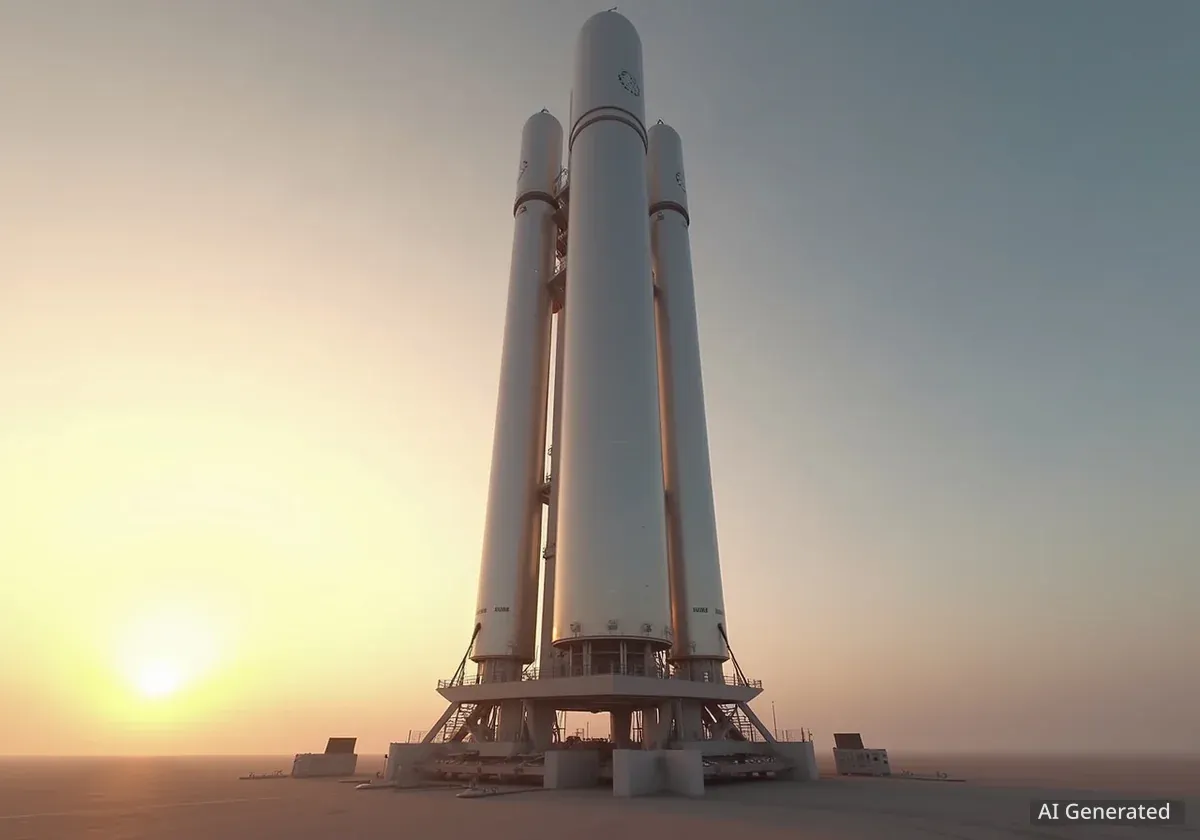
SpaceX has moved the Super Heavy booster for the upcoming Starship Flight 11 mission to its orbital launch pad in South Texas. The company confirmed the operation on Wednesday, October 8, releasing images of the massive first stage being prepared for its scheduled launch on Monday, October 13.
Key Takeaways
- SpaceX moved the Super Heavy booster for Starship Flight 11 to the launch mount at its Starbase facility.
- The eleventh test flight is scheduled for Monday, October 13, at 7:15 p.m. EDT.
- The mission plan involves a controlled splashdown of the booster in the Gulf of Mexico and the upper stage in the Indian Ocean.
- The upper stage will deploy eight dummy Starlink internet satellites as part of the test.
Final Preparations at Starbase
SpaceX is proceeding with preparations for the eleventh integrated test flight of its Starship rocket system. On October 8, 2025, the company shared photographs showing the Super Heavy booster being transported and lifted onto the orbital launch mount at the Starbase site located in South Texas.
The move is a critical step in the final integration of the two-stage vehicle ahead of its launch. The mission, designated Flight 11, is currently targeted for liftoff on Monday, October 13, at 7:15 p.m. EDT (2315 GMT). This schedule continues SpaceX's rapid testing cadence for the world's most powerful launch system.
The Starship Launch System
Starship is a fully reusable transportation system designed to carry crew and cargo to Earth orbit, the Moon, Mars, and beyond. It is the most powerful rocket ever developed, capable of producing more than twice the thrust of the Saturn V rockets used for the Apollo missions.
Both stages are engineered for rapid reusability, a key element of SpaceX's strategy to reduce the cost of access to space. According to company founder Elon Musk, future versions of the rocket are planned to be even larger and more capable.
Flight 11 Mission Objectives
The flight plan for Starship's eleventh mission closely mirrors the profile of its successful tenth flight, which took place on August 26. The primary goals are to gather data and demonstrate the vehicle's capabilities through a series of complex maneuvers.
After separating from the upper stage, the Super Heavy booster is expected to perform a boostback burn and return for a controlled landing. The target for this mission is a soft water landing, or splashdown, in the Gulf of Mexico. This allows engineers to test landing procedures without the risk of a pad-side recovery attempt.
Payload and Upper Stage Trajectory
The Starship upper stage will continue its journey after stage separation, climbing toward space. During its flight, it is scheduled to deploy a payload of eight dummy Starlink internet satellites. This test verifies the vehicle's payload deployment mechanism, a crucial function for future commercial and government missions.
Following payload deployment, the Ship will perform a deorbit burn and begin its own atmospheric reentry. The mission is planned to conclude with the upper stage splashing down in the Indian Ocean, completing a suborbital flight that tests its heat shield and flight controls at hypersonic speeds.
Booster Reuse and Recovery
The Super Heavy booster being used for Flight 11 has flown before. It was previously used for Starship Flight 8 in March of this year. During that mission, SpaceX successfully demonstrated a catch of the booster using the launch tower's large mechanical arms, often called "chopsticks." For Flight 11, however, the company will not attempt a catch, opting instead for the less complex water landing to gather additional flight data.
Path to Operational Status
Each Starship test flight provides valuable information that informs design changes and software updates. The iterative approach allows SpaceX to rapidly advance the system's reliability and performance.
The success of recent flights, including the fully successful Flight 10, indicates significant progress toward making Starship an operational launch vehicle. The ability to deploy payloads, as planned for Flight 11, is a major step toward commercial viability.
"Starship is the biggest and most powerful rocket ever built. The vehicle consists of two elements — Super Heavy and an upper-stage spacecraft known as Starship, or Ship for short," the company has previously stated, emphasizing the two-stage, fully reusable design.
With each test, SpaceX moves closer to its long-term goals, which include launching large satellite constellations, supporting NASA's Artemis program with a human landing system for the Moon, and ultimately enabling human settlement on Mars.