
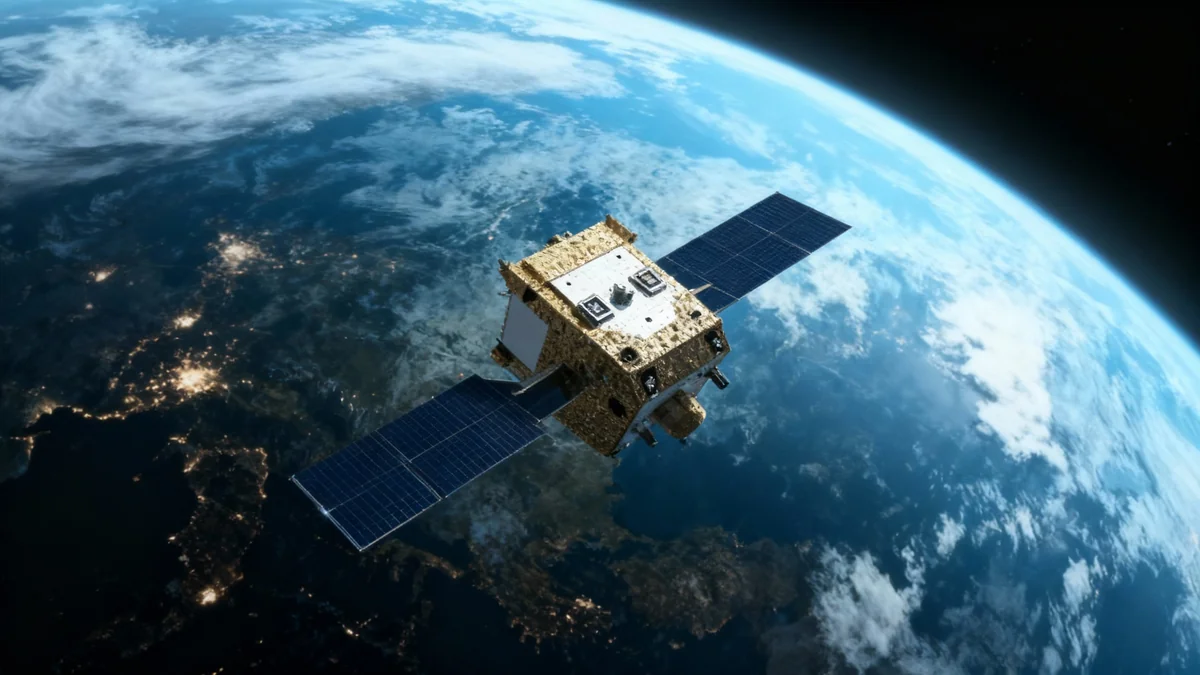


The year 2026 is poised to become a landmark period for space operations, marking a fundamental shift from disposable spacecraft to a new era of sustainable, serviceable satellites. A series of missions planned by military, civil, and commercial entities will test and deploy technologies for on-orbit refueling, repair, and rapid response, potentially transforming how activities are conducted in Earth's orbit and beyond.
These advancements aim to make space operations more dynamic and flexible, addressing the growing recognition of space as a critical domain for national security and economic activity. The ability to service satellites in orbit could extend their operational lives, enhance their capabilities, and provide unprecedented agility in responding to emerging needs or threats.
Key Takeaways
- Multiple missions in 2026 will focus on on-orbit servicing, including refueling and robotic repairs.
- The U.S. Space Force and DARPA are leading efforts to develop dynamic space operations for national security.
- Commercial companies are also entering the on-orbit servicing market, with plans for refueling and maintenance in geosynchronous orbit.
- These technologies are considered essential for future long-duration missions to the Moon and Mars.
National Security Drives a New Space Paradigm
The United States Space Force is actively pursuing what it calls “dynamic space operations,” a concept centered on the ability to maneuver and operate spacecraft without the traditional constraint of finite fuel. This strategic shift is the driving force behind several key missions scheduled for 2026, designed to build a more resilient and responsive presence in orbit.
The Victus Missions: Launching on Demand
Building on the successful Victus Nox demonstration in 2023, the Space Force plans to advance its tactically responsive launch capabilities. The upcoming Victus Haze mission will simulate a rapid response to an in-orbit threat, involving the quick launch and operation of a space domain awareness satellite.
Two related efforts, Victus Surgo and Victus Salo, will further test this model. These missions, utilizing launchers from Impulse Space, will deploy satellites to different orbits—geosynchronous transfer orbit (GEO) and low Earth orbit (LEO)—to demonstrate the advantages of modular designs for rapid deployment.
A New Era of Agility
The goal of tactically responsive launch is to significantly shorten the timeline from identifying a need to having an operational asset in space, reducing it from months or years to mere days or hours.
Tetra-5: The Orbital Gas Station
Perhaps one of the most critical national security space missions for 2026 is Tetra-5. This joint project between the Space Systems Command and the Air Force Research Lab is focused on demonstrating the core technologies needed for an orbital refueling architecture.
The spacecraft will test autonomous rendezvous, proximity operations, and docking procedures. Its primary objective is to successfully transfer fuel to another object in space, a capability that could allow military satellites to extend their missions, change orbits frequently, or perform evasive maneuvers without exhausting their propellant.
Robots to the Rescue: Repairing Satellites in Orbit
Beyond simply refueling, the ability to repair, upgrade, or modify satellites while they are in orbit represents another transformational leap. DARPA, the Defense Advanced Research Projects Agency, is at the forefront of this effort with its Robotic Servicing of Geosynchronous Satellites (RSGS) program.
Scheduled for 2026, the RSGS mission will utilize a sophisticated robotic payload attached to a Mission Robotics Vehicle, provided by Northrop Grumman. Equipped with two robotic arms, the system will demonstrate its ability to physically interact with a satellite in geosynchronous orbit, a region approximately 36,000 kilometers above Earth that is home to critical communication and surveillance satellites.
Why Geosynchronous Orbit Matters
Satellites in GEO orbit the Earth at the same speed as the planet's rotation, making them appear stationary from the ground. This is ideal for telecommunications, broadcasting, and persistent surveillance. Servicing these high-value assets could save billions of dollars and maintain critical infrastructure.
The potential to repair a malfunctioning component, attach a new instrument, or reposition a satellite could normalize space operations, bringing them in line with how vehicles and equipment are maintained in every other domain, from air to sea. This would change not only how missions are executed but also how spacecraft are designed from the ground up, likely leading to modular and upgradeable satellite platforms.
The Commercial Frontier of On-Orbit Servicing
The push for a sustainable space ecosystem is not limited to government and military initiatives. A growing commercial market is emerging to provide on-orbit services to both private and public sector clients. Several ventures are set to make significant strides in 2026.
One notable commercial mission is the scheduled launch of Vast’s Haven-1, which is being developed as the first commercial destination in low Earth orbit. While primarily a space station, its development relies on the same principles of orbital logistics and sustainability.
New Propellants for a New Market
A partnership between the U.S.-based Argo Space Corp and France's Infinite Orbits is also targeting the GEO servicing market. Their approach introduces an innovative and more sustainable propulsion technology.
Argo's spacecraft is designed to be refuelable and uses water as its propellant. This method is significantly more affordable and less toxic than traditional propellants like hydrazine.
The use of water as propellant has far-reaching implications. It opens the door to leveraging resources found in space, such as ice harvested from the Moon, to create fuel depots beyond Earth. This in-situ resource utilization is a cornerstone of plans for establishing a sustained human presence on the Moon and mounting future missions to Mars.
Paving the Way to the Moon and Mars
The technologies being tested in Earth's orbit in 2026 are foundational for the future of deep space exploration. Sustaining operations on the Moon and undertaking the long journey to Mars will be impossible without robust refueling and servicing capabilities.
At least three missions are planned to head to the Moon in 2026, each contributing to the infrastructure needed for long-term exploration. The ability to refuel landers and transfer vehicles using locally sourced propellant from lunar ice would dramatically reduce the cost and complexity of these missions.
Ultimately, the combination of rapid launch, robotic servicing, and on-orbit refueling will enable a complete rethinking of space mission architecture. While planned missions can face delays and unforeseen challenges, the concerted effort from so many different organizations signals a clear and determined trajectory. The activities of 2026 are set to lay the groundwork for a more dynamic, responsive, and sustainable future in space.