
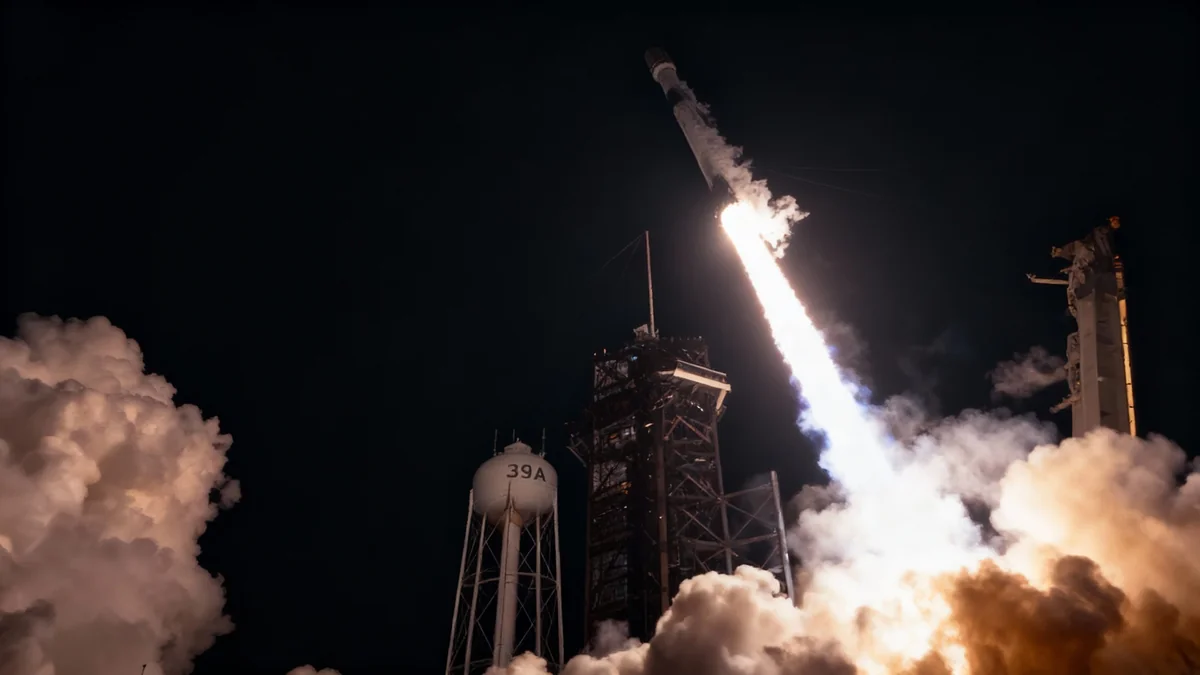


SpaceX successfully launched another batch of its Starlink internet satellites into orbit late Friday night. A Falcon 9 rocket carrying 29 satellites lifted off from Launch Complex 39A at NASA’s Kennedy Space Center in Florida at 10:08 p.m. EST on November 14, 2025.
The mission, designated Starlink 6-89, adds to the company's growing megaconstellation designed to provide global broadband internet coverage. The launch proceeded smoothly under nearly perfect weather conditions, marking another routine flight for the commercial space company.
Key Takeaways
- SpaceX launched 29 Starlink satellites on November 14, 2025, from Kennedy Space Center.
- The mission, Starlink 6-89, utilized a Falcon 9 rocket with a flight-proven first-stage booster.
- The booster, B1092, completed its eighth successful mission and landed on a droneship in the Atlantic Ocean.
- This was the 533rd overall booster landing for SpaceX and the 132nd on the droneship 'A Shortfall of Gravitas'.
A Flawless Liftoff from Pad 39A
The Falcon 9 rocket lit up the night sky over Florida's Space Coast, ascending on a south-easterly trajectory over the Atlantic Ocean. The launch was the first of two Starlink missions planned for the same evening from the region, demonstrating SpaceX's high operational tempo.
Weather conditions for the Starlink 6-89 mission were ideal. The 45th Weather Squadron had forecast a greater than 95 percent chance of favorable weather at the time of liftoff, and that prediction held true. The clear skies provided excellent viewing opportunities for residents across the state, from Titusville to Lakeland and Cape Coral.
Launch weather officers also noted that the risk from solar activity, which had been elevated in previous days, had been downgraded to moderate. This reduced the potential for solar radiation to interfere with the rocket's avionics during its ascent.
The Reusable Rocket Engine
Central to the mission's success was the reusable Falcon 9 first-stage booster, identified by the tail number B1092. This particular booster was making its eighth flight, a testament to SpaceX's strategy of reusing its most expensive rocket components to lower the cost of access to space.
Booster B1092 Flight History
- Flight 1: CRS-32 (Cargo Resupply to ISS)
- Flight 2: GPS III SV08 (U.S. Space Force satellite)
- Flight 3: NROL-69 (National Reconnaissance Office payload)
- Flights 4-7: Various Starlink missions
- Flight 8: Starlink 6-89
By reusing boosters like B1092, SpaceX can maintain an aggressive launch schedule that would be impossible with traditional, expendable rockets. Each successful recovery and relaunch provides valuable data that helps the company refine its processes for rapid refurbishment and reuse. This approach has been a key factor in the rapid deployment of the Starlink constellation.
A Pinpoint Landing in the Atlantic
Approximately 8.5 minutes after liftoff, the first-stage booster completed its primary role in pushing the second stage and the Starlink satellites toward orbit. After separating, B1092 performed a series of engine burns to reorient itself and slow its descent back through Earth's atmosphere.
The booster successfully landed on the autonomous droneship, 'A Shortfall of Gravitas,' which was stationed in the Atlantic Ocean east of The Bahamas. This marked the 132nd successful landing on this specific droneship and the 533rd successful SpaceX booster recovery to date. These landings have become a signature and almost routine part of every Falcon 9 mission.
The Importance of Droneship Landings
SpaceX uses autonomous droneships to recover boosters on missions that require high velocity, such as those delivering payloads to geostationary orbit or on certain Starlink trajectories. The high speeds of these missions leave the booster with insufficient fuel to return to a landing pad on land. The mobile ocean platform allows for recovery far downrange, maximizing the rocket's performance and payload capacity.
The successful recovery of B1092 means it will be inspected, refurbished, and prepared to fly yet again, continuing its role in building out the Starlink network and launching other commercial and government payloads.
Expanding the Starlink Network
The 29 satellites deployed from the Starlink 6-89 mission will soon raise their orbits and join the thousands of active satellites already providing internet services to millions of users worldwide. The Starlink project aims to deliver high-speed, low-latency internet to underserved and remote areas where traditional internet infrastructure is unreliable or non-existent.
SpaceX has been launching Starlink satellites at a rapid pace, with missions often occurring multiple times per week. The company utilizes both its Falcon 9 and Falcon Heavy rockets to deploy different generations and configurations of the satellites.
As the constellation grows, SpaceX continues to expand its service offerings, providing connectivity for residential users, aviation, maritime industries, and emergency responders. Each successful launch like Starlink 6-89 is a critical step toward achieving the company's goal of a truly global internet service provider operating from low-Earth orbit.