
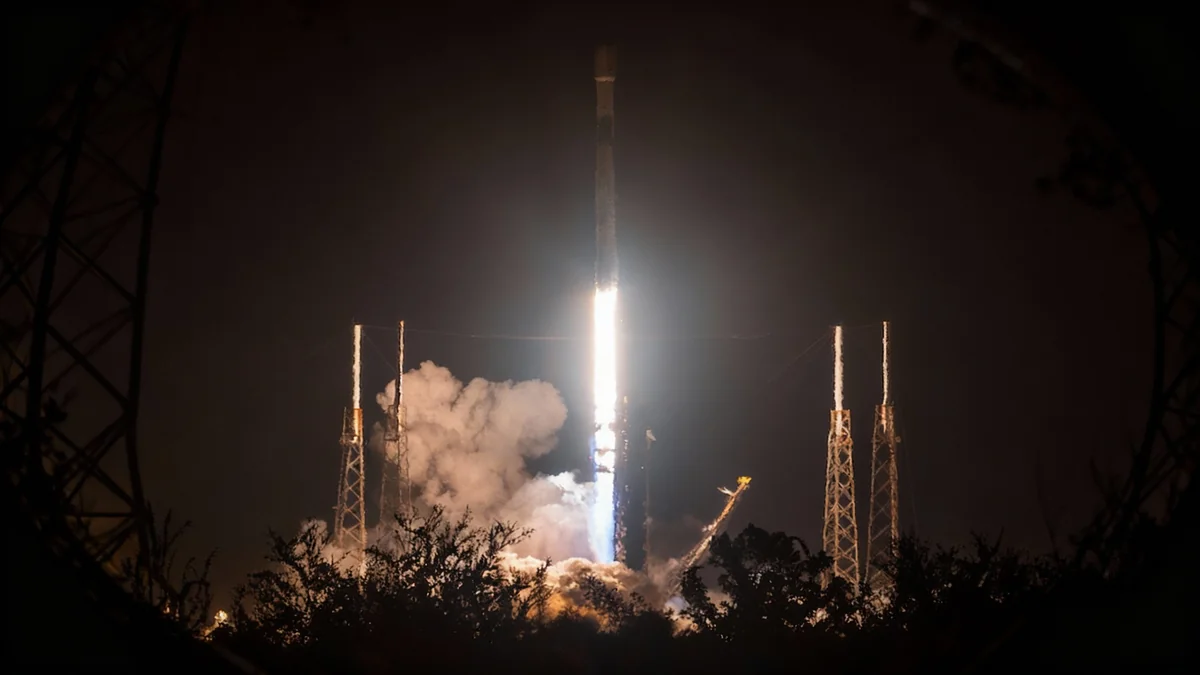


SpaceX successfully launched a Falcon 9 rocket from Cape Canaveral Space Force Station on Wednesday evening, deploying another 29 Starlink satellites into low Earth orbit. The mission, designated Starlink 6-81, lifted off at 8:31 p.m. EST, marking the company's first launch of November and continuing its rapid deployment of the global internet constellation.
Following a southeasterly trajectory over the Atlantic Ocean, the rocket's first stage booster completed its flight with a successful autonomous landing on a droneship. Weather conditions for the launch were nearly perfect, with officials forecasting a greater than 95 percent chance of favorable skies.
Key Takeaways
- SpaceX launched 29 Starlink V2 Mini satellites on November 5, 2025.
- The Falcon 9 rocket lifted off from Space Launch Complex 40 in Florida.
- The first stage booster, B1094, successfully landed on the droneship 'Just Read the Instructions'.
- This mission was the fifth flight for this particular booster.
- SpaceX has at least seven Starlink missions planned before the end of November.
Accelerating the Starlink Constellation
The Starlink 6-81 mission is the first of an ambitious launch schedule for SpaceX this month. The company aims to conduct at least seven missions before the Thanksgiving holiday, underscoring its commitment to rapidly expanding its satellite internet service. Each launch adds more capacity and coverage to the growing network, which provides high-speed internet to users worldwide.
The 29 satellites deployed on this mission are the V2 Mini variant, a more compact but powerful version of the earlier Starlink models. These satellites are designed to offer increased bandwidth and more reliable service. The deployment occurred approximately one hour after liftoff, with SpaceX confirming all spacecraft were successfully released into their intended orbit.
What is Starlink?
Starlink is a satellite internet constellation operated by SpaceX, designed to provide satellite Internet access coverage to 40 countries. It aims for global coverage, especially in rural and underserved areas. The system relies on thousands of mass-produced small satellites in low Earth orbit that communicate with designated ground transceivers.
A Veteran Booster Takes Flight Again
The workhorse for Wednesday's mission was the Falcon 9 first stage booster with the tail number B1094. This flight marked its fifth journey to space and back, a testament to SpaceX's focus on reusability to lower the cost of space access. Previously, this booster supported several high-profile missions, showcasing its reliability and versatility.
Previous Missions for B1094
- Crew-11: A mission transporting astronauts to the International Space Station.
- Ax-4: A private astronaut mission to the ISS with Axiom Space.
- NG-23: A Northrop Grumman Cygnus cargo resupply mission.
- Starlink 12-10: A previous Starlink deployment mission.
Approximately 8.5 minutes after liftoff, B1094 performed a precise landing on the droneship 'Just Read the Instructions', which was positioned in the Atlantic Ocean east of The Bahamas. This recovery is a critical component of SpaceX's operational model, allowing for rapid refurbishment and reuse of its most expensive rocket components.
Landing by the Numbers
This successful recovery marked the 140th booster landing on the 'Just Read the Instructions' droneship. It was also the 529th successful Falcon booster landing for SpaceX overall, a significant milestone in the history of reusable rocket technology.
Ideal Conditions at the Space Coast
Launch operations at Cape Canaveral are heavily dependent on weather. For the Starlink 6-81 mission, the 45th Weather Squadron provided an exceptionally positive forecast, citing a greater than 95 percent chance of favorable conditions during the launch window. Meteorologists noted no significant weather concerns that could have threatened either the launch or the booster's return.
The clear skies provided excellent viewing opportunities for residents and visitors along Florida's Space Coast. Onlookers from various locations, including Port Saint Lucie, reported seeing the Falcon 9 ascend through the night sky. The spectacle of a night launch continues to draw significant public interest, with many gathering at viewing spots to witness the event firsthand.
The consistent launch schedule has made rocket sightings a regular occurrence in Florida, yet each event still generates excitement. For many, it's a powerful reminder of the ongoing advancements in space exploration and technology happening right in their backyard.
The Broader Impact of SpaceX's Launch Cadence
SpaceX's ability to launch, land, and relaunch its Falcon 9 boosters has fundamentally changed the economics of the space industry. The frequent Starlink missions not only build out the company's own internet service but also serve as a continuous flight-testing program, gathering valuable data on the performance and longevity of its reusable hardware.
This operational tempo has solidified the company's position as a leader in global launch services. Beyond its own projects, SpaceX supports missions for NASA, commercial satellite operators, and national security clients. The company's focus on reusability and a high launch rate is central to its long-term goals, which include ambitious projects like the Starship program and eventual human missions to Mars.
As the Starlink constellation grows, it continues to connect more people in remote and underserved regions, demonstrating a practical application of space technology that has a direct impact on daily life around the globe. Each successful launch, like the one on Wednesday, is another step toward achieving that goal.