
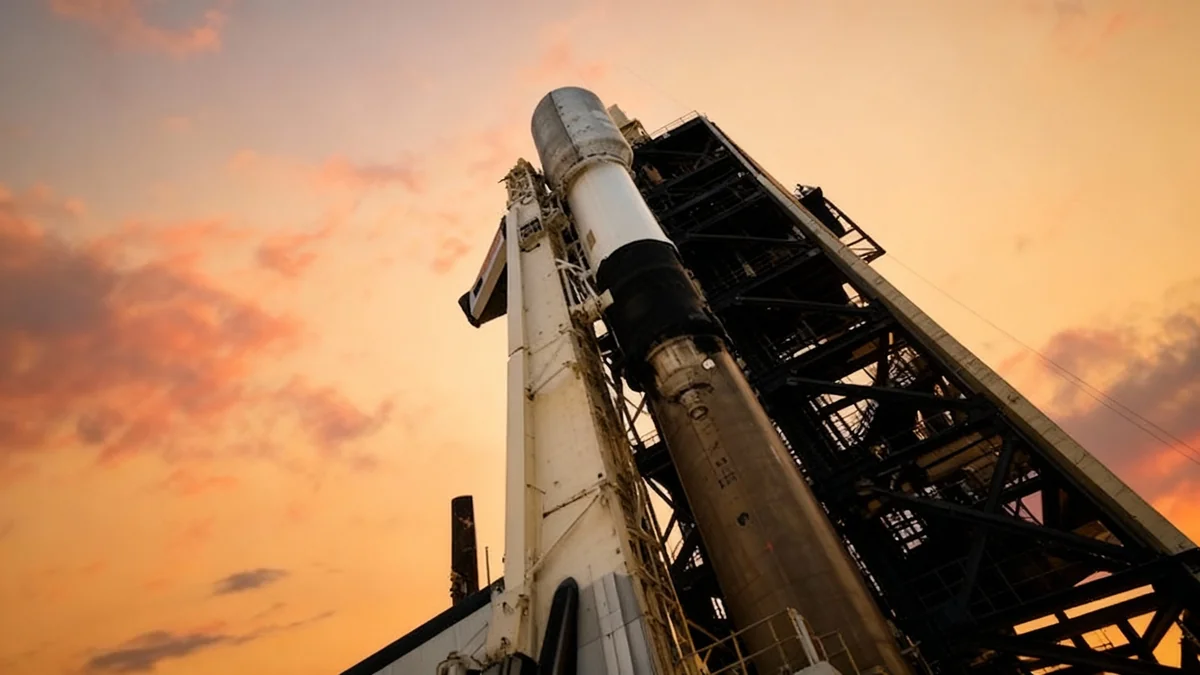


SpaceX has postponed the launch of a Falcon 9 rocket scheduled for Monday, December 14, from NASA's Kennedy Space Center in Florida. The mission, designated Starlink 6-99, was intended to deploy 29 Starlink V2 Mini satellites into low Earth orbit, but was placed on hold due to unfavorable weather conditions.
The primary concerns cited were strong liftoff winds at the launch pad and challenging sea conditions in the booster recovery zone. A new launch date for the mission has not yet been announced by the company.
Key Takeaways
- The SpaceX Starlink 6-99 mission, scheduled for December 14, 2025, has been postponed.
- The launch was scrubbed due to concerns over high winds at the launch site and poor weather in the booster recovery area.
- The mission will carry 29 Starlink V2 Mini satellites to expand the company's global internet service.
- The Falcon 9 first stage for this mission, B1094, is a flight-proven booster preparing for its sixth flight.
Weather Conditions Halt Launch Countdown
The decision to delay the launch was driven by weather forecasts that predicted unacceptable conditions at Launch Complex 39A. High winds at the time of liftoff posed a potential risk to the Falcon 9 rocket's ascent. Launch constraints are carefully managed to ensure the vehicle remains stable during its initial climb through the dense lower atmosphere.
In addition to the conditions at the launch site, the weather in the Atlantic Ocean was also a significant factor. The forecast indicated a low to moderate risk for the recovery of the Falcon 9's first stage booster. Safe recovery operations are a cornerstone of SpaceX's reusable rocket strategy, requiring relatively calm seas for the drone ship to maintain its position and for the booster to land securely.
The Importance of Booster Recovery
SpaceX's ability to reuse its Falcon 9 first-stage boosters is central to its high launch frequency and reduced costs. After stage separation, the booster performs a series of engine burns to reorient itself and slow its descent, targeting an autonomous landing on a drone ship positioned hundreds of miles offshore. This process requires precise coordination and favorable weather conditions.
Mission to Expand Starlink Constellation
When it does launch, the Starlink 6-99 mission will continue SpaceX's ambitious effort to build out its satellite internet constellation. The 29 Starlink V2 Mini satellites on board are part of the newer generation of spacecraft designed to provide higher bandwidth and more reliable service to users around the globe.
The company has maintained an aggressive launch schedule throughout 2025, having already deployed more than 3,000 Starlink satellites this year alone. This rapid expansion aims to increase network capacity and reduce latency for customers in residential, commercial, and mobile sectors.
- The planned landing will be the 146th on the drone ship 'Just Read the Instructions'.
- It will mark the 552nd successful booster landing for SpaceX overall.
Upon liftoff, the Falcon 9 will follow a south-easterly trajectory from Florida’s Space Coast, a flight path commonly used for Starlink missions targeting specific orbital inclinations.
A Veteran Booster Prepares for Sixth Flight
The first stage assigned to this mission is booster B1094, a veteran of five previous flights. Reusability is a key element of SpaceX's operational model, and this booster has a proven track record of successful missions.
Its previous launches include several high-profile flights:
- Crew-11: A NASA Commercial Crew mission carrying astronauts to the International Space Station.
- Ax-4: A private astronaut mission to the ISS organized by Axiom Space.
- Cygnus NG-23: A commercial resupply mission for Northrop Grumman, delivering cargo to the space station.
This will be the booster's sixth flight, demonstrating the durability and reliability of the Falcon 9 hardware. Following its ascent, B1094 is scheduled to land on the drone ship ‘Just Read the Instructions,’ which will be stationed in the Atlantic Ocean east of the Bahamas. The landing is expected to occur approximately 8.5 minutes after liftoff.
A History of Iteration and Improvement
SpaceX has a long history of continuously upgrading its Falcon 9 rocket to improve performance, reliability, and reusability. Over the years, the company has introduced enhancements like redesigned titanium grid fins for better steering control during descent and numerous software updates to optimize the landing process.
This iterative approach to engineering, where lessons from each flight are incorporated into future missions, has been fundamental to the company's success in pioneering reusable rocket technology.
The practice of reusing boosters, once a theoretical concept, has become routine. This has not only lowered the cost of access to space but has also enabled a launch cadence that was previously unimaginable. The delay of the Starlink 6-99 mission, while a temporary setback, underscores the company's cautious approach, prioritizing vehicle safety and the successful recovery of its flight-proven hardware over sticking to a rigid schedule.