
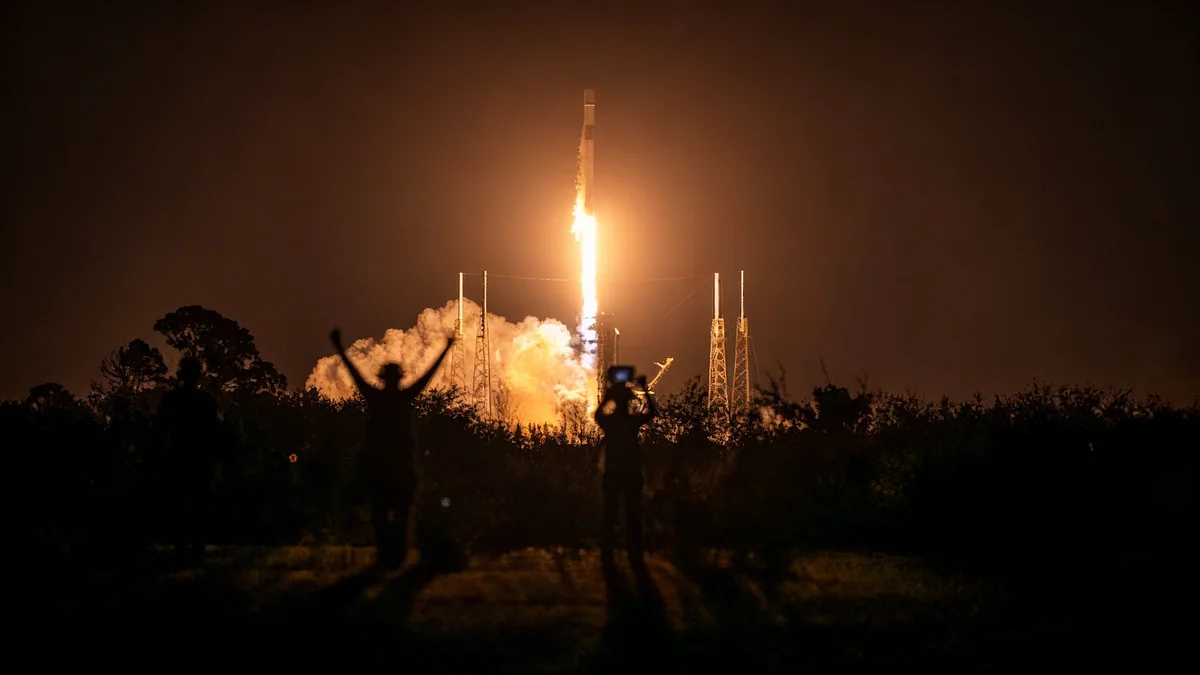


A SpaceX Falcon 9 booster, now the most-flown in the company's fleet, successfully launched and landed for a record 33rd time on Saturday night. The mission, originating from Cape Canaveral Space Force Station, delivered another batch of Starlink internet satellites into orbit, further expanding the global constellation.
The flight marks a significant step in SpaceX's push to extend the operational life of its rockets, with the company aiming to certify its first-stage boosters for as many as 40 missions each. This reusability is central to the company's strategy of reducing the cost of access to space.
Key Takeaways
- A single Falcon 9 booster, designated B1067, completed its 33rd spaceflight, a new record for reusability.
- The mission launched 28 Starlink satellites, growing the constellation to over 9,700 active units.
- The successful landing was the 575th time SpaceX has recovered a first-stage booster.
- This flight is part of a broader initiative to certify Falcon 9 boosters for up to 40 launches, enhancing cost-effectiveness.
A Historic Launch from the Space Coast
Under nearly clear skies, the Falcon 9 rocket ignited its engines at 10:47 p.m. EST, lifting off from Space Launch Complex 40 at Cape Canaveral. The launch proceeded flawlessly, with weather conditions rated at over 95 percent favorable by the 45th Weather Squadron.
The rocket followed a south-easterly trajectory over the Atlantic Ocean, a standard flight path for many Starlink missions launched from Florida. Onboard was the Starlink 6-104 mission, a payload of 28 satellites designed to provide high-speed internet service to locations around the globe.
This launch continues a rapid deployment pace for SpaceX, which has consistently added to its massive low-Earth orbit network. With this latest batch, the total number of Starlink satellites launched now exceeds 9,700.
The Workhorse Booster B1067
The star of the mission was the first-stage booster, B1067. This particular rocket has become a cornerstone of SpaceX's launch manifest. Its flight history demonstrates the versatility and reliability of the Falcon 9 design. Prior to this record-setting flight, B1067 had already completed 32 missions.
A Diverse Mission History
Booster 1067 has a notable flight record that includes both commercial and government missions. It has been trusted to carry critical payloads for various clients, including:
- Four separate missions for NASA.
- Deployment of the European Commission’s Galileo L13 navigation satellite.
- A total of 20 previous Starlink deployment missions.
The turnaround time for this flight was approximately two and a half months, with its 32nd launch taking place in early December. This rapid refurbishment and relaunch cycle is a key component of SpaceX's operational model.
Perfecting the Art of Recovery
Approximately eight and a half minutes after liftoff, while the second stage of the rocket continued to carry the satellites to their designated orbit, the first stage completed its primary mission. B1067 performed a series of engine burns to slow its descent through the Earth's atmosphere before making a pinpoint landing.
The booster touched down on the autonomous droneship, ‘A Shortfall of Gravitas,’ which was stationed in the Atlantic Ocean. This marked the 143rd successful landing on this specific vessel and the 575th overall booster recovery for SpaceX. This consistent success in landing and reusing boosters has fundamentally changed the economics of spaceflight.
By the Numbers: SpaceX Reusability
- Total Booster Landings: 575
- Landings on 'A Shortfall of Gravitas': 143
- Record Flights by a Single Booster: 33 (B1067)
- Company Goal: Certify boosters for 40 flights
The ability to reliably recover and reuse the most expensive part of the rocket has allowed SpaceX to maintain a high launch frequency, supporting its own Starlink project while also serving commercial and government clients like NASA and the U.S. Space Force.
Pushing the Boundaries of Reusability
The 33rd flight of B1067 is more than just a new record; it is a data point in an ongoing engineering effort. SpaceX is actively working to certify its Falcon 9 boosters for 40 flights. Each successful mission provides valuable information on the durability of the hardware and the efficiency of the refurbishment process.
This incremental approach to extending the life of its fleet is crucial. It allows engineers to inspect components after each flight, understand wear and tear, and make necessary adjustments to ensure safety and reliability. The goal is to make spaceflight more akin to air travel, where vehicles are used hundreds or thousands of times with routine maintenance.
As boosters like B1067 continue to fly, they pave the way for an even more sustainable and accessible future in space, not only for deploying satellite constellations but also for scientific missions and eventual human spaceflight to the Moon and Mars.