
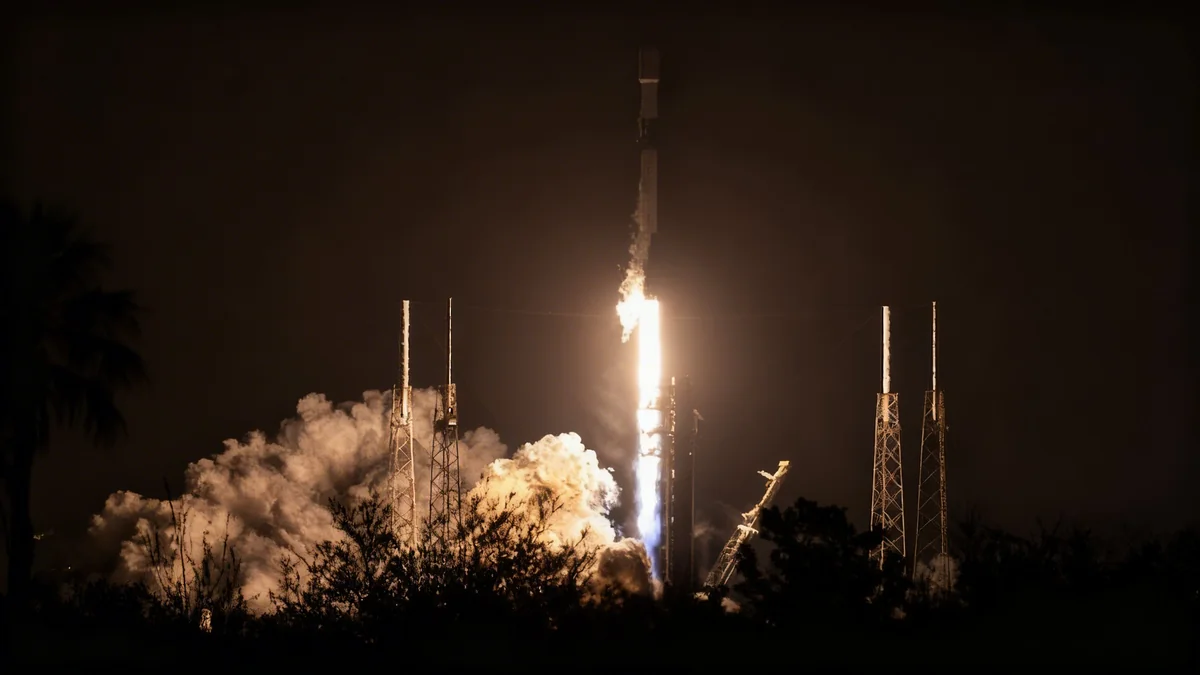


SpaceX successfully launched a Falcon 9 rocket from Cape Canaveral on Thursday evening, delivering 29 Starlink satellites into orbit. The mission was notable for its conclusion, which saw the rocket's first stage booster land on a droneship in the territorial waters of The Bahamas for only the second time in the company's history.
Key Takeaways
- A Falcon 9 rocket launched 29 Starlink satellites from Cape Canaveral Space Force Station on February 19, 2026.
- The first stage booster, B1077, successfully landed on a droneship near The Bahamas, marking only the second time this recovery location has been used.
- This was the 26th successful flight and landing for this particular Falcon 9 booster.
- The landing marks the 573rd successful booster recovery for SpaceX overall.
Details of the Starlink 10-36 Mission
The Falcon 9 rocket lifted off from Space Launch Complex 40 at 8:41 p.m. EST. Weather conditions for the launch were nearly perfect, with the 45th Weather Squadron forecasting a greater than 95 percent chance of favorable conditions.
The primary goal of the mission was to deploy another batch of satellites for SpaceX's Starlink internet constellation. The 29 satellites were successfully placed into their intended orbit following the launch.
A Return to a Unique Recovery Zone
Approximately 8.5 minutes after liftoff, the first stage of the Falcon 9 rocket, booster B1077, performed its landing burn and touched down on the autonomous droneship, 'Just Read the Instructions'.
The vessel was positioned off the coast of Exuma, an island district of The Bahamas. This event marks a significant operational milestone, as it is only the second instance of a SpaceX booster recovery within the island nation's waters.
A Renewed Partnership
The first booster landing in The Bahamas occurred almost exactly one year prior, on February 18, 2025. Following that initial mission, there were reports of environmental concerns from the Bahamian government, particularly after in-flight anomalies with SpaceX's larger Starship rocket tests. However, the two parties have since reached an agreement, allowing for the resumption of these unique landing operations.
The use of this southerly landing zone is part of a broader strategy to support a wider range of mission profiles, including potential polar orbit flights launching from Florida.
The Veteran Booster B1077
The first stage booster used in this mission, designated B1077, is a veteran of SpaceX's fleet. This launch marked its 26th successful mission, a testament to the reliability and reusability of the Falcon 9 system.
Throughout its operational life, B1077 has supported a variety of important missions. Its flight history includes:
- Crew-5: Transporting astronauts to the International Space Station for NASA.
- CRS-28: A cargo resupply mission to the ISS.
- NG-20: A commercial resupply services mission for Northrop Grumman.
The successful recovery of B1077 allows it to be refurbished and prepared for future flights, further reducing the cost of access to space.
SpaceX Landing Milestones
This recovery was the 150th successful landing on the 'Just Read the Instructions' droneship and the 573rd overall booster landing for SpaceX. The company's consistent success in recovering and reusing rocket boosters is a cornerstone of its business model and has fundamentally changed the economics of the launch industry.
Expanding the Starlink Constellation
The 29 satellites launched on this mission will join the thousands already in orbit, expanding the global coverage of the Starlink satellite internet service. SpaceX continues to conduct regular launches to build out the network's capacity and reach.
Each launch adds to what is already the largest satellite constellation ever deployed. The service aims to provide high-speed, low-latency internet to underserved and remote areas around the world.
The successful launch and innovative booster recovery in The Bahamas underscore SpaceX's continued push to refine its operations and expand its capabilities on the Florida Space Coast.