
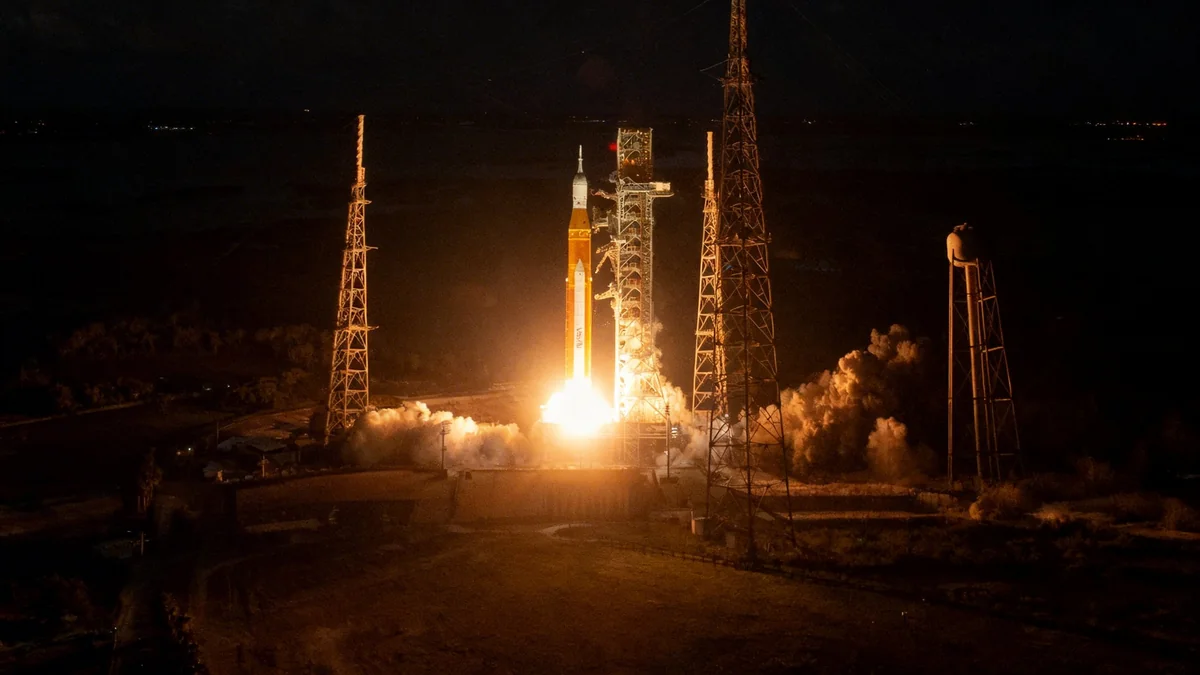


NASA's timeline for the historic Artemis 2 mission, planned as the first crewed flight around the Moon in over 50 years, is now uncertain. A technical issue discovered on the Space Launch System (SLS) rocket will likely postpone the launch from its early March target.
The problem, identified as a helium-flow interruption in the rocket's upper stage, emerged overnight while the vehicle was on Launch Pad 39B at Kennedy Space Center. Mission managers are now preparing for a probable rollback to the Vehicle Assembly Building (VAB) to address the issue, a move that makes a March launch highly improbable.
Key Takeaways
- A helium flow issue was detected in the upper stage of the Artemis 2 SLS rocket.
- The glitch will almost certainly cause the mission to miss its March launch window.
- NASA is preparing to roll the rocket from the launch pad back to the Vehicle Assembly Building for inspection and repairs.
- The Artemis 2 mission is set to carry four astronauts on a flight around the Moon, the first crewed deep space voyage since the Apollo program.
Unexpected Setback After Successful Test
The discovery of the helium glitch came as a surprise, arriving just one day after NASA had expressed confidence in a March 6 launch target. That optimism followed a successful Wet Dress Rehearsal (WDR) where teams fully loaded the SLS rocket with its cryogenic propellants.
The rehearsal, completed on Thursday, was a critical milestone. It demonstrated that engineers had overcome the liquid hydrogen leaks that caused delays during the uncrewed Artemis 1 mission in 2022. With the fueling test deemed a success, the path seemed clear for the final launch preparations.
What is Artemis 2?
Artemis 2 is the first crewed mission of NASA's program to return humans to the lunar surface. It will send three NASA astronauts and one Canadian Space Agency astronaut on an approximately 10-day flight that will orbit the Moon before returning to Earth. It serves as a vital test of the Orion spacecraft's life-support systems and capabilities before future missions attempt a landing.
The Technical Challenge Explained
The issue centers on the flow of helium in the rocket's interim cryogenic propulsion stage (ICPS), which is the upper stage responsible for propelling the Orion capsule toward the Moon.
Helium plays a crucial role in the rocket's operation. It is used to pressurize the liquid hydrogen and liquid oxygen propellant tanks, ensuring a steady flow of fuel to the engine. It also helps maintain the correct environmental conditions for the engine to function properly. An interruption in this system is a significant concern that must be resolved before flight.
Why a Rollback is Necessary
Complex repairs, especially those involving the intricate systems of a rocket's upper stage, are often too difficult or hazardous to perform on the exposed launch pad. The Vehicle Assembly Building (VAB) provides a controlled, enclosed environment where technicians can have comprehensive access to the vehicle for detailed inspections and repairs.
According to a statement from NASA Administrator Jared Isaacman, the situation will have a direct impact on the schedule.
"This will almost assuredly impact the March launch window," Isaacman stated, confirming the high probability of a delay.
Revised Launch Timeline
With the March window—spanning from March 6 to March 11—now out of reach, NASA is looking ahead to the next available opportunity. A rollback to the VAB is a time-consuming process involving transport, de-stacking, repairs, and re-stacking before the rocket can return to the pad.
Mission planners are now assessing the timeline for a potential April launch. The next window opens on April 1, with additional opportunities from April 3-6 and on April 30.
- Previous Target: March 6
- Affected Window: March 6-9, March 11
- Next Potential Window: April 1, April 3-6, April 30
NASA officials noted that while a rollback means missing the March window, the team's swift preparations could potentially preserve the April launch window. The final schedule will depend entirely on the findings from the upcoming engineering review and the complexity of the required repairs.
Preparations at the Pad
In anticipation of a rollback, teams at Kennedy Space Center are already taking action. Crews are working to remove two large "contingency pad access" trusses that were recently installed on the mobile launch tower. These platforms were intended to give technicians access to the rocket's flight termination system while at the pad.
However, the structures have constraints related to wind speed. With high winds forecasted, engineers are removing them to ensure they are not an obstacle if the decision is made to transport the massive rocket back to the VAB.
The Artemis 2 mission remains a top priority for NASA and its international partners. While this delay is a setback, it underscores the rigorous safety checks and meticulous attention to detail required for sending humans back into deep space for the first time in a generation.