
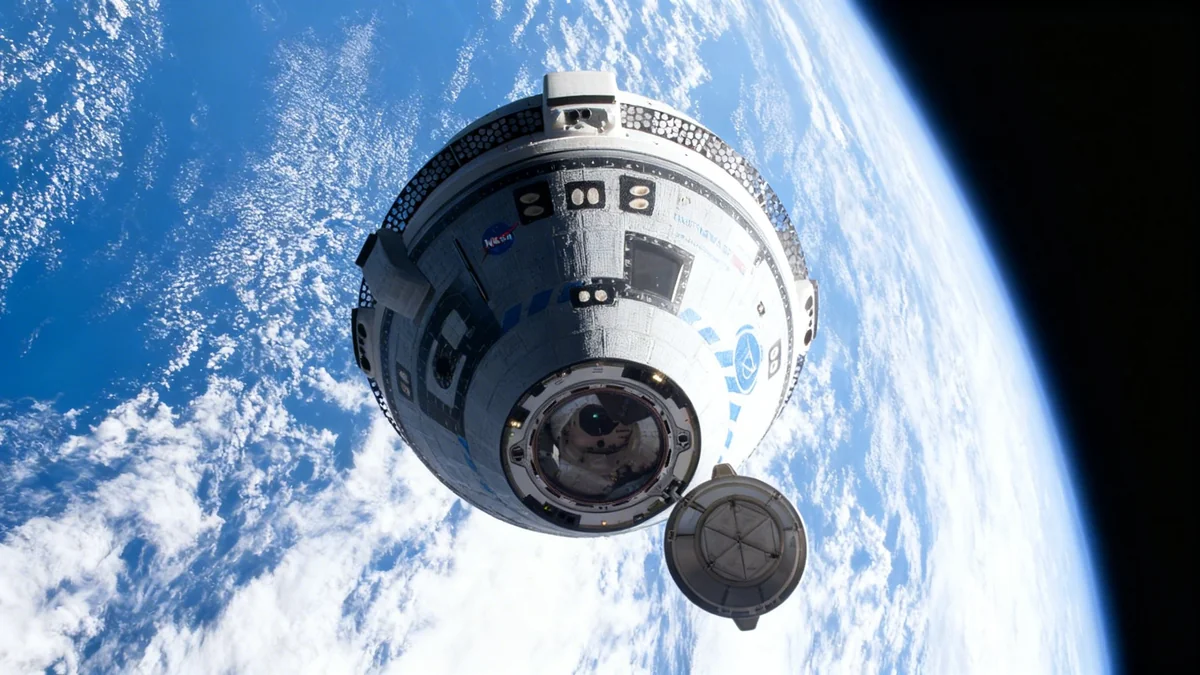


NASA has officially reclassified the first astronaut flight of Boeing's Starliner spacecraft as a "Type A mishap," the most severe safety designation used by the agency. The decision follows an in-depth review of the mission, which experienced multiple critical failures, including thruster malfunctions and a temporary loss of flight control.
The designation places the June 2024 mission, known as the Crew Flight Test (CFT), in the same category as the tragic space shuttle Challenger and Columbia disasters. During a press conference, NASA Associate Administrator Amit Kshatriya acknowledged the gravity of the situation, stating, "We almost did have a really terrible day."
Key Takeaways
- NASA has designated Boeing's first crewed Starliner mission as a "Type A mishap," its most serious classification.
- The mission experienced multiple thruster failures and a temporary loss of controlled flight while en route to the International Space Station.
- Astronauts Suni Williams and Butch Wilmore were stranded on the ISS for nine months before returning on a SpaceX capsule.
- NASA officials admitted that concern for the Starliner program's reputation influenced the initial, less severe assessment of the mission's problems.
Understanding the 'Type A' Designation
NASA categorizes incidents into five levels, from minor "close calls" to the most critical "Type A mishaps." This highest level is reserved for events that involve a fatality or total loss of a vehicle, cause at least $2 million in damages or unplanned costs, or include an unexpected "departure from controlled flight."
The Starliner CFT mission met multiple criteria for this classification. The spacecraft suffered numerous thruster failures on its way to the International Space Station (ISS) and briefly lost its ability to maintain its correct orientation and trajectory, a state known as "six degree of freedom" control.
NASA's Mishap Classification System
The agency uses a tiered system to investigate and learn from incidents:
- Type A: The most serious, involving loss of life, vehicle, or damages exceeding $2 million.
- Type B: Involves damages between $500,000 and $2 million.
- Type C: Involves damages between $50,000 and $500,000.
- Type D: Involves damages between $1,000 and $50,000.
- Close Call: An event with the potential for severe consequences that was narrowly avoided.
While flight controllers managed to recover the spacecraft and successfully dock with the ISS, the severity of the in-flight anomalies prompted the formal reclassification after a thorough investigation.
A Mission Plagued by Technical Failures
The Crew Flight Test launched on June 5, 2024, carrying veteran NASA astronauts Suni Williams and Butch Wilmore on what was planned as a 10-day mission. Problems emerged shortly after leaving Earth's atmosphere.
Multiple thrusters on the Starliner's service module failed to operate as expected, which are critical for maneuvering the capsule in space. This was followed by the temporary loss of flight control, a serious event that challenged the mission's flight rules. NASA Administrator Jared Isaacman addressed the near-miss in a letter to agency employees.
"It is worth restating what should be obvious: At that moment, had different decisions been made, had thrusters not been recovered, or had docking been unsuccessful, the outcome of this mission could have been very, very different."
After reaching the ISS, the mission was extended several times as engineers on the ground worked to understand the thruster issues. Ultimately, NASA made the difficult decision that it was not safe for Williams and Wilmore to return to Earth aboard the Starliner. The capsule was brought back uncrewed on September 6, and even its departure was not without incident, experiencing what was described as an "unexpected crew module propulsion failure."
An Extended Stay in Orbit
The original 10-day mission for astronauts Suni Williams and Butch Wilmore turned into a nine-month stay aboard the International Space Station. They eventually returned to Earth in March of the following year aboard a SpaceX Crew Dragon capsule. Both astronauts have since retired from NASA.
A Culture of 'Programmatic Advocacy'
One of the most significant findings from NASA's review was the admission that its own internal culture contributed to the risk. Initially, the agency did not classify the mission as a Type A mishap, a decision that has now been reversed.
Administrator Isaacman stated that the initial judgment was clouded by a desire to protect the program's image and push for Starliner's certification for regular crewed flights.
"Concern for the Starliner program's reputation influenced that decision," Isaacman said. "Programmatic advocacy exceeded reasonable balance and placed the mission, the crew and America's space program at risk... This created a culture of mistrust that can never happen again, and there will be leadership accountability."
The reclassification to a Type A mishap is part of an effort to correct the record and ensure a more transparent and safety-focused approach moving forward. An independent team was chartered in February 2025 to investigate the mission, and its findings were recently made public.
The Future of Starliner and Commercial Crew
The Starliner program is a key part of NASA's Commercial Crew Program (CCP), which aims to have at least two independent American spacecraft capable of carrying astronauts to the ISS. SpaceX has been successfully flying missions with its Crew Dragon capsule since 2020, and Boeing's Starliner is intended to provide critical redundancy.
However, Starliner will not fly astronauts again until the root causes of the thruster failures are fully understood and resolved. NASA and Boeing are continuing their joint investigation into the propulsion system issues.
While the spacecraft may be grounded for crewed missions for the foreseeable future, it is currently scheduled to fly an uncrewed cargo mission to the ISS as early as this April. This flight will serve as another test for the vehicle and its systems before NASA considers putting astronauts back on board.
Despite the setbacks, NASA remains committed to having multiple providers for crew transport to low Earth orbit. This capability is seen as essential not only for the remaining years of the ISS, which is set to be retired in 2030, but also for supporting the future commercial space stations that are expected to follow.