


In a landmark achievement for renewable energy, researchers have successfully demonstrated the ability to collect solar power in orbit and wirelessly transmit it to Earth. This breakthrough, part of a Caltech-led mission, validates a concept that could one day provide continuous, clean energy to the planet, unaffected by weather or time of day.
The Space Solar Power Demonstrator (SSPD-1), launched in early 2023, confirmed that key technologies for harvesting and beaming energy from space are viable. The success marks a pivotal moment in the decades-long quest to turn a science fiction concept into a practical solution for global energy needs.
Key Takeaways
- Caltech's SSPD-1 mission successfully transmitted detectable solar energy from orbit to a receiver on Earth for the first time.
- Space-based solar power aims to overcome the limitations of terrestrial solar farms, such as nighttime and cloud cover, by collecting sunlight 24/7.
- The experiment validated three core technologies: lightweight deployable structures, efficient solar cells, and wireless power transmission.
- While still in its early stages, this proof of concept paves the way for future development of gigawatt-scale orbital power plants.
A Decades-Old Idea Takes Flight
The concept of collecting solar energy in space is not new. It was first seriously proposed in 1968 by engineer Peter Glaser, who envisioned massive solar arrays in geostationary orbit. These arrays would capture uninterrupted sunlight, convert it into microwaves, and beam the energy to large receiving stations on the ground.
For decades, the idea remained largely theoretical. The astronomical cost of launching heavy materials into orbit, coupled with technological limitations in wireless power transfer, made the concept seem impractical. Agencies like NASA and Japan's JAXA explored the idea, but the financial and technical hurdles were too high to overcome.
What Changed?
Recent advancements have drastically altered the feasibility of space-based solar power. The development of reusable rockets has significantly lowered launch costs. Simultaneously, innovations in lightweight, flexible solar materials and more efficient wireless energy transmission have brought the long-held dream within reach.
These parallel developments created the perfect conditions for a new generation of researchers to revisit Glaser's original vision, leading directly to the current experimental missions designed to test the core principles in a real-world space environment.
The Caltech Mission: A Critical First Step
To move from theory to practice, the California Institute of Technology (Caltech) developed the Space Solar Power Demonstrator (SSPD-1). Launched in January 2023 aboard a Vigoride spacecraft, the 50-kilogram prototype was not designed to generate massive amounts of power but to test three distinct and crucial technologies.
The SSPD-1 project is a critical proof of concept, providing the foundational data and operational experience needed to design and build much larger, commercially viable systems in the future. The mission's success is measured not in kilowatts generated, but in lessons learned.
Testing the Core Components
The SSPD-1 payload consisted of three main experiments, each tackling a different challenge of space-based solar power:
- DOLCE (Deployable on-Orbit ultra-Lightweight Composite Experiment): This tested the deployment mechanism for a 6-by-6-foot structure that would support the solar arrays. While the team encountered a minor jamming issue, it provided invaluable data for designing more robust systems for future, larger structures.
- ALBA: This component carried 32 different types of photovoltaic cells to evaluate which designs are most effective and resilient in the harsh environment of space. The results are helping scientists select the optimal technology for future missions.
- MAPLE (Microwave Array for Power-transfer Low-orbit Experiment): The centerpiece of the mission, MAPLE is a flexible array of microwave power transmitters. Its goal was to demonstrate, for the first time, the wireless transmission of energy in space.
A Historic Transmission
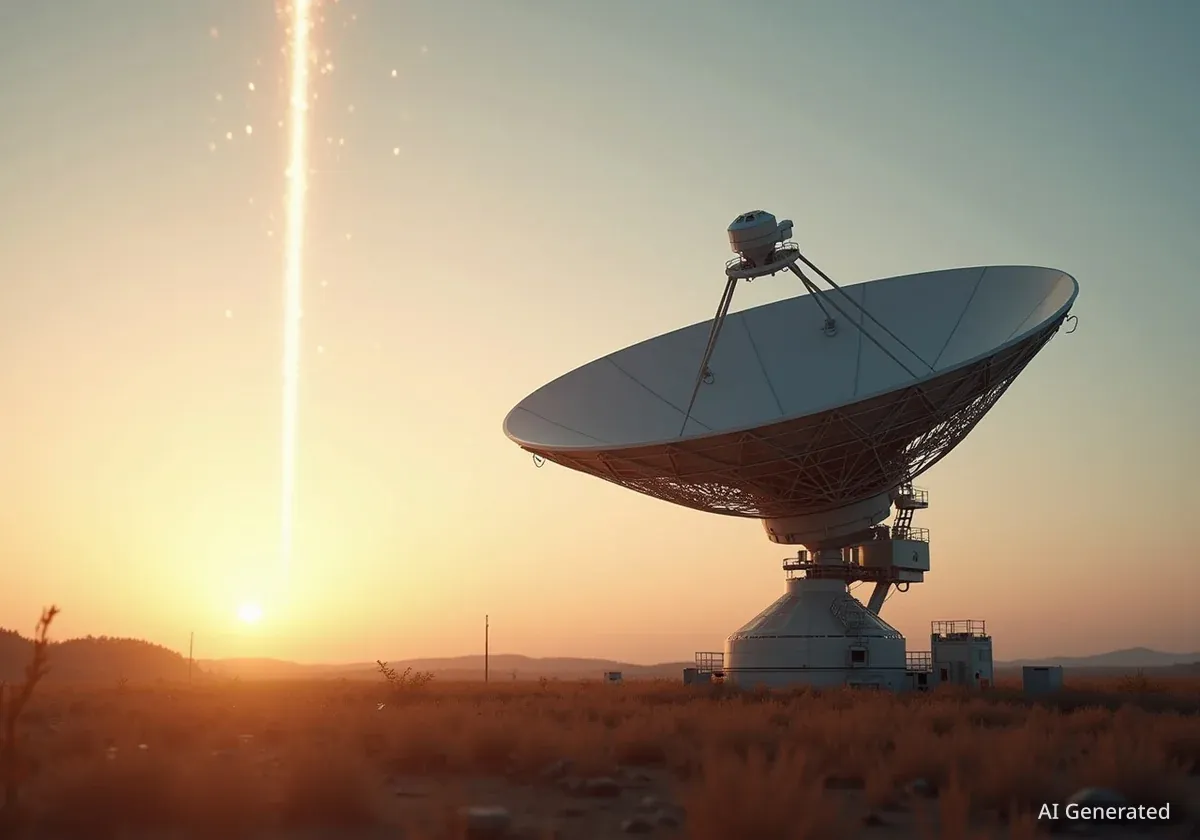
The MAPLE experiment successfully collected solar power, converted it into microwaves, and beamed a detectable amount of energy to the Gordon and Betty Moore Laboratory of Engineering on Caltech's campus in Pasadena, California. This marked the first time energy had been wirelessly transmitted from orbit and detected on Earth.
Implications for a Clean Energy Future
The success of the SSPD-1, particularly the MAPLE experiment, is a monumental step forward. It proves that the fundamental physics of beaming power from space works. While the energy transmitted was small, it provides the validation needed to attract further investment and research into scaling up the technology.
"To the best of our knowledge, no one has ever demonstrated wireless energy transfer in space, even with expensive rigid structures. We are doing it with flexible lightweight structures and with our own integrated circuits. This is a first."
The primary advantage of space-based solar power is its consistency. An orbital power plant could generate electricity 24 hours a day, 7 days a week, regardless of weather, seasons, or time of day on the ground. This would provide a source of constant, reliable baseload power that other renewables like wind and terrestrial solar cannot currently offer without massive energy storage solutions.
The Path to Gigawatt-Scale Power
The journey from this small-scale demonstrator to a full-fledged orbital power plant is long and filled with challenges. Scientists and engineers must now work on increasing the efficiency of power transmission, designing massive yet lightweight structures that can be assembled in orbit, and further driving down launch costs.
Future designs envision modular power plants, assembled over time by robots, that could span several square kilometers. These gigawatt-scale stations would beam energy to large, circular receiving pads in remote areas on Earth, which would then feed the electricity into the national grid.
While it may be years or even decades before our homes are powered by energy from space, the successful test of SSPD-1 has transformed the concept from a distant dream into a tangible goal for the future of clean energy.