
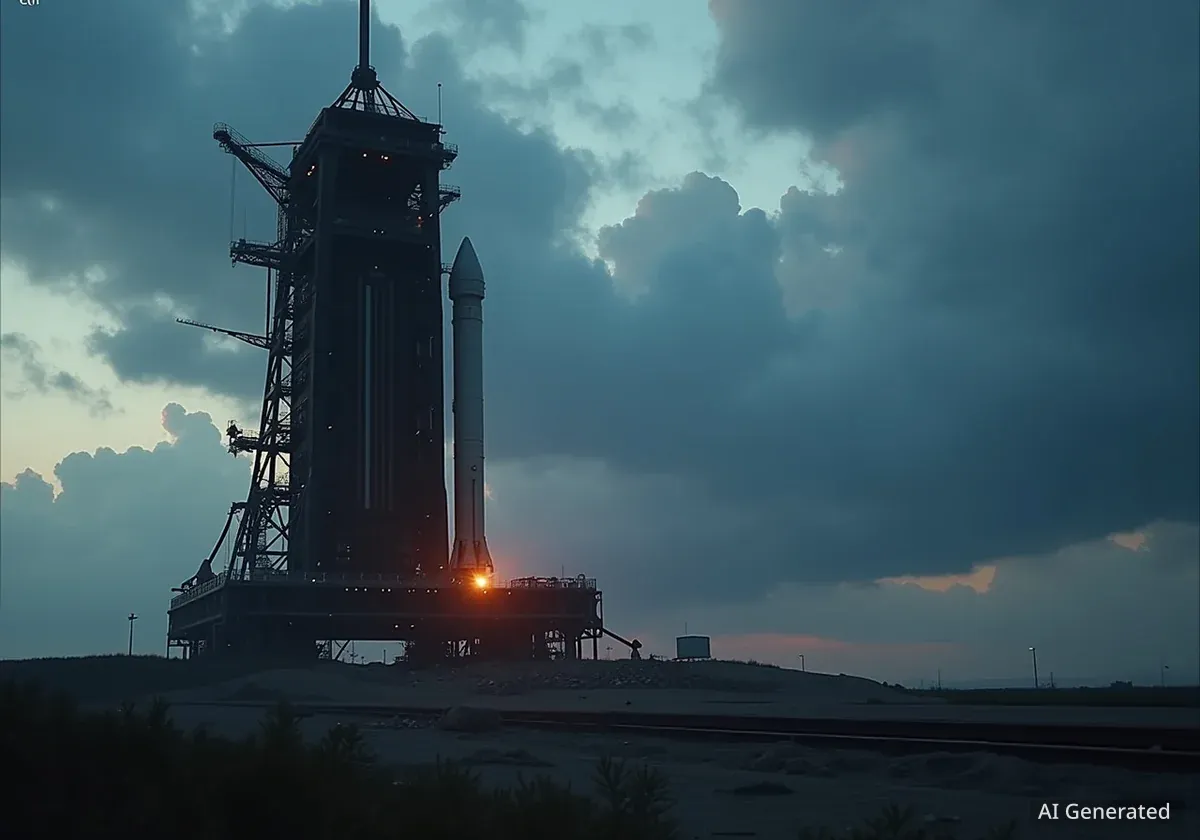


Russia's ability to launch crews to the International Space Station (ISS) has been suspended indefinitely following a major accident at the Baikonur Cosmodrome on November 27, 2025. A critical piece of ground support equipment was destroyed moments after a successful Soyuz launch, rendering the nation's only crew-capable launch pad unusable.
While the crew of Soyuz-MS28 arrived safely at the ISS, the Russian space agency, Roscosmos, now faces a significant operational crisis. The incident has halted all planned Soyuz and Progress missions from the site, creating uncertainty for future ISS crew rotations and cargo deliveries.
Key Takeaways
- A 130-metric-ton mobile maintenance cabin at Baikonur's Site 31/6 was destroyed during a launch on November 27th.
- This was Russia's only launch pad capable of sending crew and cargo to the International Space Station.
- All upcoming Soyuz crew and Progress cargo missions are now postponed, with repair estimates ranging from months to several years.
- The accident compounds existing pressures on Roscosmos, which has faced international sanctions and loss of commercial contracts since 2022.
Launch Success Followed by Ground Failure
The Soyuz-MS28 mission began without issue, lifting off from Launch Site 31/6 at 09:27 UTC. The crew, consisting of cosmonauts Sergey Kud-Sverchkov and Sergei Mikayev, along with NASA astronaut Christopher Williams, successfully docked with the International Space Station a few hours later. They are reported to be in good health and have begun their mission aboard the orbiting laboratory.
However, post-launch inspections revealed a catastrophic failure on the ground. Drone footage showed the 8U216 mobile maintenance cabin, a massive 130-metric-ton platform, lying inverted and severely damaged in the flame trench approximately 20 meters below the launch pad.
This cabin is essential for pre-launch preparations, allowing technicians to service the Soyuz rocket's engines. Initial assessments suggest that a pressure differential created during liftoff pulled the structure from its storage nook. Investigators are examining whether the locks meant to secure the cabin failed or were not properly engaged before the launch.
Roscosmos Acknowledges Damage
In a statement released via the Telegram messaging app, Roscosmos confirmed the incident while focusing on the success of the crewed launch. "The space rocket launched without incident. The spacecraft successfully docked with the International Space Station," the agency stated. "Damage to several launch pad components was identified. Damage can occur after launch, so such inspections are mandatory worldwide."
"The condition of the launch pad is currently being assessed. All necessary spare components are available for repair, and the damage will be repaired shortly."
Despite the agency's assurances, external experts believe the timeline for recovery could be extensive. The maintenance cabin, which dates back to the 1960s, appears to be damaged beyond repair. A full replacement is considered the most likely scenario, a process that could take years.
Baikonur Site 31/6
Launch Site 31/6 has been a workhorse for the Russian space program, supporting launches of the R-7 family of rockets, including the Soyuz, for decades. Its failure represents a critical single point of failure for Russia's access to the ISS.
A Logistical Dead End for Russia
The loss of Site 31/6 creates an immediate and severe problem for Roscosmos. It is the only facility currently configured to launch Soyuz rockets on the specific trajectory required to reach the International Space Station.
Russia operates other launch sites, but none offer a simple alternative:
- Plesetsk Cosmodrome: Located in northern Russia, it is primarily used for military launches into polar orbits and cannot reach the ISS's orbital inclination.
- Vostochny Cosmodrome: While modern, Russia's far-eastern spaceport is not yet equipped for crewed Soyuz launches and would require significant modifications even for cargo missions to the ISS.
- Gagarin's Start (Site 1/5): The historic pad at Baikonur from which Yuri Gagarin launched is not operational for crewed missions.
This leaves Roscosmos with no viable options for launching its own personnel or resupply vehicles to the space station. The next scheduled cargo mission, Progress MS-33, planned for December 21, 2025, has been postponed. The next crewed flight, Soyuz MS-29, scheduled for July 14, 2026, is now in serious doubt.
A Program Under Pressure
This operational failure comes at a difficult time for Roscosmos. Since 2022, the agency has been impacted by international sanctions that have led to the loss of lucrative commercial launch contracts and the termination of several joint scientific missions with NASA and the European Space Agency (ESA). This includes the ExoMars rover and the Venera-D Venus mission, severely curtailing Russia's interplanetary science ambitions.
The Path to Recovery
The recovery timeline is the subject of considerable debate. While Roscosmos claims to have the necessary spare parts, the complexity of the task is immense. If the cabin must be entirely rebuilt or a replacement must be sourced from another site—such as dismantling a similar structure at the Plesetsk Cosmodrome—the process could extend for three years or more.
Before any crew can launch from Site 31 again, a lengthy process must be completed:
- A full inspection of the launch pad for any additional structural damage.
- Removal of the destroyed 130-ton cabin from the flame trench.
- Installation and integration of a new or refurbished maintenance cabin.
- Extensive testing of all launch pad systems.
- At least one successful uncrewed launch to certify the pad's readiness.
Until this work is complete, Russia's independent access to the International Space Station remains severed. The long-term implications for its participation in the program and its status as a leading space power are now under intense scrutiny.