
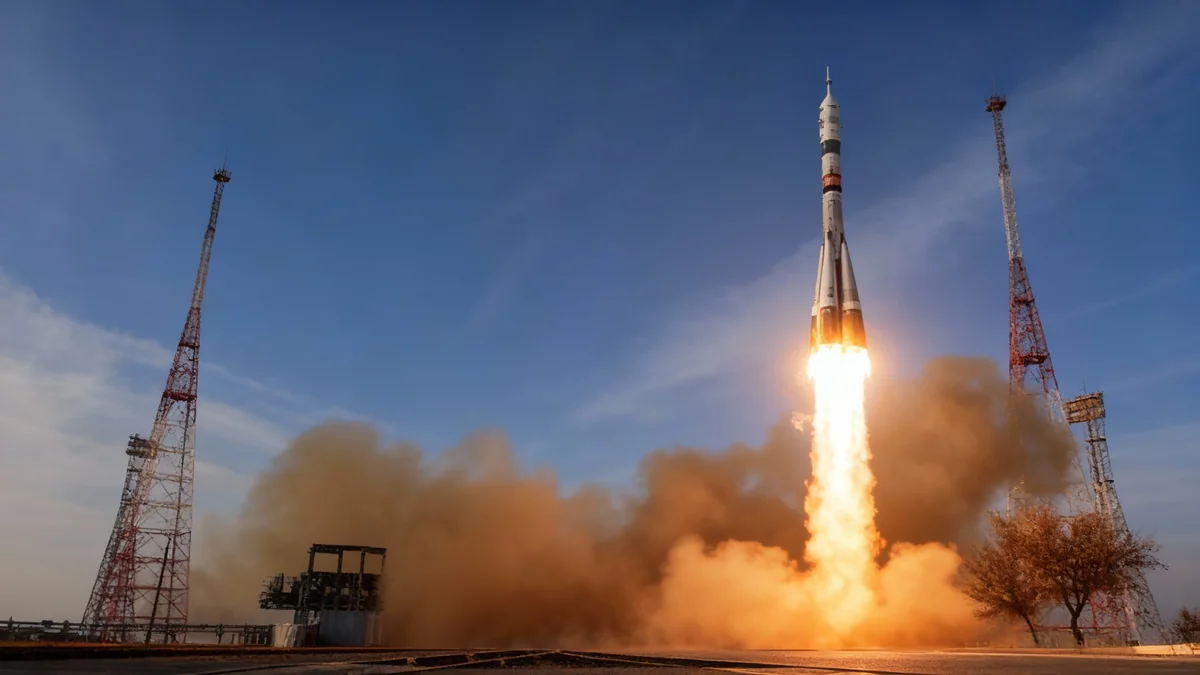


Russia’s ability to launch astronauts to the International Space Station (ISS) is now on indefinite hold following a significant incident at the Baikonur Cosmodrome in Kazakhstan. During a recent Soyuz rocket launch, a crucial service platform was dislodged by the rocket's exhaust, falling into the flame trench below and sustaining heavy damage.
While the rocket itself successfully delivered three astronauts to the station, the damage to the launchpad infrastructure has rendered it inoperable. This single pad has been the exclusive gateway for all Russian crewed and cargo missions to the ISS since 2019, creating a critical bottleneck in space station operations.
Key Takeaways
- A service platform at Russia's primary ISS launchpad in Baikonur was severely damaged during a recent Soyuz liftoff.
- The incident has suspended Russia's independent capability to launch humans into space for the first time since 1961.
- Upcoming resupply missions carrying essential propellant for the ISS are now delayed, raising concerns for long-term station stability.
- Repair estimates for the damaged launchpad range from six months to over a year, with a full replacement potentially taking longer.
Launchpad Damage Halts Critical Missions
The incident occurred during an otherwise successful launch that carried Russian cosmonauts Sergey Kud-Sverchkov and Sergei Mikaev, along with NASA astronaut Chris Williams, to orbit. However, photographs and video from the site confirmed the aftermath: a mangled service platform lying twisted in the concrete flame trench designed to channel the rocket's immense heat and force.
Anatoly Zak, a respected analyst who operates the website RussianSpaceWeb.com, described the platform as "heavily damaged" and likely destroyed, suggesting it will need to be completely rebuilt. This assessment casts serious doubt on a quick return to service.
Roscosmos, the Russian state space corporation, acknowledged that "damage" occurred at the launch site. In a brief statement, the agency assured that all necessary parts for repairs were available and that the issue would be addressed "in the near future," but provided no specific timeline.
The Only Gateway to Space
Since 2019, the damaged launchpad, known as Site 31/6, has been the sole facility used by Russia for launches to the International Space Station. While Russia has other Soyuz launchpads, they are located at latitudes that are not suitable for reaching the specific orbital inclination of the ISS.
Immediate Impact on the International Space Station
The immediate consequence is the suspension of Russia's human spaceflight program. According to space commentator Vitaly Yegorov, "Russia today lost its ability to launch humans into space, something that has not happened since 1961."
While commercial partners like SpaceX can transport astronauts, a more pressing concern is the supply of propellant for the ISS. The Russian Progress cargo vehicle is the only spacecraft capable of delivering the specific fuel used by the thrusters on the station's Russian segment. These thrusters are essential for maintaining the station's altitude and orientation.
Station Stability at Risk
The ISS constantly loses altitude due to atmospheric drag and requires periodic "reboosts" from docked spacecraft to stay in orbit. The Russian Zvezda module's thrusters perform the majority of these maneuvers, making the Progress resupply missions non-negotiable for the station's long-term survival.
The next Progress cargo launch was scheduled for December 20, but that mission is now indefinitely postponed. NASA issued a statement indicating that the station currently has sufficient capability for attitude control and that there are no immediate impacts. However, a prolonged delay could introduce new risks to station operations.
A System Under Strain
Investigators are exploring the cause of the mishap, with initial speculation pointing towards human error. The service platform is designed to roll into a protective shelter before launch, a procedure secured by manually installed brakes. According to experts, it is possible this routine step, performed over 1,600 times for Soyuz launches, was missed. A mechanical failure has not been ruled out.
This event is the latest in a series of high-profile setbacks for Roscosmos. These include a dramatic launch abort in 2018, a coolant leak on a docked Soyuz capsule in 2022, and the crash of the Luna-25 robotic moon lander in 2023. Some analysts connect these recurring issues to broader challenges facing the Russian program, including resource diversions and international sanctions that complicate supply chains.
"How committed is the Russian leadership to fixing that launchpad and continuing the contributions to the International Space Station program? It’s going to be extremely interesting to see how indeed they respond."
Jeff Manber, Voyager Technologies
Jeff Manber, an official at Voyager Technologies, which is developing private space stations, noted that this incident highlights the fragility of the aging ISS. "This should be a wake-up call," he stated, emphasizing the need for robust planning for the station's future.
Uncertain Path to Recovery
The timeline for repairing the launchpad remains unclear and is a subject of debate among experts. Estimates vary widely, reflecting the complexity of the situation.
- Short-Term Fix (6-12 months): Some Russian analysts believe repairs could be completed within a year if existing hardware can be salvaged.
- Long-Term Rebuild (2+ years): If a new service platform must be manufactured from scratch, the process could take a couple of years.
- Temporary Solutions: Roscosmos might explore using temporary, disposable structures or attempting to adapt components from other, mothballed launchpads at Baikonur.
The repairs are further complicated by the fact that the Baikonur Cosmodrome is located in Kazakhstan, which Russia leases from the former Soviet republic. This arrangement could introduce logistical hurdles to the repair effort.
For now, the global space community watches closely. The reliability of the Soyuz system has been a cornerstone of international space cooperation for decades. The ability of Roscosmos to quickly and effectively respond to this crisis will be a crucial test of the storied program's current capabilities and its future role in space exploration.