
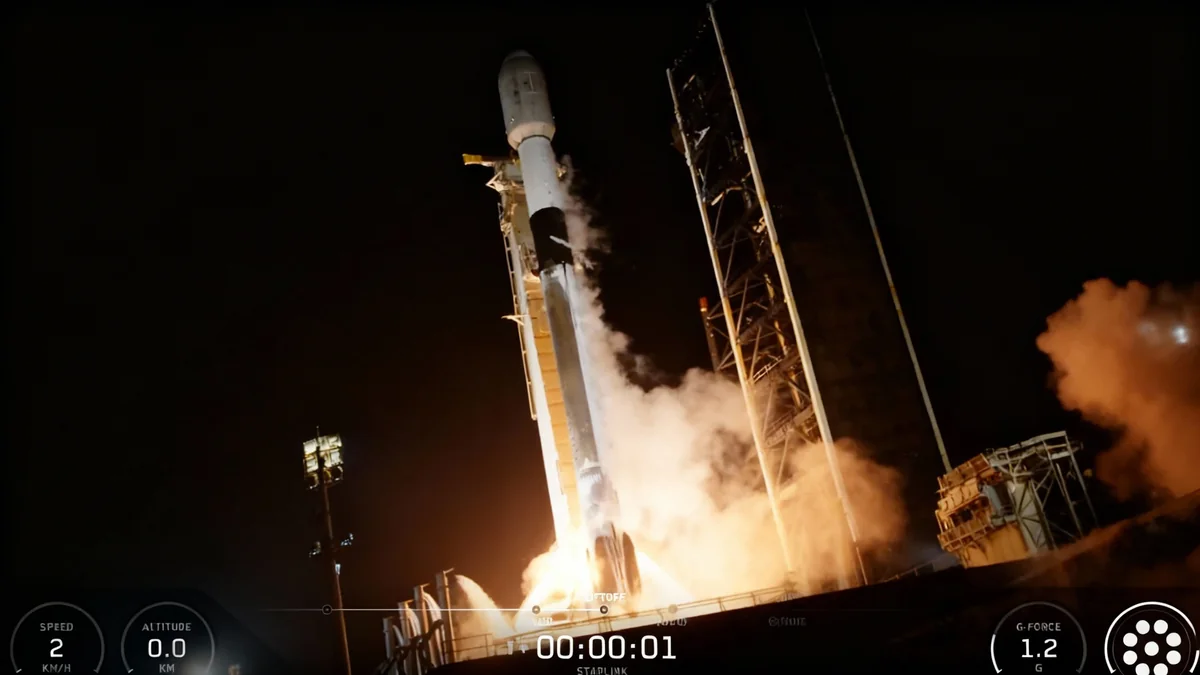


Florida's Space Coast has officially crossed a historic threshold, marking its 100th orbital launch of the year with a SpaceX Falcon 9 mission on Wednesday night. The rocket lifted off from Cape Canaveral Space Force Station, carrying a new batch of Starlink satellites into orbit and cementing 2025 as the busiest year ever for the storied launch site.
The mission, which launched at 10:39 p.m. EST, not only set a new benchmark for Florida's launch cadence but also highlighted SpaceX's continued dominance in the commercial space industry. The successful flight and booster recovery underscore the rapid pace of operations that has become routine for the region.
Key Takeaways
- Florida's Space Coast completed its 100th launch of 2025, a new annual record for the spaceport.
- The milestone mission was a SpaceX Falcon 9 rocket carrying 29 Starlink internet satellites.
- The rocket's first-stage booster successfully landed on a droneship for the 23rd time, demonstrating continued reusability.
- SpaceX is responsible for the vast majority of Florida's launches, having flown over 90 missions from the state this year alone.
A Landmark Liftoff from Cape Canaveral
Under the clear Florida night sky, the Falcon 9 rocket ascended from its launch pad, pushing through the atmosphere on its way to low Earth orbit. The primary goal of the mission was to deploy 29 satellites for SpaceX's Starlink constellation, which provides global internet coverage.
Approximately 8.5 minutes after liftoff, the first stage of the Falcon 9 rocket completed its part of the journey. It performed a controlled descent back to Earth, successfully landing on the automated droneship "Just Read the Instructions" stationed in the Atlantic Ocean. The upper stage continued its trajectory, deploying the satellite payload about 65 minutes after the launch.
The Space Coast's Resurgence
Florida's Space Coast, comprising NASA's Kennedy Space Center and the Cape Canaveral Space Force Station, has experienced a dramatic resurgence in launch activity over the past decade. Once defined by the Space Shuttle program, the region is now the global hub for commercial spaceflight, driven largely by the high volume of missions from companies like SpaceX.
An Unprecedented Pace of Launches
Reaching 100 launches in a single year is a significant achievement for the Space Coast. The rapid succession of missions reflects major advancements in rocket reusability and streamlined launch operations. SpaceX has been the primary driver of this increased tempo, consistently launching missions every few days.
This particular launch was the 149th Falcon 9 mission for SpaceX in 2025. This figure already surpasses the company's previous annual record of 132 Falcon 9 launches, which was set in 2024. With more than a month remaining in the year, that number is expected to climb even higher.
By the Numbers: SpaceX in 2025
- 149: Total Falcon 9 launches this year.
- Over 90: Falcon 9 missions launched from Florida.
- 5: Suborbital test flights of the Starship vehicle from Texas.
While most of the company's launches originate from Florida, SpaceX also operates a launch site at Vandenberg Space Force Base in California. In addition to its Falcon 9 operations, the company has also conducted five test flights of its next-generation Starship rocket from its Starbase facility in South Texas this year.
The Veteran Booster Takes Flight Again
The first-stage booster used in Wednesday's historic mission, designated B1080, is a testament to the success of reusable rocket technology. This was its 23rd successful launch and landing, making it one of the most experienced boosters in SpaceX's fleet.
Its previous missions include a variety of assignments, highlighting its reliability and versatility:
- Transporting private astronauts for Axiom Space missions (Ax-2 and Ax-3).
- Launching the European Space Agency's Euclid space telescope.
- Executing cargo resupply missions to the International Space Station (CRS-30).
- Deploying commercial communication satellites and other Starlink batches.
The ability to reuse first-stage boosters has been a critical factor in reducing the cost of access to space and enabling the high frequency of launches now seen from the Space Coast. Each successful landing and subsequent reuse proves the viability of a model that was once considered purely theoretical, paving the way for an even more active future in space exploration and commerce.