

In an unexpected turn of events, a mission designed to study space weather at Mars has been postponed by the very phenomenon it aims to investigate. Blue Origin's New Glenn rocket, scheduled to carry NASA's twin ESCAPADE probes, was grounded at Cape Canaveral Space Force Station due to a powerful solar storm impacting Earth.
The launch, which was slated for November 12, was called off after officials determined the highly elevated solar activity could pose a risk to the sensitive spacecraft during their journey. This marks the second delay for the mission, following a previous scrub due to terrestrial weather conditions.
Key Takeaways
- Blue Origin's New Glenn launch carrying NASA's ESCAPADE mission has been postponed indefinitely.
- The delay was caused by a severe solar storm, which created concerns for the safety of the spacecraft.
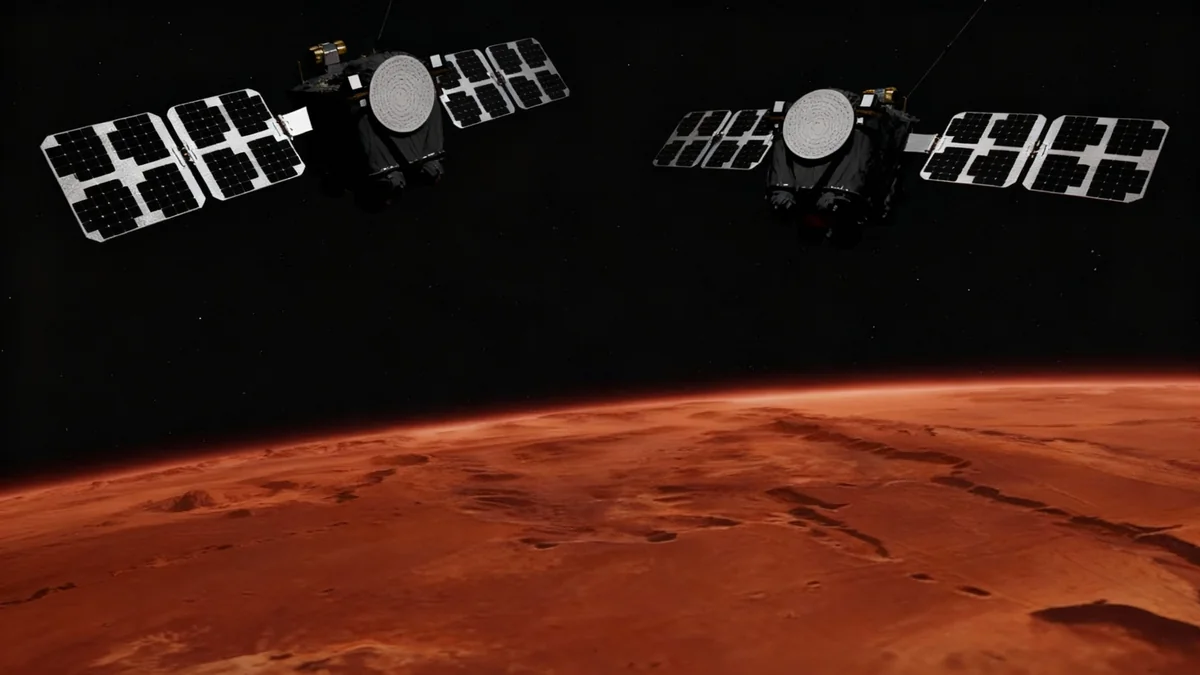
- The ESCAPADE mission consists of twin orbiters designed to study the interaction between the solar wind and Mars' atmosphere.
- This was set to be the second-ever launch of the New Glenn rocket.
- A new launch date is pending improved space weather conditions and range availability.
Launch Scrubbed Amid Intense Solar Activity
Blue Origin confirmed the delay, stating the decision was made in coordination with NASA to protect the mission's hardware. The New Glenn rocket was reported to be ready for its flight from Space Launch Complex-36 in Florida.
"However, due to highly elevated solar activity and its potential effects on the ESCAPADE spacecraft, NASA is postponing launch until space weather conditions improve," the company announced in a statement. This decision underscores the significant challenges that space weather poses not just to operational satellites, but to the process of launching them as well.
The team is now working to find a new launch window. "We are currently assessing opportunities to establish our next launch window based on forecasted space weather and range availability," Blue Origin added. Securing a new slot may involve coordination with the Federal Aviation Administration, which has placed restrictions on daytime commercial launches during the ongoing government shutdown to reduce strain on air traffic control.
The Science Behind the Delay
The solar storm responsible for the launch postponement is one of the most significant of the current solar cycle. It originated from a highly active sunspot group, AR4274, which unleashed a powerful coronal mass ejection (CME) directly toward Earth.
What is a Coronal Mass Ejection?
A CME is a massive eruption of plasma and magnetic field from the Sun's corona. When directed at Earth, these eruptions can interact with our planet's magnetic field, causing geomagnetic storms that can disrupt communications, power grids, and satellite operations. They are also the cause of brilliant auroral displays.
This particular G4-class storm was strong enough to generate stunning aurora borealis displays visible much farther south than usual, including in parts of Mexico and Florida, near the launch site itself. While beautiful, the underlying radiation and plasma present a tangible risk to unshielded or newly launched electronics, which are most vulnerable before reaching their stable operational orbits.
ESCAPADE A Mission to Understand Martian Atmosphere
The delayed mission, officially named the Escape and Plasma Acceleration and Dynamics Explorers (ESCAPADE), is a key part of NASA's small satellite science program. It represents the agency's first dedicated mission to Mars since the launch of the Perseverance rover in 2020.
Built by Rocket Lab, the mission consists of two identical orbiters designed to work in tandem. Their primary objective is to provide a comprehensive, two-point view of how the solar wind strips away Mars' atmosphere over time. This process is believed to be responsible for transforming Mars from a potentially habitable world with liquid water into the cold, dry planet it is today.
Why Study Mars' Atmosphere?
Understanding the mechanisms of atmospheric loss at Mars provides crucial insights into planetary evolution. By studying how the solar wind affects a planet with a weak global magnetic field like Mars, scientists can better model the conditions that make a planet habitable and how that habitability can be lost over geological timescales.
The twin spacecraft will measure magnetic fields, plasma, and various particles to create a detailed 3D map of the Martian magnetosphere. This data will help scientists answer long-standing questions about the Red Planet's climate history and its potential for past life.
A Major Flight for New Glenn
The postponement is also a significant event for Blue Origin's launch program. This mission was scheduled to be the second flight of the company's heavy-lift New Glenn rocket, a vehicle designed to compete in the commercial, civil, and national security launch markets.
A successful launch of the ESCAPADE mission would have been a major milestone, demonstrating the rocket's capability and reliability for interplanetary science missions. As the solar cycle continues to ramp up toward its peak, the interplay between launch schedules and space weather will likely become an increasingly important factor for all space-faring entities.
For now, the twin Mars probes will remain on Earth, waiting for a calmer period in our star's activity before they can begin their journey to study the very same phenomena at another world.