
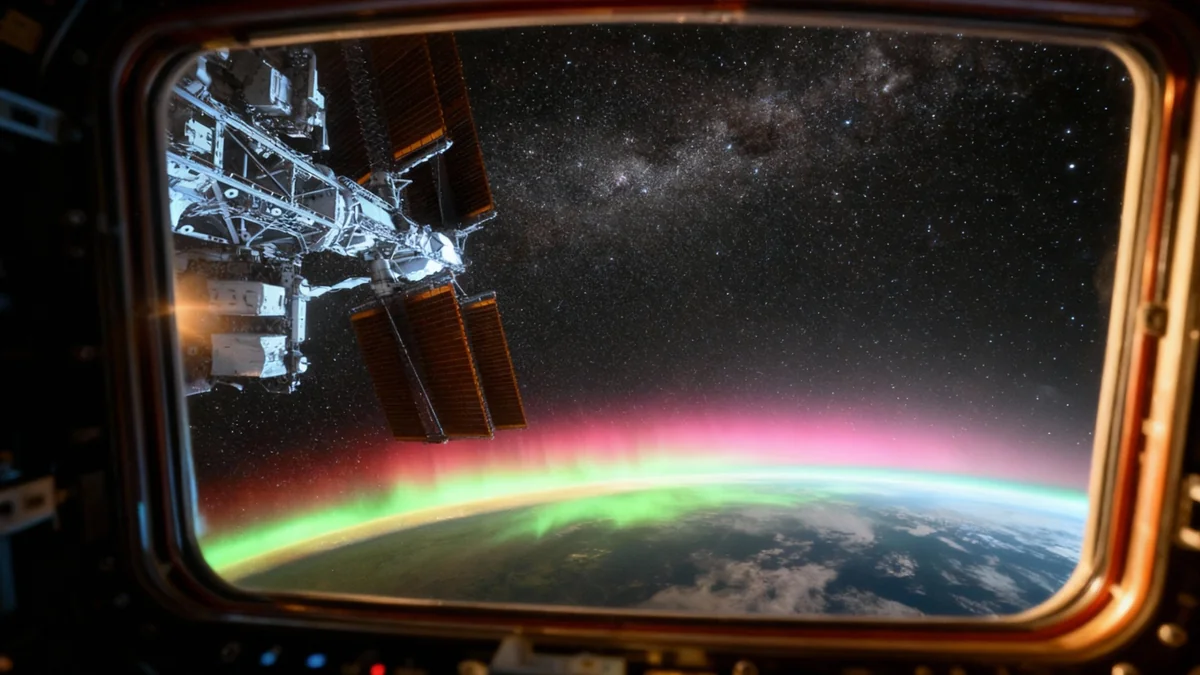



An astronaut from the Japan Aerospace Exploration Agency (JAXA) has captured a remarkable photograph of an aurora from the International Space Station (ISS). Kimiya Yui, an Expedition 73 flight engineer, shared the image on October 14, 2025, offering a rare public glimpse into life aboard the orbiting laboratory while official NASA updates are paused.
The image, taken from the station's Japanese 'Kibo' module, showcases a vibrant green and red aurora dancing above Earth's horizon, set against the backdrop of the Milky Way galaxy. The photo provides a unique perspective due to an unusual orientation of the space station at the time.
Key Takeaways
- JAXA astronaut Kimiya Yui took a photograph of an aurora and the Milky Way from the ISS.
- The image was captured from the 'Kibo' laboratory window during an unusual station orientation.
- Yui is also preparing for the arrival of Japan's first next-generation HTV-X cargo vehicle.
- The ISS currently hosts a seven-member international crew from NASA, Roscosmos, and JAXA.
A Unique Orbital Perspective
Kimiya Yui shared his enthusiasm for the photograph through a social media post, describing the sight as one of the most stunning views he has witnessed from space. The image was made possible by a temporary change in the space station's attitude, or orientation, relative to Earth.
"Isn't this one of the top five stunning views among all the photos taken from the 'Kibo' window?" Yui posted. "The ISS took on a different posture than usual, so the view from the window changed as well."
The post included two distinct images. One prominently features the colorful aurora, while the other captures a clearer view of the Milky Way against the dark expanse of space. Both photographs show parts of the space station, including its large solar arrays and the Kibo exposed facility, in the foreground.
According to Yui, he prioritized his work to ensure he had time to document the rare visual event. "[It was a] special view that I wanted everyone to see, so I pushed through my work early to make time and took this photo," he explained.
Science and Logistics Continue in Orbit
Despite a temporary halt in public communications from NASA due to a U.S. government shutdown, scientific research and operational tasks continue uninterrupted aboard the ISS. Yui's activities this week have focused on preparations for a significant logistics milestone for Japan's space program.
The HTV-X Cargo Vehicle
The HTV-X, also known as the H-II Transfer Vehicle-X, is a new uncrewed cargo spacecraft developed by JAXA. It is designed to be a more cost-effective and capable successor to the original HTV 'Kounotori' vehicle, which completed its final mission in 2020. The HTV-X1 is the inaugural flight of this new series.
Yui is preparing to operate the station's robotic arm, Canadarm2, to capture the first next-generation HTV-X cargo vehicle. The uncrewed resupply ship, designated HTV-X1, is scheduled to launch on Monday, October 20, 2025.
Once the spacecraft approaches the station, Yui will maneuver the 17-meter-long robotic arm to grapple it, allowing ground controllers to guide it to a berthing port. In a message to the vehicle still on Earth, Yui wrote, "I'm waiting for you! I'll catch you gently, so don't worry!"
Current Status of the International Space Station
As of October 17, 2025, the International Space Station is home to a crew of seven astronauts and cosmonauts. The multinational team is essential for conducting experiments, performing maintenance, and ensuring the continuous operation of the orbiting laboratory.
ISS by the Numbers (as of Oct. 17, 2025)
- Current Crew: 7 people
- Commander: Sergey Ryzhikov (Roscosmos)
- Continuous Habitation: 24 years, 11 months, 15 days
- Docked Crew Vehicles: 2 (SpaceX Dragon, Roscosmos Soyuz)
- Docked Cargo Vehicles: 4 (Roscosmos Progress x2, SpaceX Dragon, Northrop Grumman Cygnus)
The Expedition 73 crew is a diverse group representing three international space agencies. The crew members are:
- Roscosmos (Russia): Sergey Ryzhikov (Commander), Alexey Zubritsky, and Oleg Platonov.
- NASA (USA): Jonny Kim, Zena Cardman, and Mike Fincke.
- JAXA (Japan): Kimiya Yui.
Docked Spacecraft
The station currently serves as a busy hub with multiple vehicles attached. Two spacecraft are present for transporting crew:
- SpaceX Dragon "Endeavour": Docked to the Harmony module's zenith (space-facing) port.
- Roscosmos Soyuz MS-27: Docked to the Prichal node's Earth-facing port.
Additionally, four uncrewed cargo vehicles are docked, providing supplies, hardware, and scientific equipment:
- Roscosmos Progress MS-31 (92P): Attached to the Poisk module.
- Roscosmos Progress M-32 (93P): Attached to the Zvezda service module.
- SpaceX CRS-33 Dragon: Docked to the Harmony module's forward port.
- Northrop Grumman NG-23 Cygnus XL: Berthed to the Unity node.
The continuous presence of crew and a fleet of support vehicles underscores the ongoing international collaboration and the complex logistics required to maintain a human presence in low Earth orbit.