
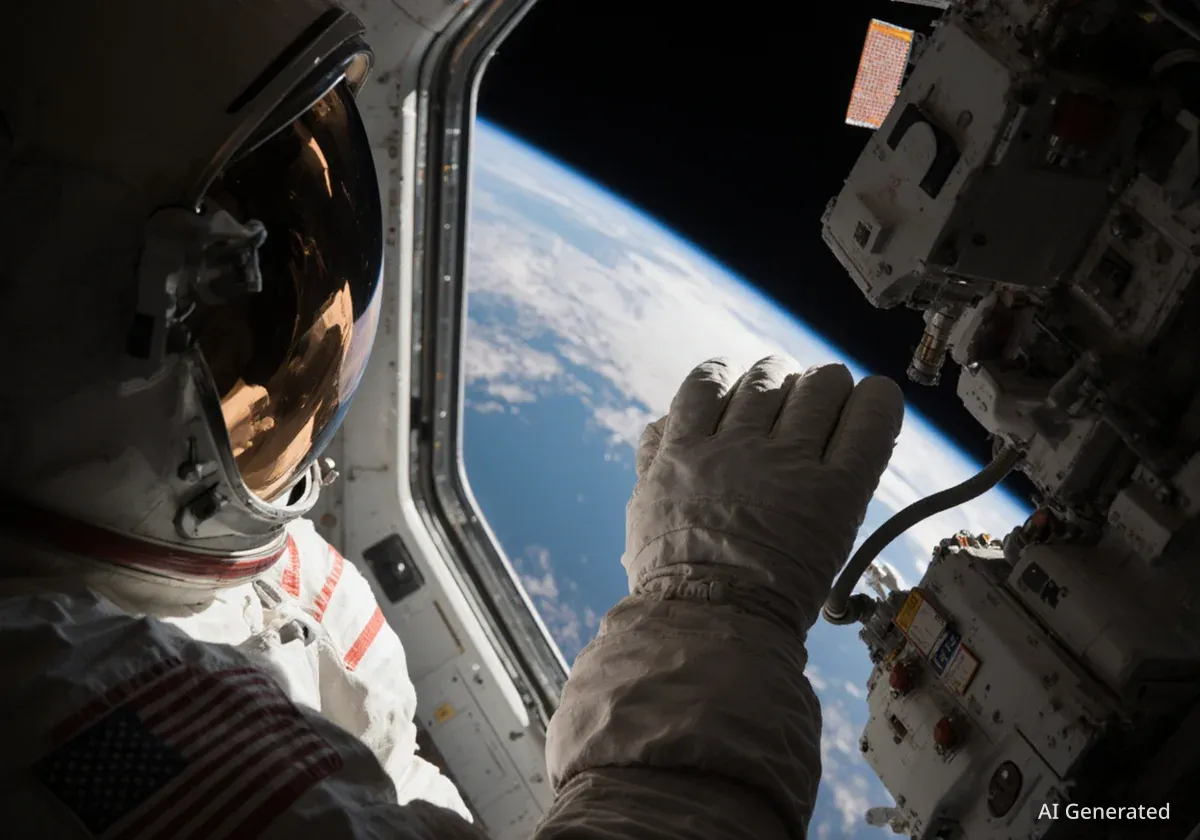



NASA astronaut and marine biologist Jessica Meir has arrived at the International Space Station (ISS) for an eight-month science mission. Leading the SpaceX Crew-12 mission as commander, she and her three crewmates will conduct experiments designed to benefit life on Earth and prepare for future human exploration of the moon and Mars.
The mission marks Meir's second journey into orbit, but her first as a commander, a wife, and a mother. The crew docked with the orbiting laboratory on February 14 after a 34-hour journey from Cape Canaveral, Florida.
Key Takeaways
- NASA astronaut Jessica Meir is serving as commander for the SpaceX Crew-12 mission to the International Space Station.
- The mission will last eight months, focusing on scientific research and technology demonstrations for future deep-space travel.
- This is Meir's second spaceflight, but her first with the added responsibilities of command and being a parent.
- Her research on the ISS will include studies on joint health, mindfulness, and piloting simulations for lunar landings.
A New Command, A New Perspective
Jessica Meir's return to space places her in a new leadership role. As commander of both the Crew-12 Dragon spacecraft and, later, Expedition 75 on the ISS, she holds ultimate responsibility for the mission and her crew. This contrasts with her first flight in 2019, where her focus was primarily on her individual tasks and contributions as a team member.
In her new capacity, Meir is focused on mentoring her crew, which includes two first-time spaceflyers, Jack Hathaway and Sophie Adenot. She has expressed a commitment to ensuring their well-being and professional development, aiming to provide them with a positive and impactful first experience in orbit.
"This time, I am responsible not only for myself, but for the entire crew, as the commander holds ultimate responsibility for the crew and the mission... My primary focus is the well being, camaraderie and development of my crew."
The mission also presents a new personal dynamic for Meir. During her first 205-day mission, she was not yet married or a mother. Now, she leaves behind her husband and three-year-old daughter for the eight-month duration. Meir acknowledged the emotional weight of this separation, noting it will be a significant challenge to miss a substantial portion of her daughter's early life.
She hopes that in the future, her daughter will see herself as part of the adventure and understand the value of the scientific contributions being made.
Science in a Weightless Laboratory
The core purpose of the extended stay aboard the ISS is scientific advancement. Meir and her crew will participate in a wide range of experiments for Expeditions 74 and 75, many of which leverage the unique microgravity environment.
From Antarctica to Orbit
Before becoming an astronaut, Jessica Meir earned a PhD in marine biology from Scripps Institution of Oceanography. Her research focused on the physiology of animals in extreme environments, leading her to study emperor penguins on expeditions to Antarctica. This background in conducting science in challenging conditions proved valuable for her astronaut training.
As a physiologist, Meir is particularly interested in studies examining the human body's response to spaceflight. Key experiments include:
- Cartilage Degeneration: An investigation into joint health in microgravity to better understand conditions like osteoarthritis on Earth.
- Cervical in Space: A study focusing on the effects of weightlessness on the upper spine.
- RelaxPro: Research exploring the potential benefits of mindfulness and meditation for astronauts on long-duration missions.
The crew will also play a crucial role in testing new hardware for future exploration. They are tasked with commissioning the European Enhanced Exploration Exercise Device (E4D), a versatile piece of equipment developed by the European Space Agency for missions to the moon and beyond. The device combines resistive exercise, cycling, rowing, and rope pulling into a single unit.
Furthermore, the crew will participate in the Manual Piloting study, practicing simulated moon landings to gather data on how gravitational transitions affect a pilot's ability to safely land a spacecraft on the lunar surface. This research is a direct contribution to NASA's Artemis program, which aims to establish a sustainable human presence on the moon.
A Legacy of Exploration
Meir's journey from a childhood in rural Maine, inspired by the starry skies, to commanding a mission in orbit highlights a path of dedicated scientific pursuit. Her education at UC San Diego’s Scripps Institution of Oceanography provided a foundation in marine biology and research in extreme environments, qualities that NASA values in its astronaut candidates.
UC San Diego's Astronauts
Jessica Meir is one of several remarkable UC San Diego alumnae who have joined NASA's astronaut corps. Others include Megan McArthur, who helped repair the Hubble Space Telescope; Kate Rubins, the first person to sequence DNA in space; and Deniz Burnham, who earned her astronaut wings in 2024. The university was also the longtime academic home of Sally Ride, the first American woman in space.
During her first spaceflight, Meir made history by participating in the first all-female spacewalk with fellow astronaut Christina Koch. The pair spent over seven hours outside the ISS to replace a faulty battery unit. She has also been selected for NASA’s Artemis program, positioning her as a potential candidate for future lunar missions.
As she embarks on this eight-month expedition, Meir continues a tradition of exploration, pushing the boundaries of scientific knowledge 250 miles above Earth while inspiring a new generation of scientists and explorers back home.