
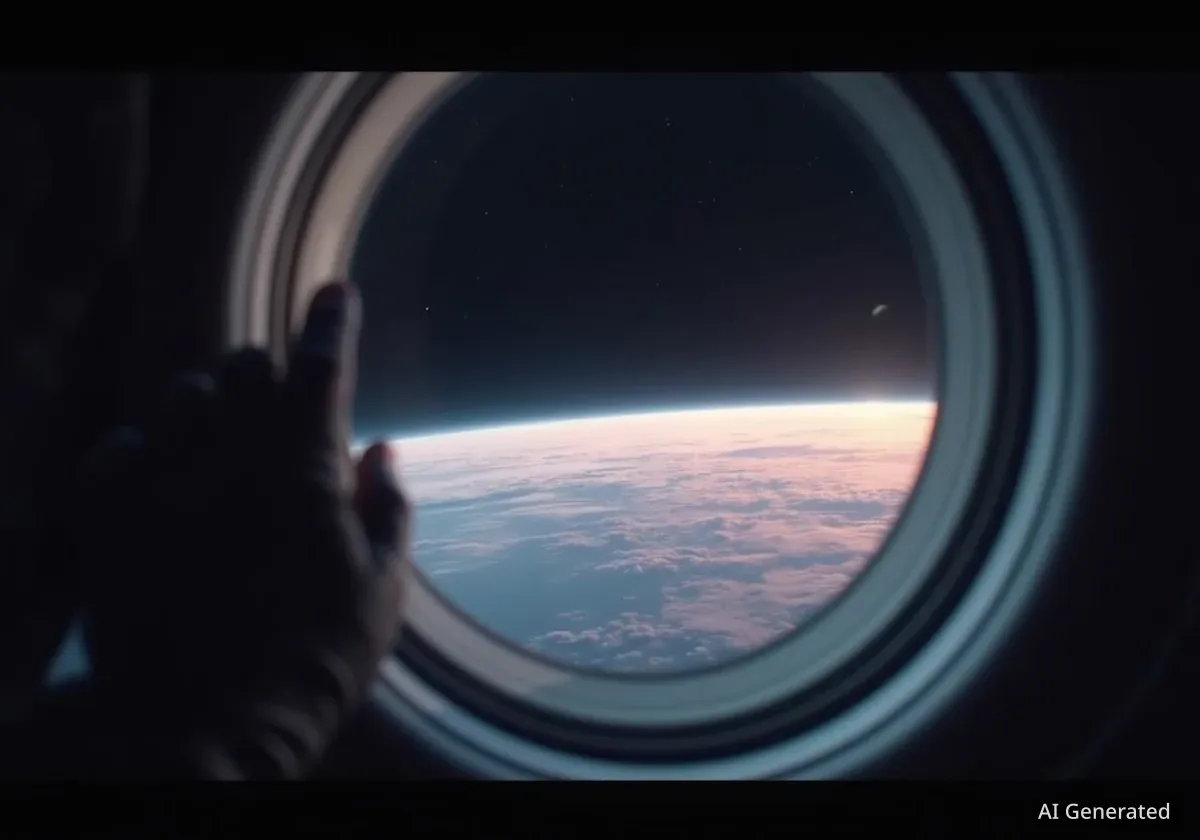

NASA astronaut Donald Pettit has released a remarkable photograph of an atmospheric phenomenon known as the Belt of Venus, captured from his unique vantage point aboard the International Space Station (ISS). The image, taken nearly two decades ago, offers a comprehensive view of the colorful band that appears in the sky during twilight.
Key Takeaways
- NASA astronaut Don Pettit shared a photo of the Belt of Venus taken from the International Space Station.
- The image was captured in 2003 during his first mission to the ISS but was shared recently.
- The Belt of Venus is an atmospheric optical phenomenon visible during twilight, just before sunrise or after sunset.
- From space, the effect is visible in its entirety, showing the pinkish glow above Earth's shadow.
A Veteran Astronaut's Perspective
Donald "Don" Pettit, a chemical engineer and a veteran of multiple spaceflights, is widely recognized for his skill in astrophotography. Throughout his career, he has documented a range of celestial and terrestrial events from orbit, providing the public with images that are often impossible to capture from the ground.
This particular photograph was taken during Pettit's first mission to the orbiting laboratory in 2003. Despite the time that has passed, he noted their value, stating, "they are old but great visuals of the effect." The image provides a clear illustration of the phenomenon from an altitude of approximately 400 kilometers (250 miles).
Who is Don Pettit?
Don Pettit is a NASA astronaut with a Ph.D. in chemical engineering. He has completed three spaceflights and has spent over 370 days in space. Beyond his official duties, he is known for his creative science demonstrations in microgravity, called "Saturday Morning Science," and for his extensive portfolio of Earth and space photography.
Understanding the Belt of Venus
The Belt of Venus is not a celestial object but rather an effect within Earth's own atmosphere. It becomes visible during twilight, the period between sunset and night or between dawn and sunrise. The phenomenon appears as a pinkish or purplish band in the sky, located just above the horizon and opposite the sun.
In a detailed explanation of the photo, Pettit described the mechanics behind the view from space.
"The Belt of Venus, seen from the ISS. An atmospheric phenomena where the setting sun projects light past Earth's horizon curve, layered over its shadow. Twilight observers on Earth see a pink band over the approaching dark, opposite the sun. From orbit we see it all at once."
This orbital perspective allows for a more complete view than what is typically seen from the planet's surface, where the horizon and landscape can obstruct the full effect.
The Science Behind the Colors
The distinct colors of the Belt of Venus are a result of how sunlight interacts with the atmosphere. The pink or reddish hue is caused by the scattering of reddened sunlight from the rising or setting sun. This light is backscattered by the atmosphere toward the observer.
NASA provides a clear explanation of the visual components involved.
How It Works
According to NASA, the blue sky directly overhead is caused by sunlight reflecting off the atmosphere. However, the light in the Belt of Venus is different because it reflects reddened light from the sun as it sits below the horizon. Below this pinkish band, a darker, blue-gray layer can be seen. This is the shadow of the Earth itself, cast upon its own atmosphere.
The combination of these elements creates the layered, colorful display that Pettit's photograph so clearly captures. The distinct separation between Earth's shadow and the illuminated atmosphere above it is a key feature of the phenomenon.
Photography from the International Space Station
Capturing images from the International Space Station presents both unique opportunities and significant challenges. The ISS orbits Earth at a speed of over 28,000 kilometers per hour (about 17,500 miles per hour), completing one full circle of the planet approximately every 90 minutes. This provides astronauts with 16 sunrises and sunsets each day.
This rapid cycle offers frequent chances to photograph transient atmospheric events like the Belt of Venus. However, the high speed requires precise timing and stable camera work to avoid motion blur, especially when creating time-lapse videos, another of Pettit's specialties.
Astronauts on the ISS use a variety of professional-grade digital cameras and lenses, often shooting through the seven windows of the Cupola module, which offers a 360-degree panoramic view of Earth.
Other Atmospheric Sights from Orbit
The Belt of Venus is just one of many stunning atmospheric phenomena that can be observed from space. Astronauts frequently photograph other events, including:
- Aurora Borealis and Aurora Australis: The northern and southern lights, caused by charged particles from the sun interacting with Earth's magnetic field.
- Noctilucent Clouds: Ethereal, silvery-blue clouds that form at very high altitudes and are visible during deep twilight.
- Airglow: A faint emission of light by a planetary atmosphere, which creates subtle bands of color that are often visible in long-exposure photographs from the ISS.
- Lightning Sprites and Elves: Large-scale electrical discharges that occur high above thunderstorm clouds, which are difficult to see from the ground but more easily observed from orbit.
These observations are not just for aesthetic purposes. They provide valuable data for scientists studying Earth's atmosphere, weather patterns, and the interaction between our planet and the sun. Pettit's work contributes to both public engagement with space and scientific understanding, showcasing the beauty and complexity of our world from a truly unique perspective.