


NASA's ESCAPADE mission, a pair of probes now on a long journey to Mars, represents a significant shift in the agency's approach to planetary exploration. Launched on November 13, 2025, the mission aims to study the Martian atmosphere at a fraction of the cost of traditional projects, but this budget-conscious strategy comes with substantial risks.
The twin spacecraft will investigate how the solar wind has stripped away Mars's atmosphere over billions of years. However, as part of a program known for its high failure rate, ESCAPADE's success is far from guaranteed, making it a crucial test case for a new era of space science.
Key Takeaways
- NASA's ESCAPADE mission, comprised of two probes, launched successfully on November 13, 2025, and is en route to Mars.
- The mission's goal is to map Mars's magnetic field and understand atmospheric loss due to solar wind.
- With a budget under $100 million, it is part of the high-risk, low-cost SIMPLEx program, which has a history of mission failures.
- ESCAPADE's success or failure will influence the future of using smaller, commercially-driven missions alongside large-scale flagship projects.
A Calculated Gamble on Mars
The Escape and Plasma Acceleration and Dynamics Explorers, or ESCAPADE, mission is not a typical NASA endeavor. It belongs to the agency's Small Innovative Missions for Planetary Exploration (SIMPLEx) program, an initiative designed to fund projects that are cheaper and can tolerate a higher chance of failure.
This approach stands in stark contrast to flagship missions like the James Webb Space Telescope, which undergo years of exhaustive testing with proven hardware to minimize risk. ESCAPADE is classified as a "Class D" mission, a designation that explicitly accepts high risk in exchange for lower costs and faster development.
The track record for this category is mixed. Of the five SIMPLEx missions selected to date, three have failed after launch due to equipment problems, and another remains in storage indefinitely. This history places significant pressure on ESCAPADE to deliver results.
Understanding NASA's Risk Classes
NASA categorizes its missions on a scale from A to D. Class A missions, like the Europa Clipper, are the highest priority and most expensive, with minimal tolerance for risk. Class D missions like ESCAPADE occupy the other end of the spectrum, allowing for greater use of novel technologies and commercial parts, even if it increases the potential for failure.
The Economics of Austerity in Space
ESCAPADE's estimated cost of $94.2 million through 2029 is a direct result of a series of deliberate cost-saving decisions. The mission relies on a small set of scientific instruments, and its lightweight design reduces launch expenses. The project also made extensive use of commercial off-the-shelf components rather than developing custom hardware.
Key aspects of the mission were outsourced to the private sector. Rocket Lab handled much of the spacecraft development, while Advanced Space LLC designed its complex trajectory to Mars. These contracts were managed with strict budget caps to prevent cost overruns.
Further savings were achieved through partnerships, including a university-funded camera system and a discounted launch aboard Blue Origin's New Glenn rocket. This model reflects a broader trend within NASA, which is facing significant budget constraints and a political shift toward funding human spaceflight programs.
A Troubled Path to Launch
The mission's principal investigator, Rob Lillis, has referred to ESCAPADE as the "mission with 11 lives" after it survived numerous near-cancellations. It overcame challenges ranging from technology readiness issues to losing its original planned ride to space, before finally securing a spot on New Glenn's maiden flight.
Weighing the Scientific Trade-Offs
While the low-cost model allows NASA to fund more projects, it comes with inherent limitations. Missions like ESCAPADE are designed to answer specific, narrowly focused scientific questions. They cannot match the broad, discovery-driven scope of a multi-billion-dollar flagship mission.
For example, the $583 million MAVEN mission was responsible for the foundational discovery of how and when Mars lost its atmosphere. ESCAPADE will build on that knowledge by providing a more detailed picture of the planet's magnetic field and its interaction with the solar wind, but it is unlikely to produce a similarly transformative breakthrough.
"My colleagues and I systematically asked: What do we want to learn? What observations prove it? And, critically, how precisely does the instrument need to work to be 'good enough,' given the budget?" - Ari Koeppel, a scientist who helped develop one of ESCAPADE's camera systems.
Furthermore, flagship projects often drive technological innovation that benefits other industries. The James Webb Space Telescope, for instance, led to advancements in medical tools used for eye exams. Smaller missions typically rely on existing, mature technologies. When private companies build the hardware, they also retain control of the patents, limiting the spread of new technology across the scientific community.
A Stressful Launch and a Long Road Ahead
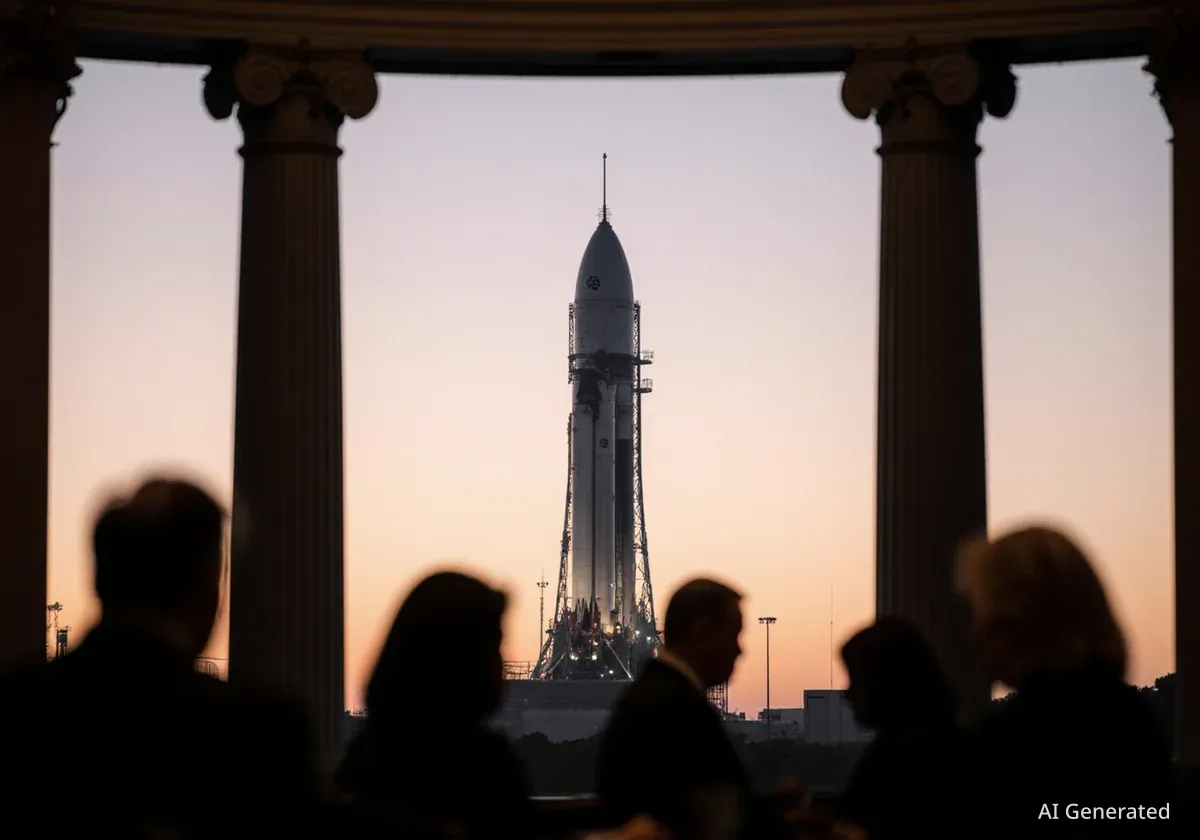
The journey to the launchpad was fraught with tension. The initial launch window on November 13, 2025, was scrubbed due to poor weather and ground equipment issues. A subsequent attempt was delayed by a strong solar storm—the very phenomenon ESCAPADE is designed to study.
After finally lifting off, the mission faced another critical moment. For several hours, controllers struggled to establish contact with the spacecraft due to a misaligned receiver. Communication was eventually established, allowing the twin probes to begin their 30-month journey to the Red Planet.
The mission's success now depends on the durability of its commercial-grade components and the precision of its long-duration flight plan. If the spacecraft arrive safely and begin returning data, they will provide a powerful argument for a more diversified approach to planetary science.
The Future of Planetary Exploration
ESCAPADE is more than just a science mission; it is an experiment in a new way of doing business in space. The growing commercial space sector, with companies like Blue Origin and SpaceX driving down launch costs, is making smaller, targeted missions more economically viable.
A successful outcome for ESCAPADE could validate the idea that a portfolio of ten $100 million missions might yield more diverse science than a single $1 billion project. However, experts caution that this approach is not a replacement for the ambitious, technology-advancing flagship missions that answer humanity's biggest questions about the cosmos.
Ultimately, the future of planetary science may lie in a hybrid model: a fleet of smaller, faster, and cheaper probes exploring specific targets, complemented by a few large-scale, ambitious projects that push the boundaries of what is possible. For now, all eyes are on the two small spacecraft making their lonely way to Mars, carrying with them the potential to reshape our exploration of the solar system.