
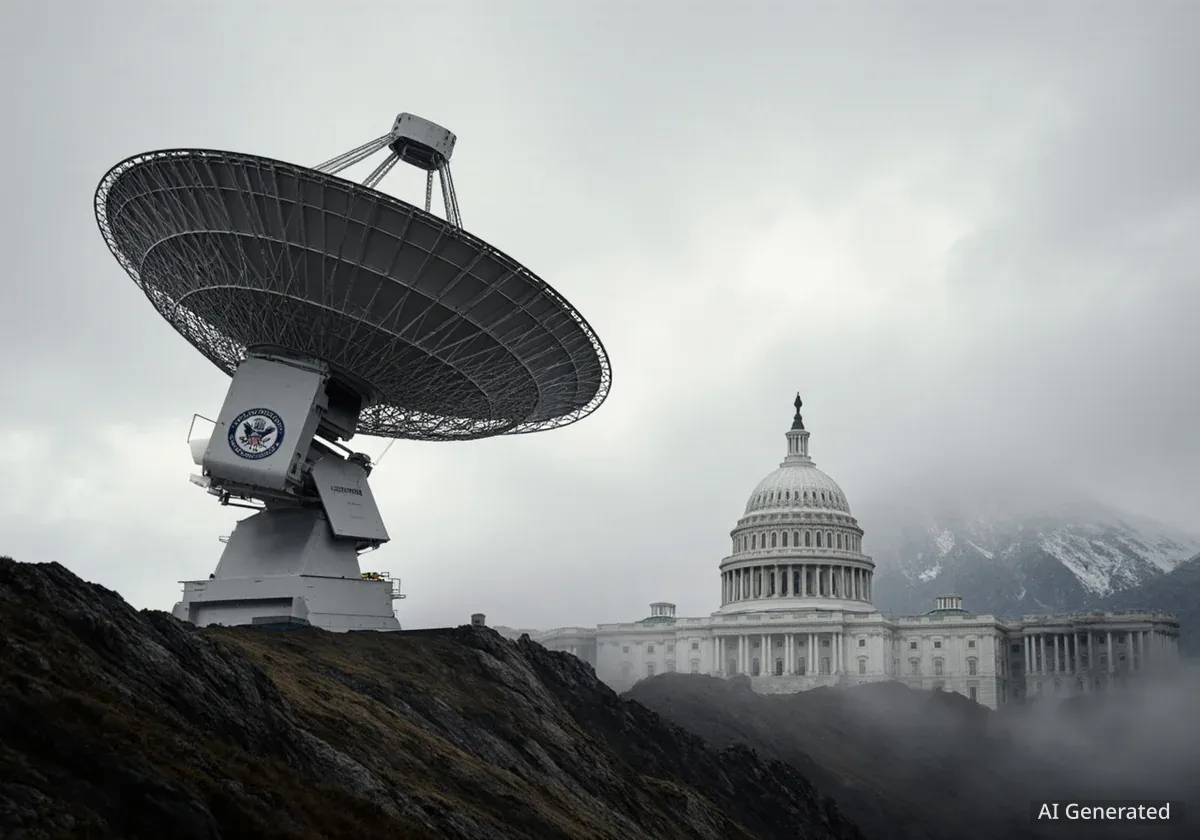




A U.S. House committee has issued a stark warning about a growing network of Chinese space facilities across Latin America, suggesting these sites could serve military intelligence purposes for the People's Liberation Army. The report identifies at least 11 such installations, raising concerns about Beijing's strategic intentions in the Western Hemisphere.
The document, released by the House Select Committee on China, details how facilities presented as scientific endeavors could enhance Beijing's global surveillance and satellite tracking capabilities. This expansion is seen by the committee as a significant challenge to regional and U.S. security interests.
Key Takeaways
- A U.S. House committee report warns of at least 11 Chinese space facilities in Latin America.
- Locations include Argentina, Venezuela, Bolivia, Chile, and Brazil.
- Lawmakers express concern that these sites could be used for military surveillance and intelligence.
- The report highlights China's policy of civil-military fusion, where civilian infrastructure can be used for defense purposes.
- Recommendations include reviewing NASA's cooperation with countries hosting these Chinese facilities.
A Network of Dual-Use Facilities
The committee's report, titled "Pulling Latin America into China's Orbit," argues that a network of ground stations, radio telescopes, and satellite laser ranging sites is being established under the guise of scientific cooperation. These facilities are strategically located in countries including Argentina, Venezuela, Bolivia, Chile, and Brazil.
While the agreements with host nations frame these projects as civilian in nature, the technical capabilities of the infrastructure tell a different story. According to the report, the equipment could be used to intercept signals, improve satellite tracking, and support intelligence-gathering operations for Beijing's defense systems.
This network provides China with crucial ground support for its rapidly expanding satellite constellations. With over 1,000 satellites now in orbit, these Latin American stations allow for continuous communication, data reception, and command transmission as they circle the globe.
Understanding Civil-Military Fusion
A central concern outlined in the report is China's national strategy of civil-military fusion. This policy intentionally blurs the lines between civilian and military sectors, ensuring that commercial and scientific advancements can be leveraged for defense purposes. Under this doctrine, a state-owned aerospace company involved in a scientific project can also be integrated into the country's military ecosystem.
Spotlight on Key Locations
The report highlights several specific sites as points of major concern. Among the most prominent is the Deep Space Station located in Argentina's Neuquén province. Operational since 2018, the facility was built under a 50-year lease agreement that provides China with significant autonomy over its operations.
Argentina's Deep Space Station
The Neuquén station is officially tasked with supporting China's lunar and deep space exploration missions. However, its powerful antennas and tracking capabilities have long drawn scrutiny. The committee suggests that its strategic location and advanced technology make it an ideal asset for monitoring satellites and gathering signals intelligence.
Fact: The Neuquén facility in Argentina is operated under a 50-year lease, giving China long-term strategic access in the region.
Expanding Presence Across the Continent
Beyond Argentina, the committee points to a broader pattern of engagement:
- Venezuela: Facilities such as El Sombrero and Luepa are mentioned as part of this network.
- Bolivia: Ground stations associated with the Túpac Katari communications satellite, which was built and launched by China, are also cited.
- Chile: The report notes projects related to radio astronomy and data processing that involve Chinese entities.
- Brazil: Agreements between Chinese technology companies and local partners are under review for their potential dual-use applications.
Together, these installations form an integrated system that significantly enhances China's global space capabilities. This infrastructure is vital for maintaining control over its extensive satellite network, a key component of modern military and economic power.
Security Implications and Committee Recommendations
The committee frames China's space activities in Latin America as a direct matter of U.S. national security. The reliance of daily American life on satellite technology—from GPS navigation and financial transactions to military communications—makes these systems a potential vulnerability.
"Much of daily American life depends on the satellites above us, and that is why China's space operations are a matter of serious concern," stated Representative John Moolenaar, the committee's chairman.
The panel argues that China's expanding ground infrastructure could give it the ability to monitor, track, and potentially interfere with U.S. and allied satellite operations. This capability is seen as a crucial element in modern warfare and global power projection.
To address these concerns, the report puts forth several recommendations. It urges NASA to conduct a thorough review of any cooperation with Latin American nations that host Chinese space infrastructure. This is to ensure compliance with the Wolf Amendment, a U.S. law that strictly limits bilateral space cooperation with China.
The committee also suggests updating the legislation to close potential loopholes that might allow for indirect cooperation through multilateral agreements. The goal is to prevent U.S. technology or data from inadvertently benefiting China's space program, which the report characterizes as having clear military objectives.