
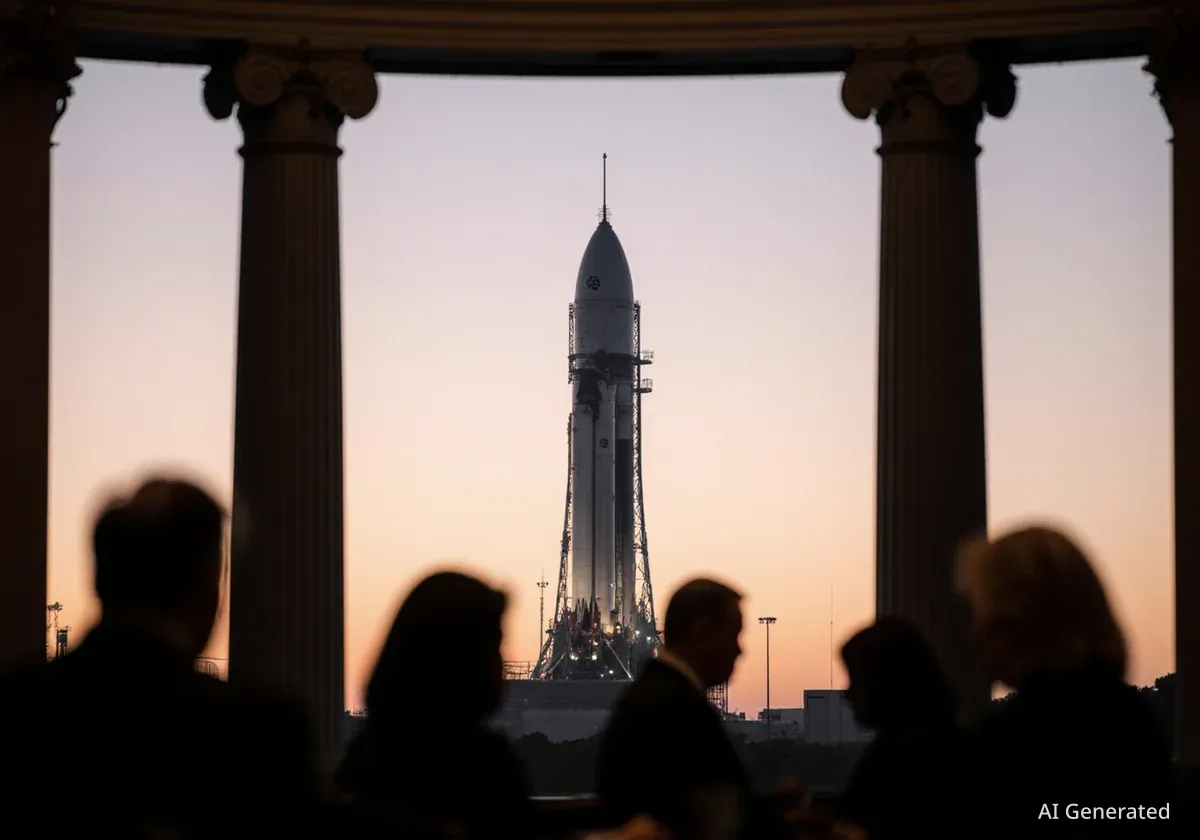


As Florida's Space Coast experiences an unprecedented surge in launch activity, the director of NASA's Kennedy Space Center (KSC) has issued a stark warning to state lawmakers. Janet Petro cautioned that a lack of state investment and a strained relationship with Florida's aerospace agency, Space Florida, could jeopardize the state's long-held position as the world's premier gateway to space.
The friction comes at a critical time, with the historic Artemis II mission preparing for its lunar orbit and commercial traffic from companies like SpaceX and Blue Origin pushing the spaceport's infrastructure to its limits. Launches from the facility have more than tripled in the last five years, yet essential support systems are struggling to keep pace.
Key Takeaways
- Kennedy Space Center Director Janet Petro stated that Florida's leadership in space is "at risk" due to a lack of adequate state support.
- KSC is facing major infrastructure challenges, including the need for updated roads, utilities, and wastewater systems to handle a tripling of launch traffic over five years.
- A significant disagreement exists between NASA's need for direct investment and Space Florida's strategy of forming long-term business partnerships.
- Competitor states like Texas are aggressively investing hundreds of millions directly with NASA, creating a stark contrast with Florida's approach.
A Growing Crisis on the Launchpad
The core of the issue lies in the operational capacity of Kennedy Space Center and the adjacent Cape Canaveral Space Force Station. Together, they form the busiest spaceport on the planet, but the infrastructure supporting this activity is showing signs of strain. Petro described the complex as a small town in need of critical upgrades.
"We have no infrastructure funds to build out the support systems for that," Petro explained, referring to the surge in commercial launches. Seventy percent of the launches from KSC are now commercial, involving 450 separate agreements with private companies operating on federal property.
This boom requires more robust electrical grids, expanded wastewater facilities, and improved roads and bridges. However, NASA's federal budget is allocated for its specific missions, rockets, and facilities, not for general infrastructure projects like public utilities. Such funding typically comes from federal grants available only to state and local governments.
By The Numbers: The Launch Boom
- 3x+: Increase in launches from the spaceport over the last five years.
- 70%: Percentage of launches from KSC that are commercial.
- 450: Number of separate agreements KSC has with private businesses operating on its property.
Petro expressed fears that without state intervention, KSC might have to delay launches simply because the ground support systems cannot handle the pace. "The decisions made within this chamber will determine whether Florida remains the undisputed launch pad of America or becomes a footnote in the history of the new Space Age," she told state lawmakers.
Diverging Paths: Florida vs. Texas
The tension is magnified by the different strategies employed by Florida and its primary competitor, Texas. While Florida has been a historic partner, its current approach, managed by Space Florida, appears to be at odds with NASA's immediate needs.
Space Florida focuses on investing in shared projects and creating long-term partnerships to grow the state's aerospace industry. Rob Long, the CEO of Space Florida, has stated the agency is "not really interested in what I would call cash incentives." Instead, it aims to build hubs for innovation and manufacturing, like its Launch and Landing Facility.
This contrasts sharply with Texas, which has taken a more direct investment approach.
"Texas invests directly in NASA, with NASA," Petro said, highlighting a fundamental difference. "Florida, meanwhile, invests in Florida."
Texas recently created its own Space Commission and has already committed significant funds to joint projects, including a $200 million space center in Houston for lunar and Martian surface simulations. This direct collaboration is what NASA officials at KSC feel is missing in their home state.
A History of Partnership
For nearly 60 years, Florida's Atlantic coast has been the home of NASA's most significant human spaceflight operations. From the Apollo missions to the Space Shuttle program and now the commercial crew era, the Kennedy Space Center has been an iconic symbol of American ingenuity and a massive economic driver for the state. The current friction threatens to undermine this long-standing and mutually beneficial relationship.
Jurisdictional and Political Hurdles
Adding another layer of complexity are disagreements over authority and development rights. Space Florida's strategic plan includes creating a "unified spaceport" connecting KSC and Cape Canaveral, which it considers a "spaceport territory" under state law. However, NASA officials are quick to point out that both facilities sit on federal land.
"We are the decision-makers," Petro stated firmly, clarifying that Florida does not control the federal property.
This has led to confusion and even misrepresentation on Capitol Hill. Rep. Kim Kendall, R-St. Augustine, introduced a bill to delineate the boundaries between federal and state control after learning that Space Florida was reportedly speaking on behalf of NASA in Washington, at times mischaracterizing the agency's positions. "We have no jurisdiction over the feds, and we don’t need to go down that trail anymore," Kendall said, emphasizing that each entity has its own lane. Her bill, however, has not advanced.
Despite Petro's alarming testimony, the legislative response in Tallahassee has been muted. Gov. Ron DeSantis's budget request for Space Florida included $17.5 million for operations and another $15 million for infrastructure and startups, but this is stalled in negotiations and pales in comparison to the $350 million Texas has recently spent on space projects.
Sen. Tom Wright, R-Port Orange, who chairs the committee that heard Petro's testimony, called it a "wake-up call" at the time but has not since sponsored legislation to address NASA's concerns. The apparent disconnect between the urgent needs of the nation's premier spaceport and the priorities of state leaders leaves the future of Florida's space dominance in question.