

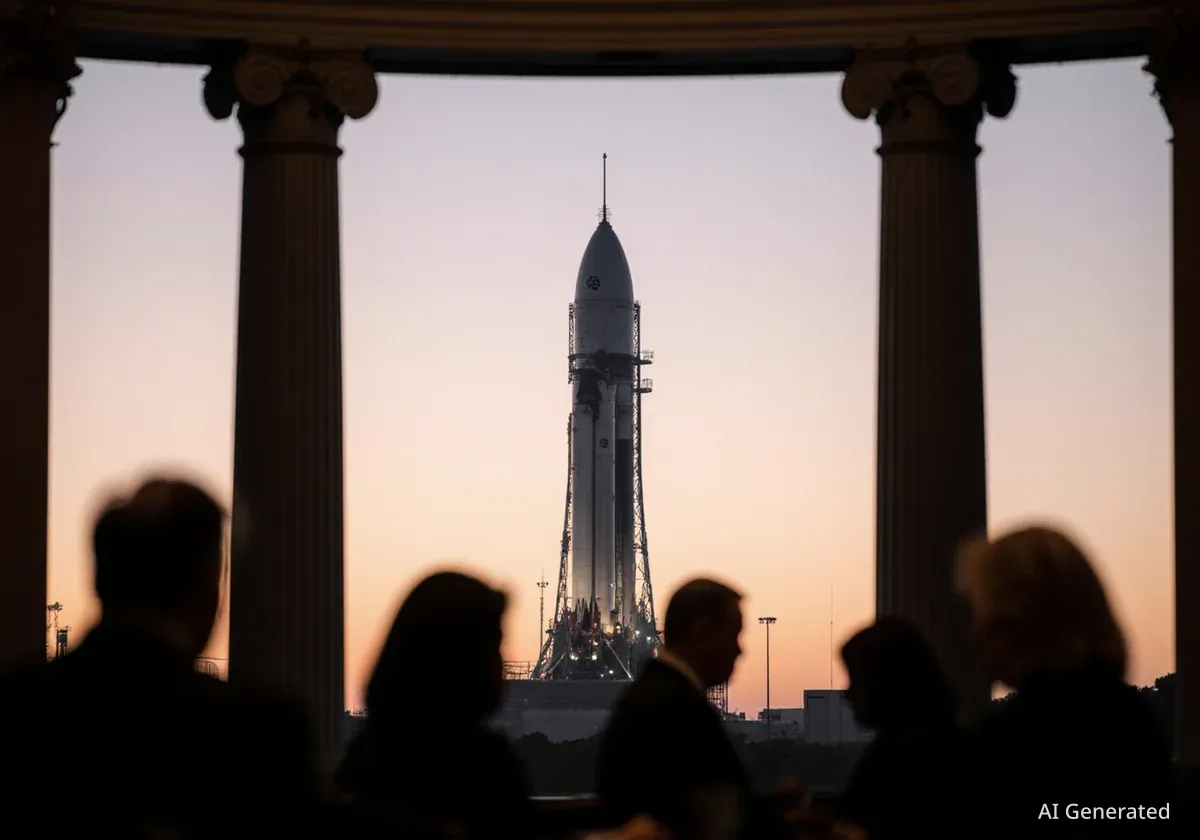



NASA's ESCAPADE mission, featuring two small probes, successfully launched on November 13, 2025, beginning a long and uncertain journey to Mars. The mission represents a significant test for the agency's strategy of using lower-cost, higher-risk projects to advance planetary science in an era of tightening budgets and a rapidly expanding commercial space industry.
Developed for under $100 million, the Escape and Plasma Acceleration and Dynamics Explorers (ESCAPADE) mission aims to study how the solar wind has stripped away the Martian atmosphere. However, its success is far from guaranteed, placing it at the center of a debate over the future of space exploration: can a series of smaller, riskier missions deliver the same value as one large-scale flagship project?
Key Takeaways
- NASA's ESCAPADE mission launched on a Blue Origin New Glenn rocket, sending twin probes to study the atmosphere of Mars.
- The mission is part of the SIMPLEx program, which focuses on low-cost, high-risk planetary science projects under $100 million.
- ESCAPADE's development relied heavily on commercial partnerships, off-the-shelf components, and a discounted launch to stay within its budget.
- The mission's outcome will influence the future of NASA's approach, weighing the benefits of frequent, smaller missions against large, technologically advanced flagship programs.
A New Model for Planetary Science
The ESCAPADE mission is a product of NASA's Small Innovative Missions for Planetary Exploration, or SIMPLEx, program. This initiative was designed to fund projects that accept a greater chance of failure in exchange for significantly lower costs. The goal is to determine if a portfolio of smaller missions can collectively yield a high scientific return, even if some fail.
This approach stands in stark contrast to flagship missions like the James Webb Space Telescope, which cost billions of dollars and undergo years of exhaustive testing to minimize risk. ESCAPADE is a Class D mission, a designation NASA uses for projects with a high tolerance for risk. The history of the SIMPLEx program underscores this reality; of the five missions selected so far, three have failed after launch and a fourth remains in storage.
To keep costs down, the ESCAPADE team made several strategic choices. The project, estimated to cost $94.2 million through the end of its science operations in 2029, utilized commercial off-the-shelf components instead of custom-built hardware. Key development tasks were outsourced to private companies, including Rocket Lab for the spacecraft and Advanced Space LLC for trajectory design.
By the Numbers: A Low-Cost Mission
- Total Cost: An estimated $94.2 million.
- Program Budget Cap: Under $100 million.
- Journey to Science: Approximately 30 months until data collection begins at Mars.
- Risk Class: NASA Class D (high risk tolerance).
The Trade-Offs of 'Faster, Better, Cheaper'
The philosophy behind missions like ESCAPADE revives NASA's "faster, better, cheaper" mantra from the 1990s. Proponents argue that launching ten $100 million missions could yield more diverse science than a single $1 billion project. This model allows for more frequent launches and a wider range of scientific targets across the solar system.
However, this strategy involves significant trade-offs. Low-cost missions typically have a narrower scientific scope. ESCAPADE will focus specifically on creating a detailed map of Mars' magnetic field and its interaction with the solar wind. While valuable, this is more modest than the goals of its $583 million predecessor, MAVEN, which had a broader suite of instruments and was responsible for determining how and when Mars lost its atmosphere.
Furthermore, flagship missions are often drivers of technological innovation. The development of the James Webb Space Telescope led to advancements in fields ranging from materials science to medical imaging tools used in eye exams. Smaller missions like ESCAPADE tend to rely on existing, proven technologies to save money. When private companies develop systems, the resulting patents often remain proprietary, limiting the spread of new technology across the scientific community.
What is a Class D Mission?
NASA categorizes its missions on a risk scale from A to D. Class A missions, like the Europa Clipper, are the highest priority and most expensive, using thoroughly tested hardware. Class D missions are at the opposite end, defined by their high risk tolerance and lower complexity. They are designed to achieve valuable science but with the understanding that failure is a more acceptable outcome.
A Difficult Path to the Launchpad
The journey for ESCAPADE was filled with challenges that nearly led to its cancellation on multiple occasions. According to its principal investigator, Rob Lillis, the mission survived 11 near-cancellations. These hurdles included delays in reaching required technology readiness levels and the loss of its original plan to launch alongside NASA's Psyche mission.
A new opportunity arose in 2024 with a discounted ride on the maiden flight of Blue Origin's New Glenn rocket. Even then, the launch faced multiple postponements. The first attempt was scrubbed due to weather and ground equipment issues. A second delay was caused by a strong solar storm—the very phenomenon ESCAPADE is designed to study.
"ESCAPADE is the mission with 11 lives."
- Rob Lillis, ESCAPADE Principal Investigator
Finally, on November 13, 2025, the New Glenn rocket lifted off from Cape Canaveral. After a tense period where mission controllers worked to resolve a receiver misalignment, communication was successfully established with both spacecraft, marking the start of their long cruise to Mars.
The Future of Exploration
The launch of ESCAPADE coincides with a boom in the commercial space sector. Companies like Blue Origin and SpaceX are driving down launch costs through reusable rocket technology, making smaller planetary science missions more economically viable. Cape Canaveral saw a record 94 launches in 2025, a testament to the increasing pace of commercial spaceflight.
If ESCAPADE's twin probes successfully reach Mars and begin sending back data, the mission will be hailed as a proof of concept for this minimalist, commercially-driven approach to exploration. It could pave the way for a future where NASA's portfolio includes a balanced mix of ambitious, technology-pushing flagship missions and a steady stream of smaller, targeted science projects.
For now, the fate of this new strategy rests on the two small spacecraft currently making their way through the void. Whether ESCAPADE becomes a model for future exploration or a cautionary tale, its journey will provide critical data not just about Mars, but about how humanity can best continue its quest to understand the solar system.