
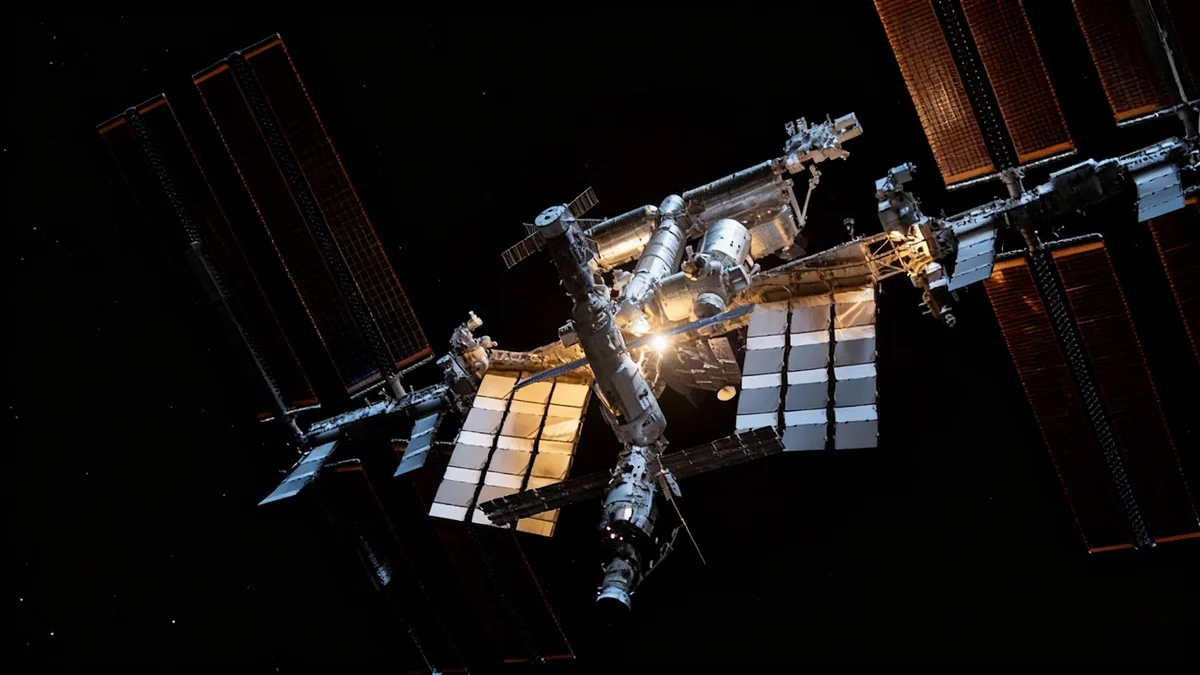


The International Space Station is entering its final five years of planned operations, with international partners preparing for its controlled deorbit in 2030. As scientific work continues at full pace, new logistical challenges, including damage at a key Russian launch site, are raising questions about the final phase of this historic orbital laboratory.
NASA and its partners are coordinating a multi-year plan to bring the station down safely over an uninhabited region of the Pacific Ocean, a complex procedure that relies on both Russian and American technology.
Key Takeaways
- The International Space Station is scheduled for a controlled deorbit and splashdown around 2030.
- SpaceX has been awarded a contract worth up to $843 million to develop a deorbit vehicle for the final phase.
- Scientific research will continue until the end, with the ISS National Lab's management extended through 2030.
- Damage to a Soyuz launch pad in Kazakhstan introduces uncertainty for future Russian crew and cargo missions.
The Final Chapter for an Orbiting Laboratory
After more than two decades of continuous human presence, the International Space Station (ISS) has begun its final operational phase. The orbiting outpost, a symbol of post-Cold War cooperation, is slated for retirement around 2030.
The plan involves a carefully managed deorbit process. According to Dana Weigel, ISS Program Manager, the station will be slowly lowered over two to two-and-a-half years using a combination of its own thrusters and natural orbital drag. The Russian segment of the station is expected to handle attitude control during this descent.
For the final, critical push out of orbit, a new vehicle is being developed. NASA awarded SpaceX a contract valued at up to $843 million to build the United States Deorbit Vehicle (USDV). This specialized spacecraft will provide the main thrust to guide the massive structure to a precise and safe splashdown in a remote area of the Pacific Ocean.
"It’s very much an integrated plan and an integrated solution," Weigel said, highlighting the redundancy built into the process. "That gives us additional layers of redundancy, so that if something happened with the attitude control, you can then switch over to the USDV."
Preparations are already underway. Weigel noted that fuel reserves needed for the deorbit maneuvers are being accumulated, with projections indicating the required levels will be reached in early 2028. The gradual descent is expected to begin in mid-2028, with the USDV arriving in 2029 for the final stage.
Science Until the Very End
Despite the planned retirement, the scientific mission of the ISS is not winding down. Research activities are expected to continue at a high tempo for the remaining years. This commitment was recently solidified when the Center for the Advancement of Science in Space (CASIS) announced an extension of its agreement with NASA.
CASIS will continue to manage the ISS National Laboratory through 2030, ensuring a steady flow of research projects to the station. The organization manages up to 50 percent of U.S. crew time and cargo space allocated for scientific purposes.
Since 2011, the ISS National Lab, managed by CASIS, has supported over 940 research payloads launched to the space station, leading to advancements in medicine, materials science, and technology.Ramon Lugo, CEO of CASIS, emphasized the importance of this continued partnership. "We are honored that NASA has extended this unique partnership through 2030, and we will continue to work in collaboration, pushing the limits of space-based R&D for the benefit of life on Earth," he stated.
New Hurdles in a Critical Phase
While the end-of-life plan is in place, the logistics of keeping the station staffed and supplied have encountered new complications. A significant incident at the Baikonur Cosmodrome in Kazakhstan has created uncertainty for Russia's Soyuz program.
Following the recent Soyuz MS-28 launch, a mobile service platform used by technicians collapsed into the launch pad's flame trench at Site 31. While Russia's space agency, Roscosmos, stated the damage would be fixed "in the nearest time," some reports suggest repairs could take as long as two years.
This damage could potentially impact the launch schedule for both crewed Soyuz missions and uncrewed Progress cargo flights. Progress vehicles are vital not only for delivering supplies but also for carrying the propellant used to periodically reboost the station's orbit.
Station Reboost and Redundancy
The ISS constantly loses altitude due to atmospheric drag and requires regular engine burns, or reboosts, to maintain its orbit. Historically, these have been performed by Russian Progress vehicles and the Zvezda service module. More recently, SpaceX's Cargo Dragon and Northrop Grumman's Cygnus spacecraft have also demonstrated this capability, providing crucial redundancy for station operations.
NASA officials have stated that the station currently has sufficient capability for reboost and attitude control, and no immediate impacts are expected. SpaceX's Cargo Dragon vehicles are also contributing to this function. Nevertheless, any long-term disruption to the Progress supply chain could complicate the process of stockpiling fuel for the deorbit maneuvers planned for later this decade.
The Final Crews of the ISS
As the station's final years approach, the focus also turns to the astronauts who will be its last inhabitants. The crew rotation schedule is mapped out through 2030, with flights alternating between American commercial crew vehicles from SpaceX and potentially Boeing, alongside Russian Soyuz capsules.
The question of who will be on that final mission is complex. While seasoned veterans with extensive spacewalking experience might seem like the logical choice, there are other factors to consider.
"One of the things from a medical consideration standpoint is we do limit radiation exposure for crew members," explained Dana Weigel. "If we’re asking for a year-long mission, we have to factor all of that in for crew health."
This means that an astronaut with too much prior spaceflight experience might exceed their lifetime radiation limits, making them ineligible for a final, extended stay. This balancing act between experience and health considerations will be a key factor in selecting the last crew to turn off the lights on the International Space Station.