

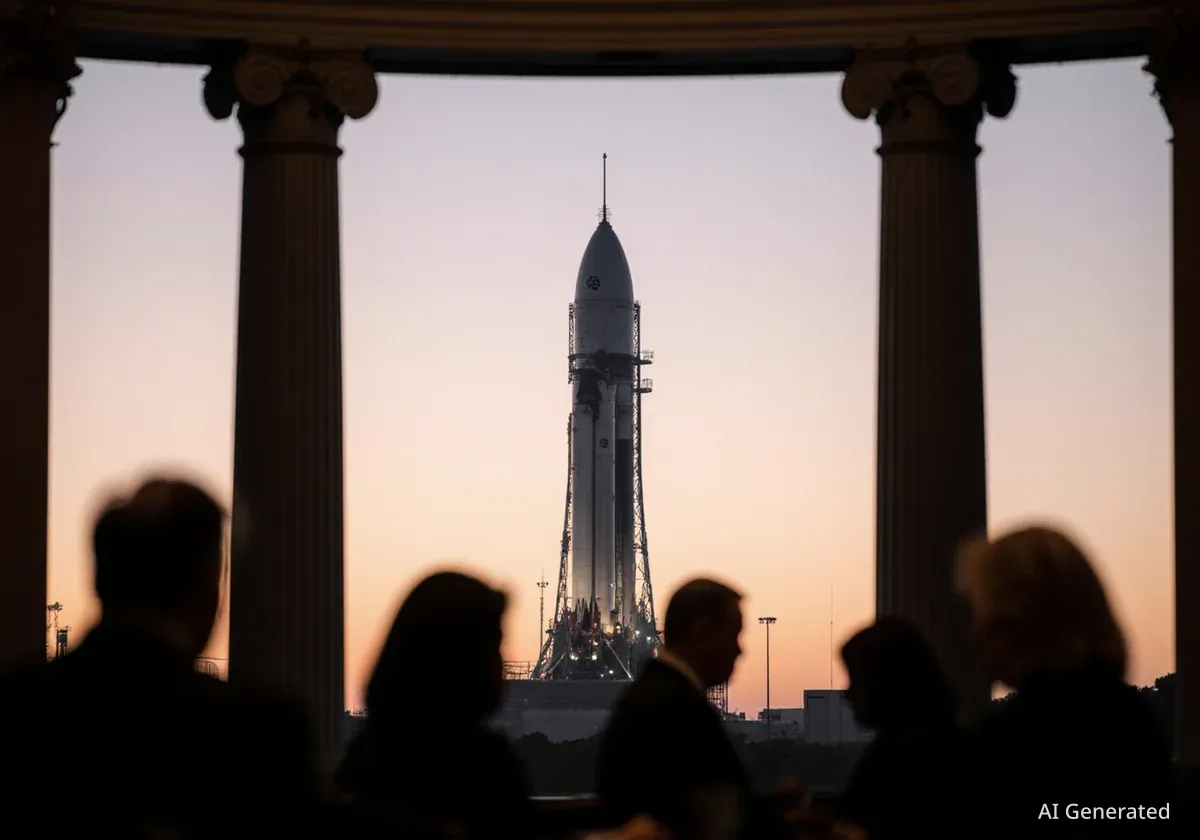


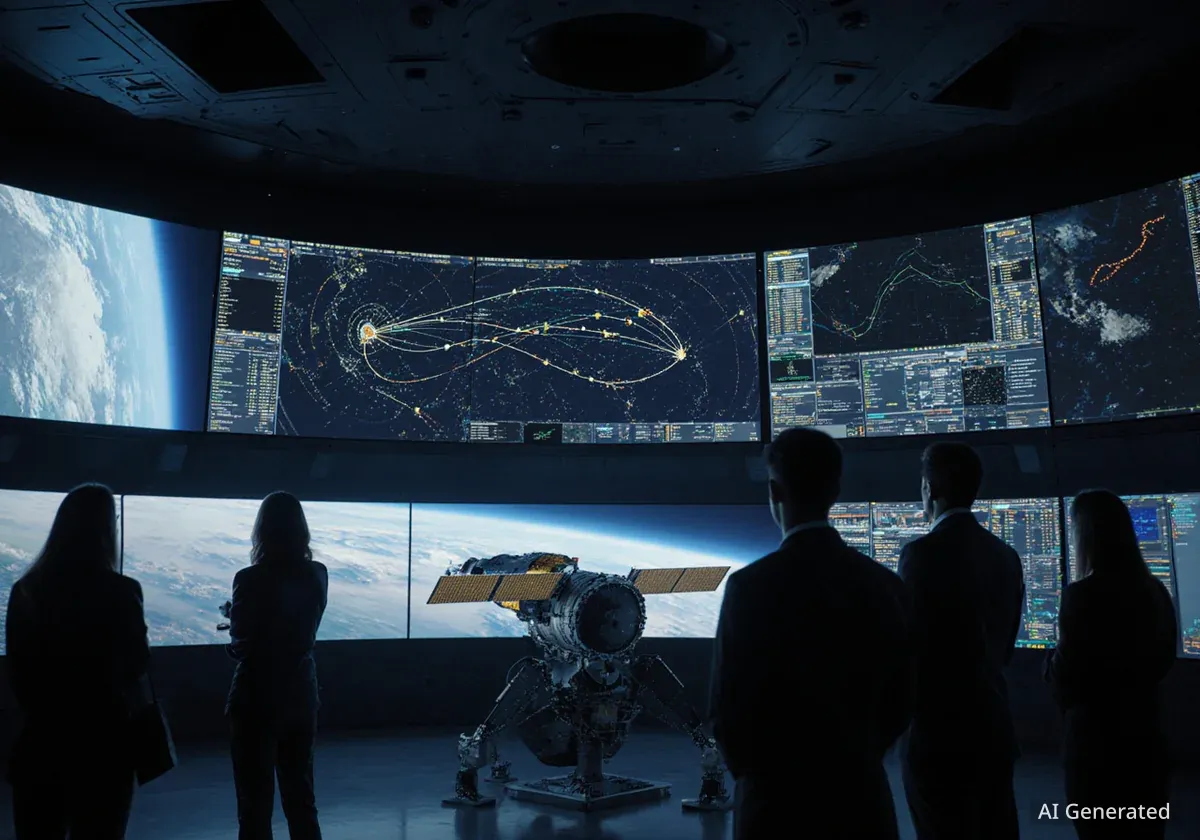
As companies like SpaceX and Amazon plan to launch tens of thousands of new satellites, the region of space just above Earth is becoming dangerously crowded. Experts are now calling for a new era of automated traffic management, warning that many current satellites lack the ability to avoid catastrophic collisions.
The explosive growth of the commercial space industry has shifted focus from simply launching rockets to managing complex logistics in orbit. However, this new orbital economy faces a critical challenge: a growing field of space debris and an increasing number of satellites that cannot maneuver out of harm's way, creating a high-stakes traffic problem traveling at over 17,500 miles per hour.
Key Takeaways
- Low-Earth orbit is becoming increasingly congested with new satellite mega-constellations.
- Many satellites currently in orbit lack propulsion systems, making them unable to avoid collisions.
- Experts advocate for AI-driven automated systems to manage orbital traffic, as the scale exceeds human capability.
- New regulations like the EU Space Act aim to enforce sustainability and operator responsibility.
- The space safety market is growing, turning compliance costs into business opportunities for new services.
The New Orbital Traffic Jam
The era of mega-constellations is here. SpaceX has filed for 42,000 Starlink satellites, Amazon is developing its Kuiper system, and China is planning its own vast network. While this growth signals a booming space economy, it also introduces unprecedented risks.
"You don’t just put big trucks on the street, you also have to manage those," explained Chiara Manfletti, CEO of the space traffic management company Neuraspace. The analogy highlights a crucial shift: space is no longer just a destination but a domain requiring active management, similar to terrestrial logistics but with far higher speeds and consequences.
A collision in orbit doesn't just destroy two assets; it can create thousands of pieces of new debris, each capable of causing further collisions in a chain reaction known as the Kessler Syndrome. Experts confirm that even if all space launches stopped today, the amount of debris in orbit would continue to increase on its own due to existing objects colliding.
A Historical Warning
The severity of orbital collisions became clear in 2009 when a defunct Russian military satellite, Kosmos-2251, crashed into an active Iridium communications satellite. The impact, occurring at a combined speed of over 26,000 miles per hour, generated more than 2,000 pieces of trackable debris, instantly making certain orbits more hazardous for all operators.
Calling for an Automated Air Traffic Controller
With thousands of satellites and millions of debris fragments, manually tracking and avoiding potential collisions is no longer feasible. The sheer volume of conjunction alerts—warnings of a potential close approach—can overwhelm human operators.
"The volume of what’s coming is going to be so big... that just having manual processes, that doesn’t work anymore," Manfletti stated. This reality is driving the development of AI-powered platforms that can analyze threats, predict trajectories, and recommend or even execute avoidance maneuvers automatically.
This transition is already underway. SpaceX's Starlink constellation, for example, uses an automated collision avoidance system. Notably, the primary source of collision risk for Starlink satellites was initially other satellites within their own fleet, demonstrating the necessity of automation even within a single network.
The role of human operators is evolving from active pilot to supervisor. "Today, we’re about augmenting the human," Manfletti said. "At some point, the human can’t be augmented anymore... we’re just going to have to automate."
The 'Sitting Duck' Problem
A significant portion of satellites in orbit, particularly smaller ones, are launched without propulsion systems. This cost-saving measure means they are incapable of maneuvering. Chiara Manfletti describes them as "sitting ducks in orbit that are circling at very high speeds," posing a passive but significant threat to all other spacecraft.
Regulation and the Business of Safety
Governments are beginning to respond to the growing congestion. The proposed EU Space Act is one of the most comprehensive efforts to establish clear "rules of the road." The regulation aims to harmonize standards across Europe, making operators more responsible for collision avoidance and mandating end-of-life disposal plans for their satellites.
Historically, guidelines suggested de-orbiting a satellite within 25 years of its mission's end. Today, that timeline is widely considered dangerously long.
"Imagine you just stopped your car for 5 years on the side of the road... It just feels very old and, you know, belongs to a different millennia," Manfletti commented on outdated de-orbiting standards.
While new rules may seem like a financial burden, they are also creating a new market. Companies are emerging to provide services in:
- Space Situational Awareness (SSA): Monitoring objects in orbit.
- Active Debris Removal: Capturing and de-orbiting large, defunct objects.
- In-orbit Servicing: Refueling and repairing satellites to extend their lifespan.
Progressive satellite operators are no longer viewing safety as a mere compliance cost. They are proactively subscribing to traffic management services because it is economically sound. Protecting a multi-million dollar satellite from a collision that could be prevented with a small investment in data services is a straightforward business decision.
The Path Forward: Global Cooperation
Space is a global commons, and a collision caused by one operator can affect everyone. However, establishing a single international regulator is complicated by geopolitical tensions and national security concerns. Operators are often unwilling to share precise location data of their satellites, especially military assets.
A potential solution lies in creating a "system of systems." This model involves regional, trusted hubs that can receive sensitive data from operators in their jurisdiction. These hubs would then share only the necessary intelligence—such as a warning to maneuver—without revealing the underlying sensitive data.
"Do you actually really need to know everything, or do you just need to know there’s something coming, you have to move?" Manfletti posed. This approach balances the need for operational security with the collective need for a safe orbital environment.
As humanity places more of its critical infrastructure in orbit, from communication and navigation to climate monitoring, ensuring the long-term sustainability of space is no longer an abstract concept. It is an immediate economic and security imperative.