

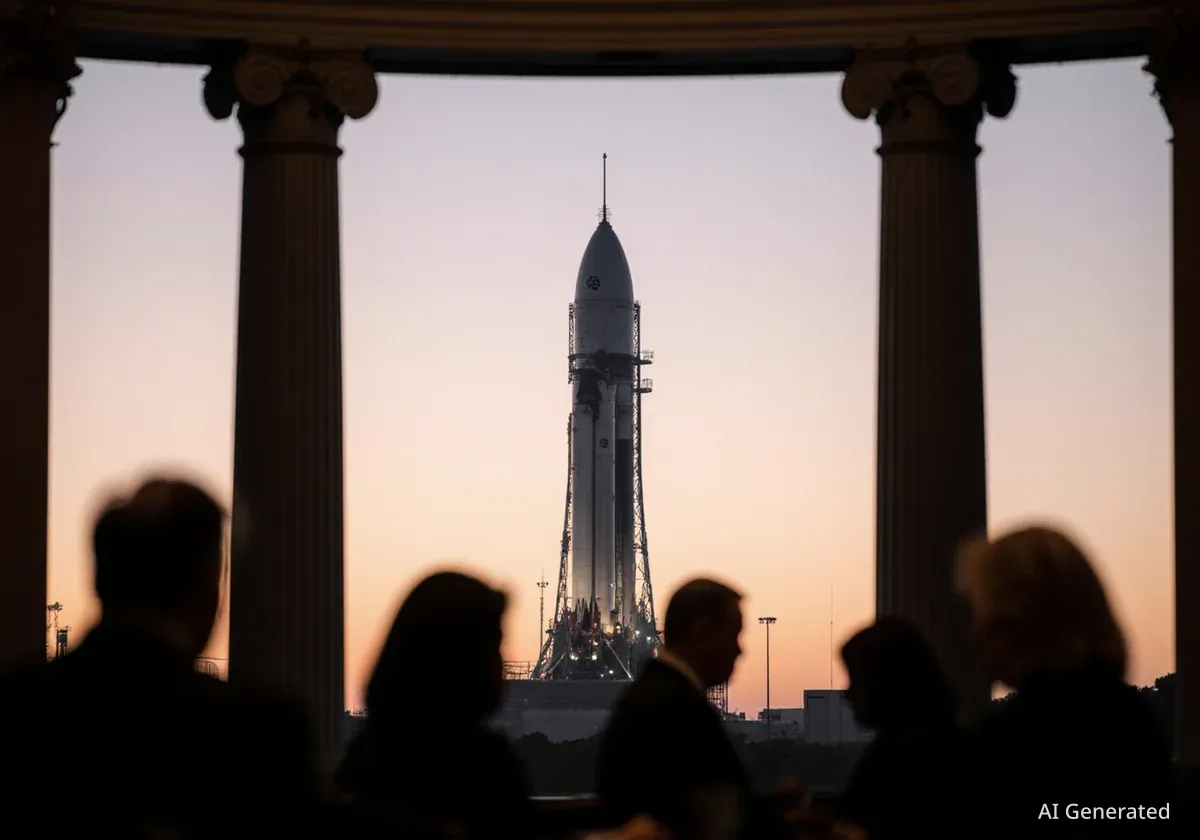



In early 2026, NASA's Artemis II mission will send four astronauts on a journey around the Moon, marking humanity's first crewed voyage beyond low-Earth orbit in over fifty years. Unlike the Apollo missions that defined the Cold War space race, this flight is not about planting a flag. Instead, it represents a fundamental shift in U.S. space strategy, focusing on long-term presence and international collaboration in an increasingly crowded field.
The mission serves as a critical test flight for the Orion spacecraft and its life-support systems, paving the way for future landings. More importantly, it signals America's approach to lunar exploration in the 21st century—one built on partnerships rather than solitary competition, setting a distinct contrast to the more closed-off lunar program of China.
Key Takeaways
- Artemis II, scheduled for early 2026, will be the first crewed mission to the Moon's vicinity since Apollo.
- The mission will not land but will test the Orion spacecraft's capabilities on a flyby trajectory around the Moon.
- This new era of space exploration is defined by competition with multiple nations, notably China, and includes commercial partners.
- The U.S. strategy emphasizes open collaboration and establishing international norms, while China's program is more state-controlled and selective.
- The mission is a crucial step toward Artemis III, which aims to land astronauts on the Moon's south pole by 2028.
From a Two-Player Race to a Global Stage
The original space race was a clear-cut contest between two superpowers: the United States and the Soviet Union. It was a race for technological and ideological supremacy, culminating in the Apollo Moon landings. Today, the landscape is vastly different. The return to the Moon is not a bilateral competition but a global endeavor involving numerous countries and private companies.
China has emerged as a significant competitor, with a methodical and well-funded lunar program. The nation has achieved major milestones, including landing a rover on the far side of the Moon and returning lunar samples to Earth. Beijing has publicly stated its goal of landing astronauts on the Moon by 2030 and establishing a permanent research station.
This new environment is not just about national prestige. The stakes now include strategic positioning, access to potential lunar resources like water ice at the south pole, and the opportunity to shape the rules for future space activities. Governments are still the primary drivers, but they are now joined by commercial entities that design, build, and operate critical space hardware.
The Apollo Legacy
When Apollo 13 faced a catastrophic failure in April 1970, the world watched as NASA engineered a safe return for its three astronauts. The event, while a mission failure, became a demonstration of American ingenuity and resolve during the Cold War. It highlighted a race focused on singular, high-profile achievements. The Artemis program, in contrast, is designed for sustained, long-term operations.
The Strategic Importance of Artemis II
On the surface, Artemis II might seem like a modest mission. Its four-person crew will not walk on the lunar surface. Instead, they will execute a flyby, looping around the far side of the Moon in their Orion capsule before returning to Earth. The entire flight is designed to test the spacecraft's life-support, communication, and navigation systems in a deep-space environment.
However, the strategic value of this mission is immense. Sending humans beyond the relative safety of low-Earth orbit is a complex and expensive undertaking that requires sustained political will and stable funding. Artemis II demonstrates that the U.S. is committed to this long-term vision.
It also functions as a vital stepping stone. The data and experience gathered from this flight are essential for the success of Artemis III, the mission slated to land astronauts near the lunar south pole in 2028. A successful Artemis II mission builds confidence among international and commercial partners, showing them that NASA's timeline is credible and that its systems are reliable.
Mission Profile: A 10-Day Journey
The Artemis II mission is planned to last approximately 10 days. After launching on the Space Launch System (SLS) rocket, the Orion capsule will orbit Earth twice to build speed before beginning its four-day trip to the Moon. It will then fly past the Moon before using its gravity to slingshot back toward Earth for splashdown.
Two Competing Models for Lunar Exploration
The return to the Moon highlights two distinct philosophical and strategic approaches, primarily between the United States and China.
The American Approach: Open Collaboration
The U.S. model, embodied by the Artemis program, is intentionally open. It is built around a coalition of international space agencies and commercial companies. This framework, outlined in the Artemis Accords, establishes a set of principles for peaceful and transparent exploration.
By inviting partners to participate, the U.S. aims to:
- Expand capabilities by pooling resources and expertise.
- Share the financial burden of deep-space exploration.
- Establish shared expectations for responsible behavior on the lunar surface, from landing procedures to resource utilization.
The Chinese Approach: State-Directed Progress
China's lunar program operates under a different model. It is centrally directed by the state, with a clear, incremental plan focused on building national capabilities. While China does engage in some international partnerships, they are typically more selective and less integrated than the Artemis coalition.
Beijing has released fewer details about how its planned lunar activities would be coordinated with other nations or commercial actors. This more guarded approach reflects a focus on achieving sovereign goals and establishing an independent, long-term presence on the Moon, including the International Lunar Research Station (ILRS) project developed with Russia.
Defining the Rules of the Road
As more countries and companies set their sights on the Moon, particularly the resource-rich polar regions, the vague principles of existing space law are being put to the test. The 1967 Outer Space Treaty, the foundational document of space law, requires nations to conduct activities with "due regard" for the interests of others and to avoid "harmful interference."
For decades, this obligation was largely theoretical. With multiple missions converging on the same lunar locations, 'due regard' is quickly becoming a practical operational challenge.
How this principle is interpreted will have significant consequences. Does it simply mean deconflicting launch schedules and landing sites, or does it require active coordination of surface operations? The actions taken by the first nations to establish a sustained presence will likely set the precedent for decades to come. The U.S. strategy of open partnership is a deliberate effort to shape these norms through collective action and transparency.
U.S. officials have increasingly framed the space program in the context of this strategic competition. Recent government reports and congressional testimony emphasize the need for continuity and a steady pace in the Artemis program to maintain American leadership in space. This perspective treats lunar exploration not as a series of sprints but as a marathon where consistency, reliability, and partnerships are key.
Artemis II is the next major step in that marathon. It is more than a test flight; it is a demonstration of a specific model for humanity's future in space. As the Orion capsule makes its historic journey around the Moon, it will carry not just four astronauts, but the ambitions of a global coalition aiming to explore the cosmos together.