
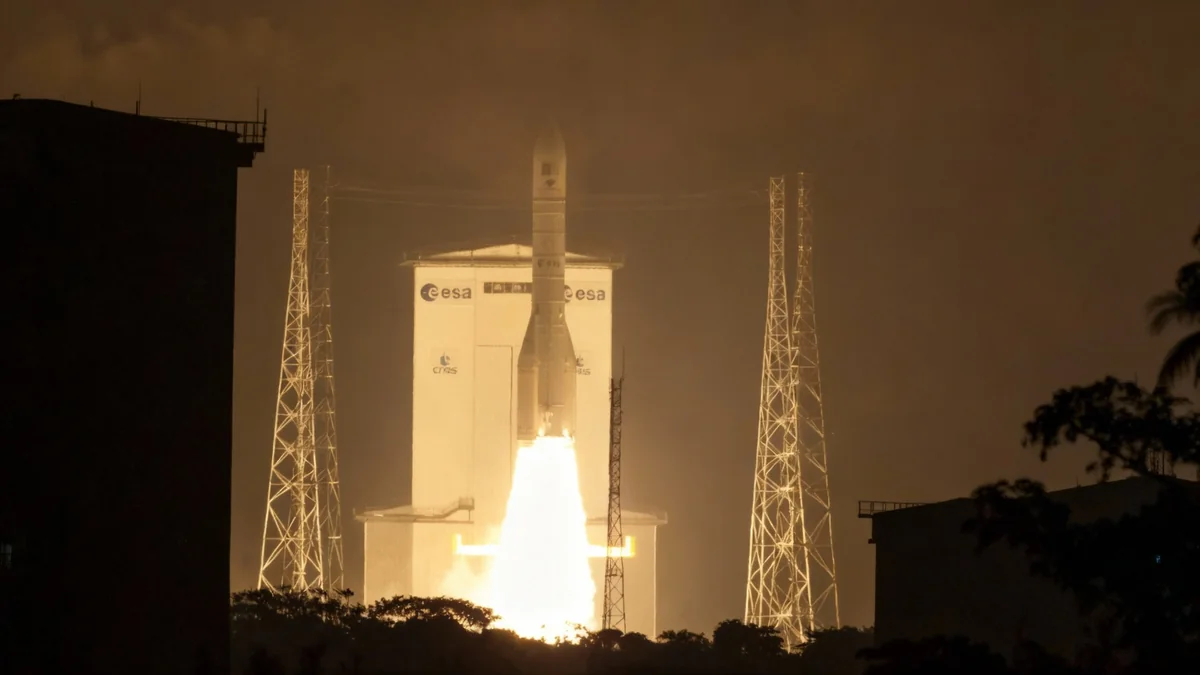




The European Union is facing a critical juncture in the modern space race, lagging significantly behind the United States in launch capabilities and satellite deployment. A proposed new law, the EU Space Act, intended to create a unified framework for the continent, is now drawing criticism for potentially stifling innovation and increasing costs, further widening the gap with global competitors.
With its market share in space manufacturing and launch services plummeting from over 20% in 2008 to just 6% today, Europe's strategy to regulate its way to competitiveness is being questioned by industry leaders and government officials alike.
Key Takeaways
- Europe's share of the global space market has fallen to 6%, a sharp decline from over 20% in 2008.
- The proposed EU Space Act could increase costs for satellite companies by up to 10%, potentially hindering research and development.
- There is a significant cost and capability gap between Europe's Ariane 6 rocket and SpaceX's reusable Falcon 9.
- Critics argue the new law favors regulation over building competitive capabilities, a strategy that could backfire in the fast-paced space sector.
A Widening Gap in Orbit
The strategic importance of a robust space presence was starkly highlighted by Ukraine's reliance on SpaceX's Starlink satellite network for military communications. The conflict revealed a significant capability gap for Europe, which currently lacks a comparable large-scale satellite constellation. This dependence on a single American company has accelerated the EU's push to develop its own sovereign capabilities.
However, the numbers paint a challenging picture. The United States accounts for well over half of both public and private investment in the space sector. In contrast, Europe contributes only about 10% of public investment and 22% of private investment. This disparity is directly reflected in the operational realities of the launch industry.
Launch Economics: A Tale of Two Rockets
- Ariane 6 (Europe): A heavily subsidized, expendable rocket. Estimated cost is over $100 million per flight. It has completed only a handful of launches since its debut last year.
- Falcon 9 (SpaceX, US): A reusable rocket that has flown more than 160 times in the past year alone. The cost per launch is estimated to be around $70 million.
This economic and operational divide is a major hurdle for Europe's ambitions, including the planned deployment of its own satellite constellation, IRIS², which is scheduled to be operational by 2030. Without a competitive and cost-effective launch system, achieving this goal remains a significant challenge.
The EU Space Act: A Solution or a Setback?
In response to these challenges, the European Union has drafted the Space Act. The legislation aims to harmonize the diverse space policies of its member states and establish global standards for space safety, sustainability, and cybersecurity. The goals include addressing real problems like orbital debris and congestion.
Despite its intentions, the proposed law has been met with concern. Both industry bodies and government officials have warned that its "regulate first, compete later" approach could impose heavy burdens on an industry where Europe is already struggling to keep pace. The European Commission itself estimates the act could add as much as 10% to the operating costs of satellite companies.
Other analyses suggest the impact on profitability, investment, and research and development could be even more severe. The legislation places a particular strain on smaller companies and startups, which are crucial for driving innovation but have fewer resources to navigate complex compliance requirements.
The 'Brussels Effect' in Space
The term "Brussels effect" describes the EU's ability to set global standards through its internal regulations, forcing international companies to adopt European rules to access its market. While effective in areas like data privacy (GDPR), critics worry that applying this model to the capital-intensive and rapidly evolving space sector could stifle the very innovation Europe needs to foster.
Some elements of the law have also been criticized as protectionist. For instance, new registration and legal representation rules appear to discriminate against non-EU operators. Additionally, specific obligations triggered by the deployment of "mega" and "giga" constellations would, in practice, apply only to American systems like Starlink, as no European equivalent currently exists.
A Call for a New Approach
As the draft legislation moves forward, there is still an opportunity for revision. Experts suggest several key changes to ensure the law supports, rather than hinders, European competitiveness.
Recommendations include amending the regulation to avoid duplicating the work of national authorities and creating exemptions or streamlined processes for smaller companies. Another proposal is to grant regulatory equivalence to companies that already meet established international safety and sustainability benchmarks, rather than imposing unique EU requirements on top of them.
Ultimately, the consensus among critics is that Europe must shift its focus from compliance to capabilities. This involves greater investment in key areas, particularly space-based defense. Germany's plan to invest $41 billion in space defense is seen as a positive step in this direction.
Expanding the mandate of the European Space Agency (ESA) to develop dual-use, military-grade systems and encouraging more joint procurement among member states are also seen as crucial steps. The success of Europe's future in space, embodied by projects like the IRIS² constellation, will depend on the ability to deliver technologically advanced and economically viable systems, not on a protective wall of regulations.