
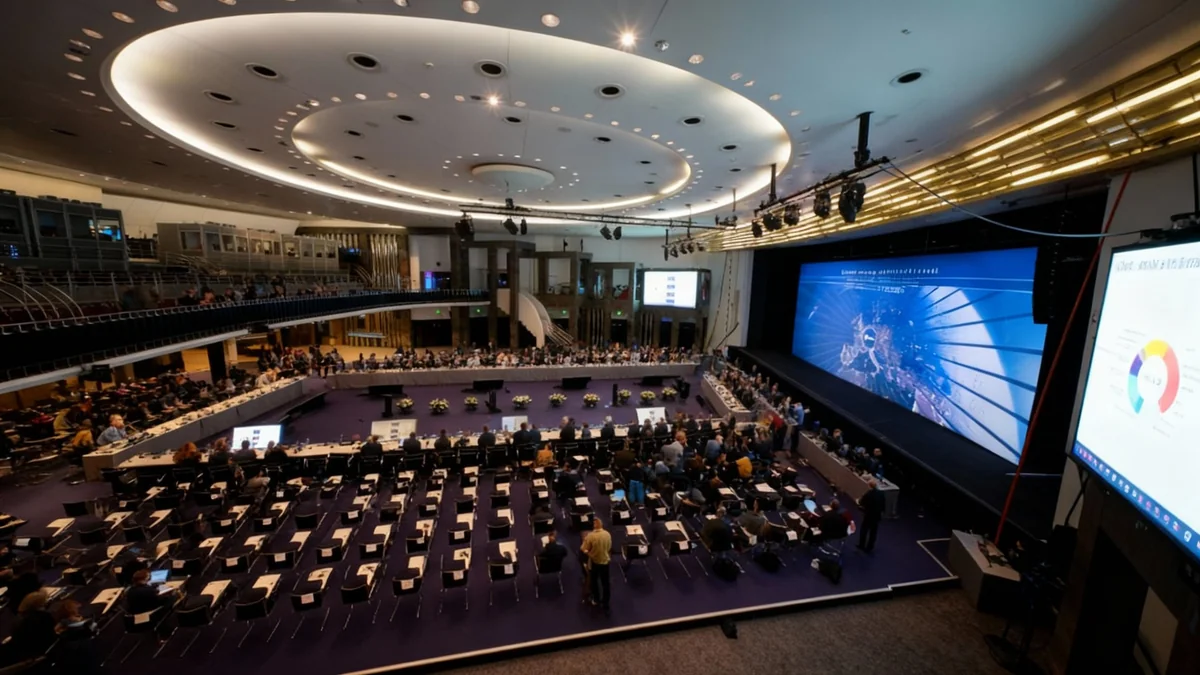



The European Space Agency (ESA) has approved a landmark €22 billion budget for 2025-2027, including a significant €1.35 billion for a new space defense initiative. This decision marks a historic pivot for the 50-year-old agency, which has traditionally maintained a strictly civilian focus.
The funding, agreed upon by the agency's 23 member states in Bremen, Germany, reflects growing concerns over geopolitical threats to space-based assets and a desire for greater European autonomy in security matters.
Key Takeaways
- The European Space Agency has allocated €1.35 billion for space defense in its new three-year budget.
- This is the first time in its 50-year history that the agency has formally funded defense-related programs.
- The total budget for 2025-2027 is a record €22 billion, a 17% increase over the previous period when accounting for inflation.
- The largest portion of the budget, €4.4 billion, is dedicated to space transportation, aiming to compete with global launch providers.
A New Era for European Space Policy
For five decades, the European Space Agency operated under a mandate that restricted its activities to peaceful, civilian purposes. This long-standing policy has now fundamentally changed. The agency's ruling Council of Ministers has given a clear mandate to develop space applications for what it terms "non-aggressive defence purposes."
This shift comes as European governments express increasing concern about the security of their satellites and other space infrastructure. The reliance on other global powers, particularly the United States, for critical military space capabilities has also been a driving factor in this policy evolution.
"The clear mandate for use of space applications for non-aggressive defence purposes signifies an historic change for ESA," the agency stated following the vote. "Non-dependence in technology is key to advancing Europe’s ambitions in space, alongside its guaranteed access to space."
The decision allows ESA to directly support the security and defense needs of its member states, aligning its activities more closely with the current geopolitical landscape.
Inside the European Resilience from Space Initiative
The new defense funding is channeled through an initiative named the European Resilience from Space (ERS). With a budget of €1.35 billion ($1.6 billion), the program is designed to bolster Europe's ability to monitor and protect its assets from orbit.
Initially, the ERS will concentrate on two main areas:
- Earth Observation: Developing dual-use technologies for a proposed network of observation satellites. This project, known as the Earth Observation Governmental Service, is championed by the European Commission.
- Navigation Services: Establishing a new program to provide navigation data from satellites in low Earth orbit, supplementing existing systems.
ESA and the EU: A Key Distinction
It is important to note that the European Space Agency is an independent intergovernmental organization and is separate from the 27-member European Union. While many countries are members of both, their structures and funding mechanisms are distinct. ESA programs are funded through a combination of mandatory contributions based on GDP and voluntary contributions from member states for specific programs.
ESA leaders have also left the door open for the ERS initiative to expand. Member states have been given a year to propose additional capabilities they might want to fund under this new defense-oriented framework.
A Record Budget to Boost European Ambitions
The defense initiative is part of a much larger financial commitment. The total three-year budget of €22 billion ($27 billion) represents a significant increase in spending. ESA Director General Josef Aschbacher noted that this amounts to a 32% increase over the 2022 budget, or 17% when adjusted for inflation.
"This is amazing," Aschbacher said during a press conference following the budget approval, highlighting the strong political support for Europe's space programs.
Budget Breakdown
- Total Budget (2025-2027): €22 billion
- Space Transportation: €4.4 billion
- Space Defense (ERS): €1.35 billion
Strengthening Europe's Access to Space
The largest single allocation within the new budget is for Space Transportation, which will receive €4.4 billion ($5.1 billion). This funding underscores Europe's determination to secure independent and competitive access to space, a market increasingly dominated by commercial players like SpaceX.
The European Launcher Challenge
A key part of this strategy is the new European Launcher Challenge, an initiative designed to cultivate a pool of commercial launch service providers based in Europe. The goal is to foster innovation, including the development of reusable rockets, to better compete on the global stage.
Five companies have been selected to participate in the initial phase of the challenge:
- Isar Aerospace (Germany)
- Rocket Factory Augsburg (Germany)
- PLD Space (Spain)
- MaiaSpace (France, subsidiary of ArianeGroup)
- Orbex (United Kingdom)
These companies are working towards first flight demonstrations, which are scheduled to take place in 2027. The initiative runs parallel to continued investment in Europe's flagship launchers, the Ariane 6 heavy-lift rocket and the Vega-C medium-lift vehicle, ensuring a multi-faceted approach to maintaining Europe's presence in the evolving launch market.