


China has officially outlined its space exploration priorities for 2026 through 2030, revealing a strategic focus on resource extraction, orbital infrastructure, and commercial spaceflight. The nation's fifteenth five-year plan, detailed by the China Aerospace Science and Technology Corporation (CASC), allocates significant state funding toward establishing a long-term presence beyond Earth.
The comprehensive roadmap includes plans for mining water ice on celestial bodies, developing massive data centers in orbit, launching a commercial space tourism program, and increasing its influence over international space regulations.
Key Takeaways
- China's 2026-2030 space plan prioritizes mining, orbital data centers, and tourism.
- The "Tiangong Kaiwu" project will focus on extracting water ice for rocket fuel and life support.
- Plans for "gigawatt-level" space data centers face significant technical challenges with heat dissipation.
- A commercial space tourism program will begin with sub-orbital flights, with a recent test vehicle already launched.
- The plan signals China's intent to play a larger role in setting international rules for space traffic.
A New Blueprint for the Cosmos
The release of a five-year plan by Chinese authorities is a significant event, transitioning national goals from theoretical ambitions to state-funded mandates. This latest plan solidifies the country's commitment to becoming a leading space power, providing a clear directive for its vast network of state-owned enterprises and private companies.
Unlike space programs in other nations that often rely on fluctuating annual budgets, China's five-year structure guarantees consistent funding and political support. This stability allows for long-term development of complex and capital-intensive projects, positioning the nation to make rapid advancements in the coming decade.
The Quest for Off-World Resources
A cornerstone of the new plan is a space mining initiative named Tiangong Kaiwu. The project's name is a nod to a 17th-century Ming Dynasty encyclopedia, and its title roughly translates to "The Exploitation of the Works of Nature." This historical reference underscores the project's foundational importance to the country's future in space.
However, China's approach diverges significantly from that of most Western space mining ventures. Instead of targeting rare materials like platinum for return to Earth, Tiangong Kaiwu will focus on harvesting water ice from asteroids or the Moon.
Why Water Ice is Critical
Water is considered the most valuable resource in space. Beyond its obvious use for drinking and growing food, it can be split into its component elements, hydrogen and oxygen. These two elements are the primary components of powerful rocket propellant, meaning that in-space refueling stations could be established, dramatically reducing the cost and complexity of deep-space missions.
The initial five-year phase will concentrate on feasibility studies and technology demonstrations. Engineers will test key components like robotic drills and in-orbit processing systems designed to extract and purify water from raw celestial material. The ultimate goal is to scale these technologies for full industrial mining operations in the near future.
Data Centers in Orbit Face Major Hurdles
Perhaps the most technologically ambitious goal is the construction of "gigawatt-level space digital infrastructure." The idea of placing massive data centers in orbit has gained traction globally, as space offers constant solar power and removes competition for land and energy resources on Earth.
Despite these advantages, a fundamental law of physics presents a formidable obstacle: heat. Data centers on Earth generate immense waste heat and rely on massive air and water cooling systems to prevent their processors from overheating. In the vacuum of space, convective cooling is impossible.
To dissipate a gigawatt of waste heat in space, engineers would need to build passive radiators for infrared radiation. Current estimates suggest these radiators would need to be the size of football fields, far beyond the launch capacity of any existing rocket.
While the plan does not detail how Chinese engineers intend to solve this thermal management problem, the stated goal serves as a direct challenge to competitors like SpaceX, which is also exploring orbital data processing. For now, this objective appears more aspirational than achievable within the five-year timeframe.
Entering the Space Tourism Race
The plan also confirms China's entry into the burgeoning space tourism market. The strategy mirrors the initial steps taken by Western companies like Blue Origin and Virgin Galactic by starting with sub-orbital flights that take passengers above the Kármán line, the recognized boundary of space.
Progress is already underway. On January 12th, CAS Space, a commercial offshoot of the Chinese Academy of Sciences, successfully tested its Lihong-1 Y1 rocket, a vehicle designed for tourist flights.
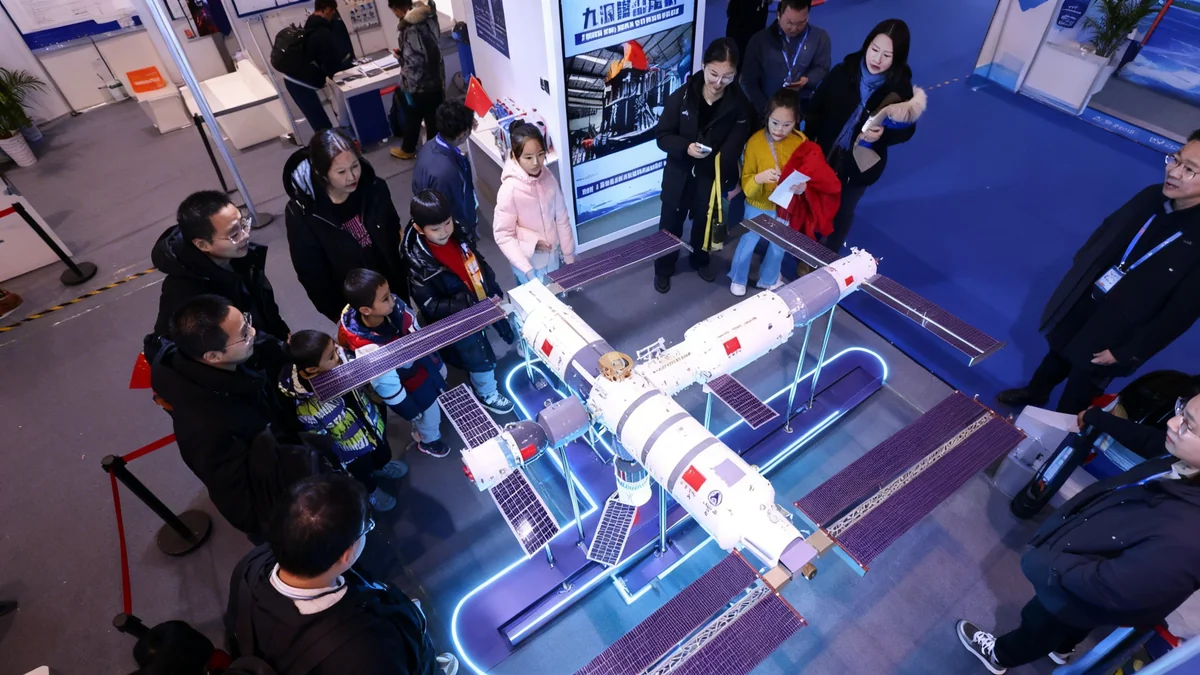
China holds a distinct long-term advantage in this arena: it operates its own space station. The Tiangong space station could eventually serve as a destination for orbital tourists, a model similar to how private astronauts have visited the International Space Station. This gives China a clear path from short sub-orbital hops to multi-day stays in orbit.
Shaping the Rules of the Road
Finally, the document includes a more political objective: to "strengthen China's role in shaping international regulations for space traffic management." As the number of satellites and space missions grows, the need for a global system to manage orbital traffic and prevent collisions becomes increasingly urgent.
Historically, these standards have been led by Western nations and space agencies. This statement signals China's intent to have a greater say in how space is governed. It remains unclear whether this will involve deeper engagement with existing international bodies or an effort to establish competing regulatory frameworks.
This five-year plan is more than a list of goals; it is a declaration of intent. With guaranteed funding and clear objectives, China is systematically building the capabilities to become a dominant force in space exploration and commerce for decades to come.