
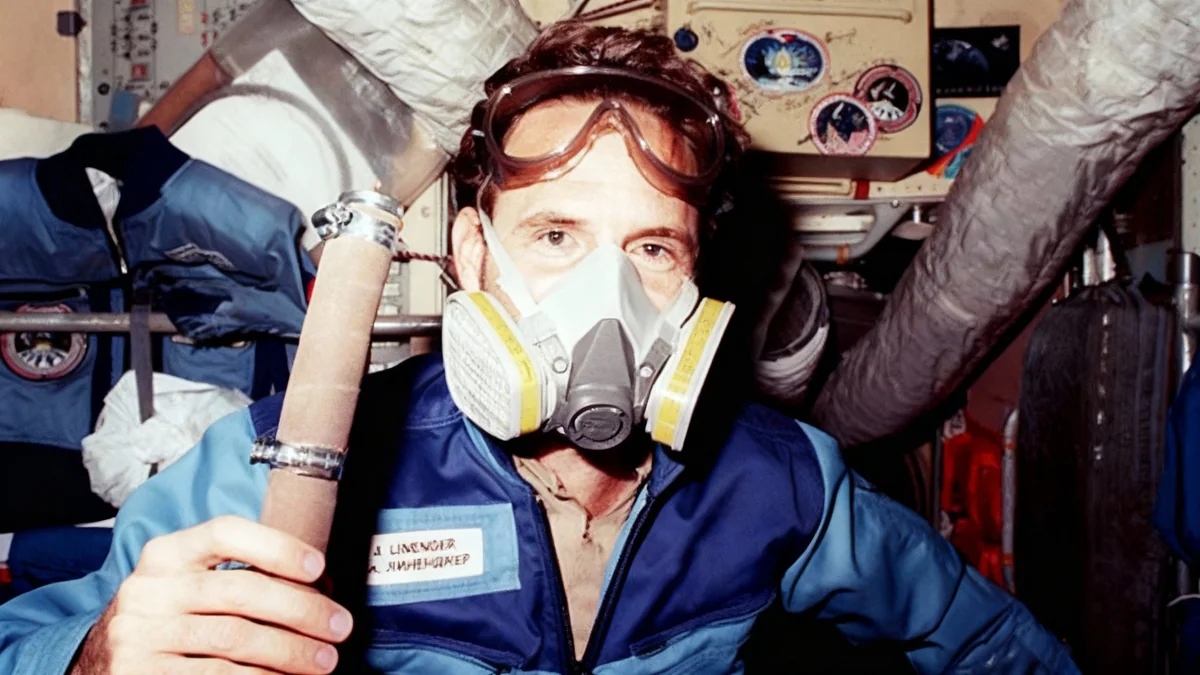

On February 24, 1997, a routine day aboard the Russian space station Mir turned into a life-or-death struggle hundreds of kilometers above Earth. A fire erupted, filling the station with thick smoke and trapping the six-person international crew. Now, former NASA astronaut Jerry Linenger is sharing his firsthand account of the harrowing event, which remains one of the most severe accidents in spaceflight history.
The incident began when a solid-fuel oxygen generator, activated to support the larger crew, malfunctioned. It spewed a nearly meter-long jet of flame and sparks, igniting a desperate 14-minute battle for survival in zero gravity, with the primary escape route blocked by the fire itself.
Key Takeaways
- A malfunctioning oxygen generator caused a major fire aboard the Mir space station in February 1997.
- The six-person crew, including NASA astronaut Jerry Linenger, fought the fire for 14 minutes in dense smoke.
- Russian mission control allegedly downplayed the incident's severity, initially describing it as a minor event.
- Linenger emphasizes that the crew's professional training was critical to their survival.
A Sudden Crisis in Orbit
The fire started shortly after the crew had finished their dinner. Russian cosmonaut Aleksandr Lazutkin activated a backup oxygen canister, a device sometimes referred to as an "oxygen candle." Instead of a controlled release of breathable air, the unit ignited violently.
"One moment, things are all going in a routine fashion, the next, it’s life and death right in your face," Linenger recalled of the incident. The intensity of the fire was shocking, described as having a "blowtorch intensity" that sent molten metal flying across the module.
The crew immediately implemented their emergency training. They donned oxygen masks and grabbed fire extinguishers to combat the blaze. The situation was complicated by the unique environment of space, where there is nowhere to run and every action must be deliberate.
Incident at a Glance
- Date: February 24, 1997
- Location: Mir Space Station
- Crew Members: 6 (American, Russian, German)
- Cause: Malfunctioning solid-fuel oxygen generator
- Fire Duration: Approximately 14 minutes
Battling Smoke and Uncertainty
While the flames were extinguished in under 15 minutes, the danger was far from over. The station was completely filled with thick, acrid smoke, making visibility near zero. The crew's survival depended on their personal respirators, but the clock was ticking on their limited oxygen supply.
"I’ve never seen smoke spread like that before. You feel you have to keep talking to yourself to stay calm, basically," Linenger stated, reflecting on the psychological pressure of the moment.
Clearing the air proved to be a significant challenge. According to Linenger, the station's filtration systems were not effective against the dense, particle-filled smoke. The crew resorted to a low-tech solution. As the station passed into Earth's shadow, the hull cooled rapidly. The water vapor from the fire extinguishers condensed on the cold interior walls, trapping the soot and smoke particles with it.
For the next 24 hours, the crew used old clothing and towels to wipe the black, contaminated water from the station's walls. It was a slow, manual process to make the air breathable again. The masks came off after about an hour, though the smoky smell lingered.
An Altered Reality and Information Control
The experience highlighted the profound differences between a crisis on Earth and one in space. Linenger noted how fundamental concepts like time and direction lose their meaning in orbit, where the sun rises and sets 15 times a day.
The Mir Space Station
Launched by the Soviet Union in 1986, Mir was the first modular space station and served as a long-term research laboratory in low Earth orbit for 15 years. It hosted numerous international crews before its controlled de-orbit in March 2001. The fire was one of several serious incidents during its operational life.
This disorientation required immense concentration for even simple tasks, a challenge that was magnified during the emergency. "Everything’s different, and you have to concentrate on everything," he explained.
Adding to the crew's isolation was the communication breakdown. With satellites malfunctioning, they had only brief windows to speak with Mission Control in Moscow. Linenger revealed that the official narrative on the ground was starkly different from the reality in orbit. Russian officials, eager to protect the reputation of their space program, reportedly suppressed the full extent of the danger.
"When we got back to Earth, we learned they’d said it was like a small cigarette fire and everything was fine," Linenger said. "It was a major fire. We survived by the skin of our teeth." He praised his Russian crewmates, calling them fantastic professionals he trusted with his life, but criticized the system on the ground for distorting the truth.
Lessons for a New Generation of Spacefarers
As a new era of commercial spaceflight and space tourism dawns, Linenger believes his experience holds critical lessons. He stresses the importance of professionalism and training, arguing that in a crisis, there is no substitute for experienced astronauts who do not panic under pressure.
"When things go well, no problem, but if things start going badly, I want a professional next me who’s had life experiences in tight situations," he asserted.
He expressed concern that tourists without rigorous training could be a liability during an emergency. On his flight, the coordinated response of three highly trained individuals—a pilot, a military engineer, and himself as a physician—was essential for survival.
Reflecting on his time in space, Linenger advises future astronauts to cherish the opportunity. "Give it everything you have... just give it 1,000 per cent because you are very, very lucky."