

A team of students from Binghamton University has secured second place in a national competition backed by NASA. The team, named Foodie Frontiers, developed an intelligent nutrition system designed to support long-term human missions to the Moon and Mars.
The xFoundry Horizons Challenge tasked university teams with addressing key technology gaps for establishing a sustained human presence on the Moon by 2040. The Binghamton team's project focuses on adaptive meal planning using artificial intelligence and biosensors.
Key Takeaways
- A Binghamton University team called Foodie Frontiers won second place in the NASA-supported xFoundry Horizons Challenge.
- Their project is an intelligent nutrition system using AI and biosensors for astronauts on long-duration space missions.
- The competition's goal is to develop technologies for a sustained human presence on the Moon by 2040.
- The final presentations occurred at the NEXPLORE 2040 Summit, held at Amazon's headquarters.
The Challenge for Future Space Exploration
The xFoundry Horizons Challenge is a nationwide initiative designed to engage university students in solving critical problems for the future of space exploration. Organized by xFoundry in collaboration with NASA, the competition aims to close technology gaps that could hinder humanity's goal of returning to the Moon and eventually reaching Mars.
Participants were asked to select one of four focus areas: Safe and Sustainable Food, Portable Off-Grid Artificial Intelligence, Peak Physical and Mental Performance, or Autonomous Health Diagnosis and Monitoring. The ultimate objective is to foster innovation that will support a permanent human settlement on the Moon within the next two decades.
University Support and Collaboration
The Binghamton team's participation was supported through a partnership between the university's Fleishman Career Center and the Watson Career and Alumni Connections Office. These departments provided resources and guidance, helping the students navigate the competitive process from concept to final presentation.
The Binghamton team consisted of four students: Eunji Hong, a biomedical engineering graduate student, along with Brendan Hurley, Krystal Facey, and Saiprakash Nalubolu. Calling themselves the Foodie Frontiers, they chose to tackle the complex issue of astronaut nutrition.
An AI-Powered Solution for Astronaut Nutrition
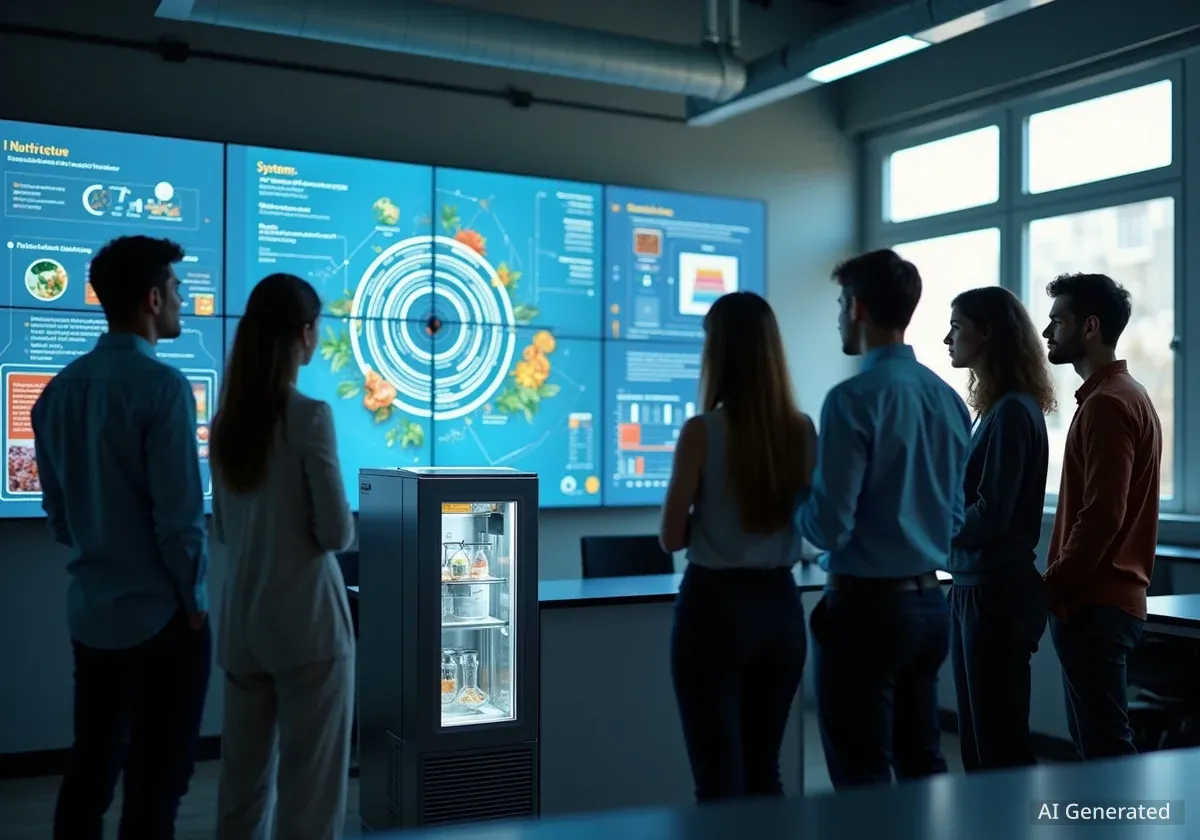
The Foodie Frontiers team developed a concept for an intelligent nutrition system. Their project is designed to provide adaptive meal planning for astronauts, a critical component for maintaining health and performance during extended missions in space.
Long-duration spaceflight presents unique physiological challenges. Astronauts experience muscle atrophy, bone density loss, and changes in their metabolism. A one-size-fits-all diet is not sufficient to counteract these effects, especially when resources are severely limited.
How the System Works
The proposed system integrates three key technologies:
- Artificial Intelligence (AI): An AI algorithm analyzes an astronaut's real-time health data to create personalized meal plans.
- Smart Hardware: Automated systems would manage food storage, preparation, and portion control based on the AI's recommendations.
- Biosensing Technology: Wearable sensors would continuously monitor an astronaut's vital signs, metabolic state, and nutrient levels, feeding this data back to the AI.
This closed-loop system allows for dynamic adjustments to an astronaut's diet, ensuring they receive optimal nutrition based on their specific needs, activity levels, and the biological stresses of the space environment. The team's proposal also highlighted the system's potential applications on Earth, particularly for individuals with specific dietary needs or those in resource-scarce environments.
The Importance of Food in Space
According to NASA, an astronaut on the International Space Station requires approximately 3,000 calories per day. For a mission to Mars, which could last up to three years, providing varied, nutritious, and palatable food is a major logistical and psychological challenge. Innovations in food systems are essential for mission success.
Presentation at the NEXPLORE 2040 Summit
After months of collaboration and development over the summer, the Foodie Frontiers team presented their project at the NEXPLORE 2040 Summit. The event took place from September 9-11 at Amazon's headquarters in Arlington, Virginia.
The summit brought together leading figures from space exploration, technology, and health. The students had the opportunity to hear from NASA astronauts, senior administrators, and executives from companies like Intel, ŌURA, Axiom Space, Ernst & Young, and KPMG. The keynote address was delivered by Dean Kamen, the renowned inventor of the Segway.
During the event, the Binghamton team received a notable mention from NASA astronaut Dr. Jeanette J. Epps during her presentation, highlighting the significance of their work.
"Participating in the Horizons Challenge is an incredible and unforgettable experience," stated Eunji Hong. "There is no need to feel stressed about being ‘perfect’ — it’s not a competition about scores. What makes this experience unique is the chance to connect with people from diverse perspectives, including astronauts, investors, engineers and academics."
Hong also noted the inspirational value of the sessions. "The sessions with astronauts and inventors were inspiring and gave me a real-world perspective on space and science for helping people," she added.
Future Opportunities and University Commitment
The success of the Foodie Frontiers team has strengthened Binghamton University's commitment to participating in high-level STEM challenges. The university plans to compete in the xFoundry challenge again in the future, with continued support from the Fleishman Center for Career and Professional Development and Watson Career Connections.
These offices are also working to create more pathways for students interested in the aerospace industry. The Fleishman Career Center is organizing its CONNECT employer treks for the upcoming spring semester, which will include a visit to NASA. This program allows students to engage directly with professionals and learn about career opportunities in the field.
The achievement of the Foodie Frontiers team serves as a practical example of how academic programs can connect students with real-world challenges, fostering skills in innovation, collaboration, and presentation that are valuable in any career path.