



Private space company Vast has successfully launched its first technology demonstration satellite into orbit, a critical first step in its ambitious plan to build a commercial space station. The mission, named Haven Demo, is designed to test key systems that will be used in the company's future human-rated habitats.
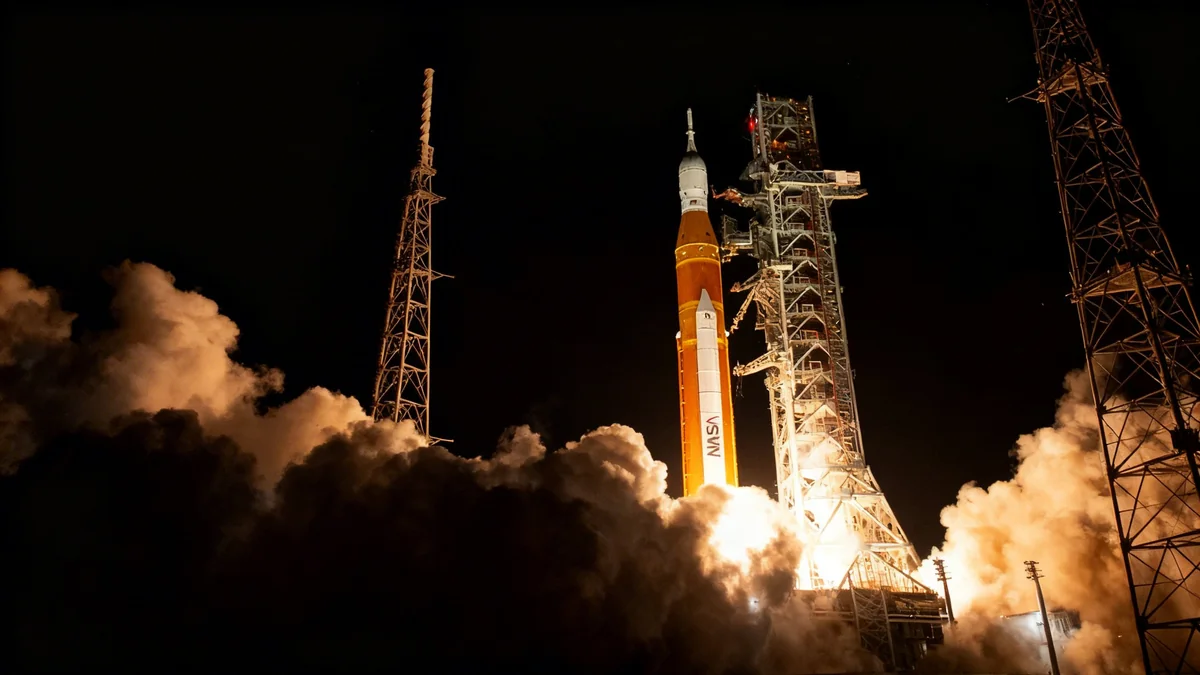
The spacecraft was launched from Cape Canaveral, Florida, aboard a SpaceX Falcon 9 rocket early Sunday morning. Shortly after reaching its operational altitude, the satellite successfully deployed its solar array, a key milestone confirming its ability to generate power in space.
Key Takeaways
- Vast successfully launched its Haven Demo satellite, a pathfinder for a future commercial space station.
- The satellite deployed its solar array in orbit, confirming its power systems are operational.
- This mission will test core technologies for Vast's planned Haven-1 human-rated habitat.
- Haven-1 is scheduled for launch no earlier than May 2026 and will host crews arriving on SpaceX Dragon capsules.
A Foothold in Orbit
The Haven Demo satellite lifted off as part of SpaceX's Bandwagon 4 rideshare mission. After separating from the rocket, the half-ton spacecraft stabilized itself and unfolded its single solar panel, an event Vast documented with 4K video shared publicly.
This initial success marks a significant moment for the company, which aims to become a key player in the emerging private space station market. The mission transitions Vast from a company developing concepts on the ground to one operating hardware in orbit.
"Haven Demo’s mission success has turned us into a proven spacecraft company," said Max Haot, Vast's CEO, in a statement following the launch. "The next step will be to become an actual commercial space station company next year. Something no one has achieved yet."
The satellite is now circling the Earth at an altitude of approximately 300 miles (500 kilometers), where it will undergo a comprehensive shakedown cruise. Over the coming weeks and months, mission controllers will test its essential systems, including its computer, software, propulsion, and communication hardware.
An Iterative Path to a Space Station
Unlike some competitors who are planning to launch large, complex stations in a single step, Vast is taking a more gradual, iterative approach. The Haven Demo is the first of a multi-phase plan to establish a permanent commercial presence in low-Earth orbit.
The data gathered from this pathfinder mission is crucial for the development of their next project: Haven-1. This will be a single-module, human-rated space habitat designed to support short-stay astronaut missions.
The Post-ISS Era
Vast is one of several companies competing to develop commercial space stations. NASA is actively supporting these efforts through its Commercial Low-Earth Orbit Destinations (CLD) program, aiming to ensure a continuous U.S. presence in orbit after the International Space Station (ISS) is retired around 2030. These private outposts are expected to serve a mix of government astronauts and commercial clients.
The systems being tested on Haven Demo are directly related to the hardware that will fly on Haven-1. For example, the solar array on the current mission is identical to one of the 12 arrays that will power the future habitat. Similarly, the thrusters, valves, and tanks on Haven Demo are the same models planned for the larger station.
Building Haven-1 on Earth
While the demo mission operates in space, work continues on the ground for the much larger Haven-1 module. Vast has already manufactured the primary structure of the habitat, which measures roughly 33 feet (10.1 meters) long and 14 feet (4.4 meters) wide.
This structure, complete with its hatch and a large domed window, has passed initial pressure and load tests. It is now undergoing final inspections before engineers begin integrating its complex internal systems. This includes:
- Environmental control and life support systems (ECLSS)
- Power, data, and thermal control hardware
- Propulsion systems and fuel tanks
- Internal crew accommodations and scientific equipment
Haven-1 Specifications
Once operational, Haven-1 will offer a habitable volume of about 1,600 cubic feet (45 cubic meters). This is roughly five times more interior space than a SpaceX Dragon capsule, providing a more comfortable environment for crews staying for up to two weeks.
Before it can launch, the completed Haven-1 module will be shipped to NASA’s Neil Armstrong Test Facility in Ohio. There, it will face a battery of tests designed to simulate the harsh conditions of space, including extreme temperatures, vacuum, and the intense vibrations of a rocket launch.
The Future of Commercial Space
Vast's current timeline targets a launch for Haven-1 no earlier than May 2026. Once in orbit, the company plans to host crews arriving on SpaceX Dragon spacecraft for missions lasting approximately two weeks.
This step-by-step validation process, starting with Haven Demo, is designed to reduce risk and build confidence in the company's technology. By proving its core systems in orbit first, Vast hopes to streamline the development and certification of its human-rated habitat.
The long-term vision extends even further, with plans for a multi-module station named Haven-2 in the 2030s. This larger complex would support bigger crews and longer-duration expeditions, catering to a growing market of space agencies, private researchers, and space tourists. The successful deployment of Haven Demo is the first concrete step on that long journey.