


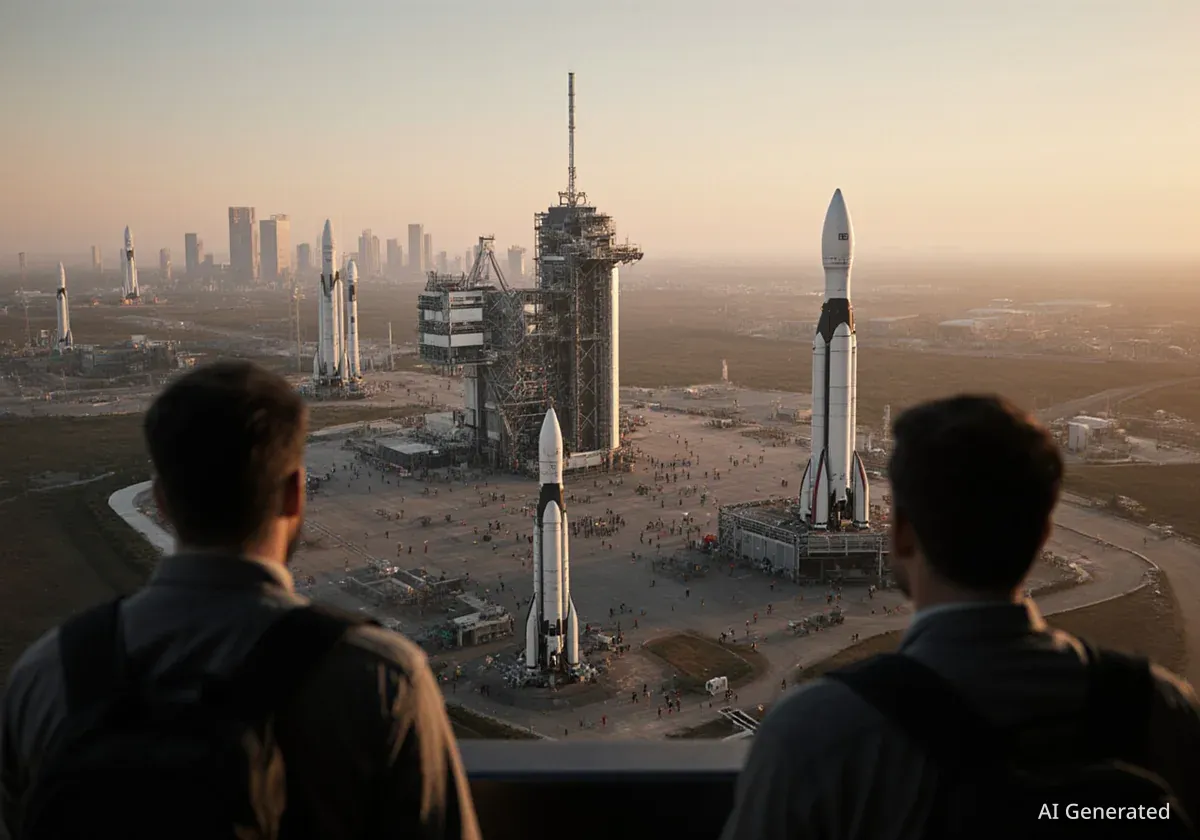

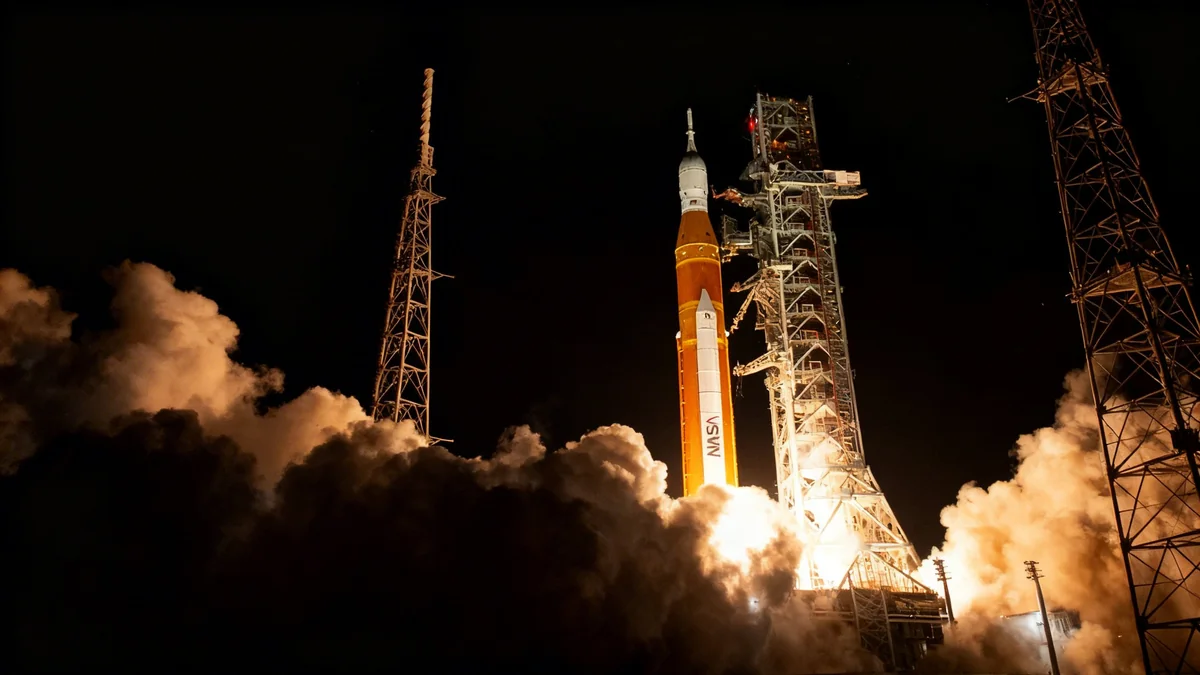
A new economic frontier is opening above our heads, with the space-based economy projected to triple in value to $1.8 trillion within a decade. This rapid expansion has ignited a high-stakes competition between the United States and China, not just for technological supremacy, but for the financial and industrial control of space itself.
While private ventures capture headlines, a quieter, more critical race is underway to build the financial systems needed to fund this new industrial revolution. Major investment firms are beginning to take notice, with JP Morgan recently announcing a $10 billion fund targeting critical sectors, including spacecraft and launch technologies. This signals a shift in perception, but a significant gap remains between ambition and actual capital deployment, a gap China is aggressively working to exploit.
Key Takeaways
- The global space economy is projected to grow from over $600 billion to $1.8 trillion annually within the next ten years.
- The United States' financial markets have not fully adapted to finance large-scale space infrastructure, creating an investment gap.
- China is treating space as a strategic industrial base, with state-backed plans for resource extraction, in-space manufacturing, and a potential $10 trillion space economy by 2050.
- Experts argue that the U.S. needs to move beyond venture capital and adopt infrastructure-style financing, like debt and insurance, to maintain leadership in space.
Space Moves From Frontier to Factory Floor
For decades, space was the domain of government agencies and science fiction. Today, it is rapidly transforming into a mature, investable economic sector. The advent of reusable rockets, pioneered by companies like SpaceX, has dramatically lowered the cost of accessing orbit, unlocking commercial possibilities previously thought impossible.
This isn't just about launching more satellites. The new space economy encompasses a wide range of activities, from in-orbit manufacturing and asteroid mining to lunar resource extraction. According to Donald Moore, CEO of the Space Finance Company, the U.S. space market needs a sophisticated financial structure to realize its full potential. He emphasizes the need for a full spectrum of capital, including venture capital, private equity, and structured debt finance.
The Reusable Rocket Revolution
The key driver behind the current space boom is the development of reusable launch vehicles. By recovering and reusing the most expensive parts of a rocket, companies have slashed launch costs. SpaceX currently dominates this market, conducting roughly 86% of all launches annually. However, China is rapidly developing its own reusable rocket programs, increasing competition and further driving down the cost of entry to space.
The U.S. government has recognized the urgency. A recent executive order on space superiority aims to attract over $50 billion in private investment into space markets by 2028. Yet, this policy goal highlights a disconnect with the current reality of capital markets, which are still catching up to the pace of technological change.
China's Strategic Long-Term Vision
While the U.S. relies heavily on private enterprise, China is executing a comprehensive, state-driven strategy to dominate the space economy. Beijing's vision extends far beyond near-Earth orbit, with analysts there projecting the space economy could be worth as much as $10 trillion by 2050.
This optimism is backed by significant achievements:
- Lunar Exploration: China is the only nation to have successfully landed a probe on the far side of the Moon.
- Mars Mission: It became only the second nation to land and operate a rover on Mars.
- Space Station: China has constructed and crewed its own independent space station, Tiangong.
These missions are not just for scientific prestige. They are foundational steps in a larger industrial plan. China views space as a vast resource hub and a future manufacturing base, a perspective that shapes its entire strategic approach.
The Riches of the Solar System
China's interest in space resources is well-founded. The lunar surface contains significant quantities of Helium-3, a rare isotope on Earth that could be a key fuel for future nuclear fusion reactors. Furthermore, near-Earth asteroids are rich in platinum-group metals and rare earth elements, minerals critical for modern electronics and green technology. Successfully mining these resources would give the controlling nation immense economic and geopolitical leverage.
Beyond mining, China is prototyping inflatable lunar factories and developing capabilities for in-space service, assembly, and manufacturing (ISAM). The goal is to produce materials like flawless semiconductors and purer pharmaceuticals in the unique microgravity environment of space—and to build structures far too large to be launched from Earth.
A Critical Investment Gap
The primary challenge for the United States is not a lack of technology or ambition, but a mismatch in financial models. The current venture capital-driven approach is effective for funding startups, but it is ill-suited for the long-term, capital-intensive projects required to build industrial infrastructure in space.
"If space is becoming industrial infrastructure, then it will need to be financed the same way as industrial infrastructure. That means moving beyond venture capital toward debt finance, insurance markets, and long-duration contracts that are enabled by policymakers."
This assessment, from analysts at the American Foreign Policy Council, suggests a new paradigm is needed. Historical parallels exist in the development of America's railways and aviation industries. In both cases, government acted as an anchor customer, creating predictable demand that allowed private capital to fund the large-scale construction of infrastructure.
American companies like Redwire, Varda, and Axiom are already making strides in in-space manufacturing, securing early-stage contracts and proving the viability of the market. However, to compete with China's state-backed initiatives, a more coherent national strategy is required to align policymakers, investors, and capital markets.
The Path Forward for US Leadership
Securing U.S. leadership in the emerging space economy will require a significant financial commitment. Analysis in the book Space Shock: 18 Threats that Will Define Space Power suggests an investment of $335 billion to $620 billion over the next decade would be sufficient. This scale of investment cannot come from venture capital alone.
Achieving this will require new public-private financial vehicles capable of funding factories, power systems, and logistics networks beyond Earth. Without these mature financial instruments, the U.S. risks ceding the economic high ground of space to China.
The choice is becoming increasingly clear. The space economy has doubled in the last decade and will be worth trillions by mid-century. The question is no longer whether this value will be created, but who will capture it. As one analyst put it, "Either American companies will capture that value — or Chinese state enterprises will."