


Startup Max Space has revealed an ambitious plan to build a commercial space station designed to launch on a single SpaceX Falcon 9 rocket. The station, named Thunderbird, would provide a habitable volume roughly one-third the size of the International Space Station, marking a significant shift in the strategy for developing commercial outposts in low Earth orbit.
The company, which emerged from stealth mode earlier this year, aims to leverage its unique expandable module technology to create a cost-effective and rapidly deployable habitat. This approach contrasts with other proposed stations that require multiple launches or reliance on future heavy-lift rockets like Starship.
Key Takeaways
- Max Space is developing Thunderbird Station, a commercial habitat with 350 cubic meters of volume.
- The entire station is designed to fit on a single Falcon 9 rocket for launch.
- A shift in NASA's commercialization strategy prompted the company to accelerate its space station plans.
- A prototype mission, named Mission Evolution, is scheduled to launch in early 2027 to test key systems.
- The company has hired former NASA astronaut Nicole Stott to assist with the habitat's interior design.
A New Vision for Orbit
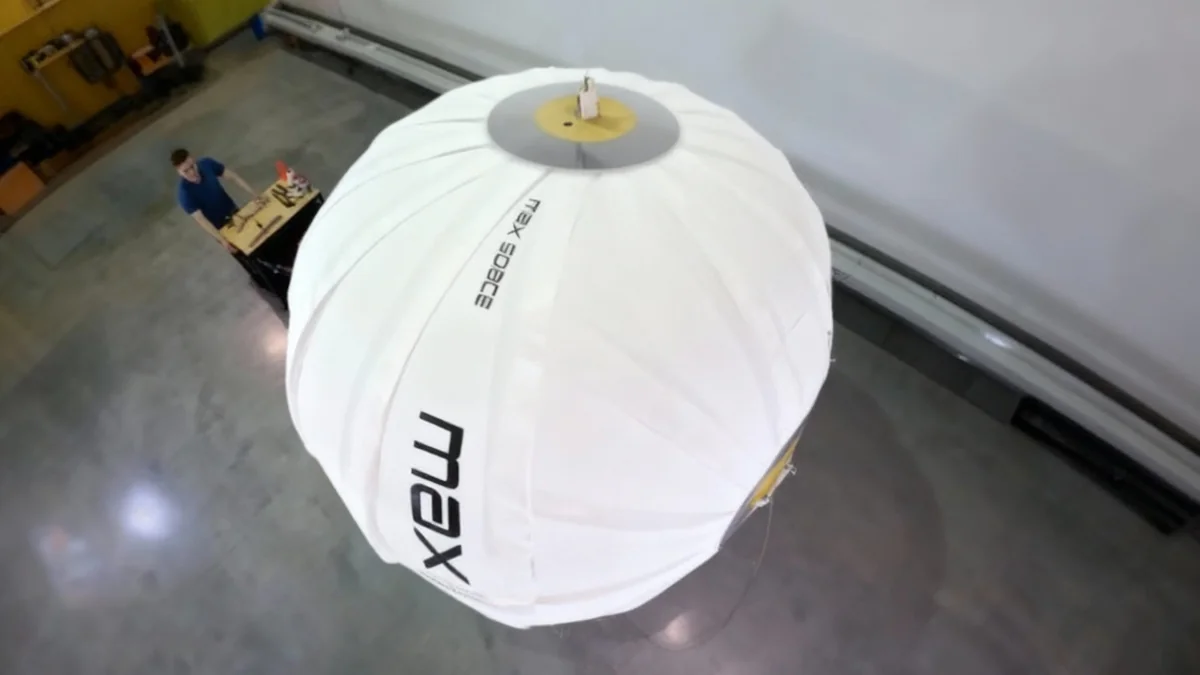
Max Space's Thunderbird Station is centered around a single, large expandable module. Once in orbit, this module would inflate to create a spacious environment capable of supporting a crew of four people continuously. The design also includes two docking ports to accommodate visiting spacecraft for crew rotations and cargo deliveries.
The company is pursuing a different technological path than competitors working on inflatable habitats. Max Space asserts that its proprietary expandable module technology offers more predictable safety margins and is better suited for scaling to even larger structures in the future.
The Post-ISS Era
With the International Space Station scheduled for retirement around 2030, NASA and other international partners are looking to the private sector to provide new platforms in low Earth orbit. This has created a competitive field of companies racing to develop the first commercially viable space stations for research, manufacturing, and tourism.
Initially, Max Space planned to be a technology supplier, offering its modules to other companies building space stations or for applications like in-space propellant depots. However, a strategic shift in NASA's approach to funding commercial space destinations changed the company's trajectory.
NASA's CLD Program as a Catalyst
The decision to develop a full-fledged station concept was heavily influenced by recent changes to NASA's Commercial Low Earth Orbit Destinations (CLD) program. In August, the agency adjusted its strategy to award multiple funded Space Act Agreements, creating a new opportunity for emerging players.
"It was pretty clear that was an opportunity for us to put a proposal forward to show how these modules can really be used for human habitation," said Saleem Miyan, Max Space’s chief executive. "That CLD proposal gave us an incentive to strategically look at how we would bring forward the roadmap."
This new NASA framework provided the impetus for Max Space to accelerate its long-term goals. The company now sees a direct path to demonstrate its technology and potentially secure government and private contracts for its orbital platform.
Designing for Efficiency and Flexibility
The ability to launch Thunderbird Station on a single Falcon 9 is a key differentiator. This significantly reduces the cost and logistical complexity compared to designs requiring multiple assembly missions in orbit.
This efficiency is enabled by what the company calls a "morphic interior structure." Instead of rigid, fixed walls and equipment racks, the interior will rely heavily on soft goods and reconfigurable elements. Miyan compared the concept to rearranging furniture in a house, allowing the crew to customize the space for different activities.
Thunderbird Station by the Numbers
- Volume: 350 cubic meters
- Crew Capacity: 4 continuous occupants
- Launch Vehicle: 1 Falcon 9 rocket
- Docking Ports: 2
"It allows us to create usable volume, personalized space for astronauts, and a large amount of space that can be readily leveraged for large-scale manufacturing in orbit," Miyan explained. This focus on manufacturing, particularly for high-value products like semiconductors and fiber optics, has reportedly generated significant interest from potential customers outside of the NASA program.
Building an Expert Team
To ensure the habitat is practical and human-centric, Max Space has brought on former NASA astronaut Nicole Stott as its lead astronaut. Stott's experience living and working on the International Space Station provides invaluable insight into the design process.
"She’s been incredibly helpful to our design and engineering teams in developing the original concepts for what an internal habitat should look like," Miyan noted.
The company also hired Kartik Sheth, a former associate chief scientist at NASA. His role will be to align the station's capabilities with the strategic needs of both NASA and the United States, ensuring the platform can support critical national research and industrial goals.
The Road to a Station
Before Thunderbird Station can be realized, Max Space must prove its core technologies in space. The next major step is Mission Evolution, a small-scale prototype scheduled for an early 2027 launch on a SpaceX rideshare mission.
This mission has several key objectives. A primary goal is to test the module's micrometeoroid and orbital debris (MMOD) protection system. Miyan described the system as a "layer of leaves" that has performed well in ground tests but has yet to be validated in the harsh environment of space. The mission will also test the module's environmental control and life support system (ECLSS).
Max Space, which employs nearly 50 people at its facility near the Kennedy Space Center, reports that it is fully funded through the 2027 prototype launch. The company has raised over $10 million in a pre-seed round from a group of strategic and institutional investors.
Looking further ahead, the company sees its expandable technology as a versatile solution for future exploration. Miyan stated that the same module design used for the orbital station could be adapted for lunar landers or habitats on Mars. "We see so many interesting applications where habitats, whether human-rated or not, are required," he said. "Those are the areas where I think we’re going to stand out.”