
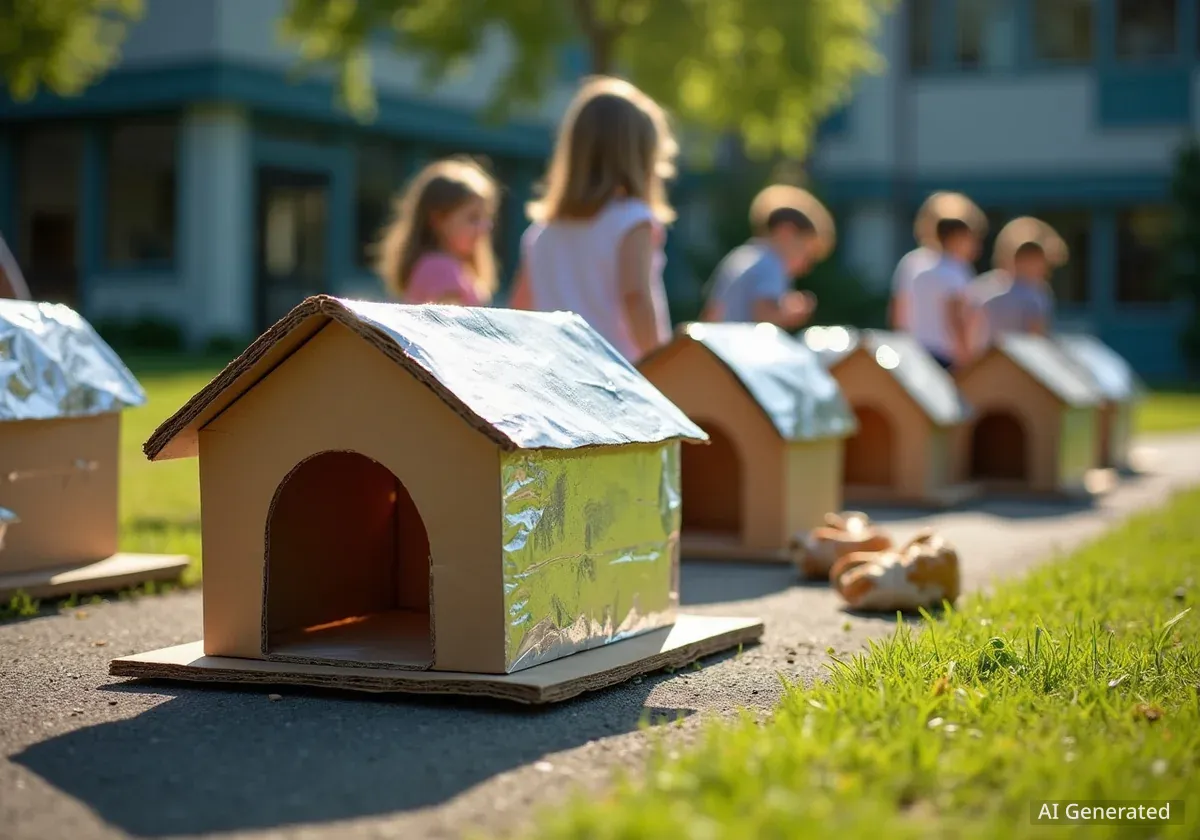


Students in the Earth and Space Science program at William Floyd High School recently applied classroom principles to a practical challenge: designing, building, and testing functional solar ovens. The hands-on project, led by teachers Christopher Ribaudo, Nicole Vitale, and Dana Harbers, tasked students with harnessing solar energy using everyday materials.
The project aimed to provide a tangible demonstration of thermodynamics, energy absorption, and reflection. After constructing their devices, students successfully used them to measure temperature changes and cook s'mores, combining scientific inquiry with a rewarding outcome.
Key Takeaways
- Earth and Space Science students at William Floyd High School participated in a hands-on STEM project.
- Students designed and constructed solar ovens using cardboard, tin foil, plastic wrap, and black paper.
- The project demonstrated core scientific principles of heat transfer, reflection, and the greenhouse effect.
- Testing involved measuring temperature increases and successfully melting s'mores using only solar power.
- A local business, Mama Lisa Restaurant, supported the educational initiative by donating 50 pizza boxes for the construction.
A Practical Application of Scientific Principles
The solar oven project was integrated into the Earth and Space Science curriculum to move learning beyond textbooks. The core objective was for students to understand how solar radiation can be captured and converted into thermal energy. Teachers Christopher Ribaudo, Nicole Vitale, and Dana Harbers guided their classes through the entire process, from initial design to final testing.
This type of project-based learning is a cornerstone of modern STEM education. It encourages critical thinking, problem-solving, and collaboration among students. By building something functional, students gain a deeper and more memorable understanding of abstract scientific concepts.
The Importance of Hands-On STEM Learning
Hands-on projects like the solar oven lab are critical for developing an intuitive grasp of scientific concepts. According to educational studies, kinesthetic learning—or learning by doing—improves information retention and helps students connect theoretical knowledge to real-world applications. This approach is particularly effective in STEM fields, where abstract ideas like energy transfer can be difficult to visualize.
Engineering with Everyday Materials
The construction phase of the project emphasized resourcefulness and ingenuity. Students were required to build their ovens using a specific set of simple, low-cost materials, demonstrating that complex scientific principles can be explored with accessible items.
Core Components and Their Functions
The design of a basic solar oven relies on a few key components working together to trap heat. The students' designs incorporated these elements:
- Cardboard Box: Served as the main structure and insulating chamber for the oven. Pizza boxes, donated by a local restaurant, were ideal for this purpose.
- Aluminum Foil: Used to line the interior flaps or create reflectors. Its shiny surface reflects sunlight into the cooking chamber, concentrating the sun's rays on the target area.
- Black Construction Paper: Placed at the bottom of the oven's interior. Dark colors are excellent absorbers of light and heat. The black paper absorbed the concentrated sunlight and converted it into thermal energy.
- Plastic Wrap: Stretched over the opening of the box to create a transparent window. This allows sunlight to enter but traps the heated air inside, creating a miniature greenhouse effect that raises the internal temperature.
Students worked in groups, modifying their designs to maximize efficiency. This iterative process of building and refining is a fundamental aspect of engineering and design, providing valuable experience for aspiring scientists and engineers.
How Hot Can a Cardboard Oven Get?
On a clear, sunny day, a well-designed cardboard solar oven can reach temperatures between 200°F and 300°F (93°C to 149°C). While this may not be hot enough for all types of cooking, it is more than sufficient to melt chocolate and marshmallows, pasteurize water, or cook simple foods like hot dogs or nachos.
Putting the Ovens to the Test
Once the solar ovens were assembled, the students took them outdoors for a two-part testing phase. The goal was to gather both quantitative and qualitative data to determine the success of their designs.
Phase One: Temperature Measurement
The first test was a purely scientific measurement. Students placed thermometers inside their sealed ovens and recorded the initial ambient temperature. They then positioned the ovens in direct sunlight, adjusting the reflective flaps to capture the maximum amount of solar energy.
After a set period, they recorded the new temperature inside the ovens. This allowed them to calculate the temperature difference and objectively compare the efficiency of various designs. This step reinforced the importance of data collection and analysis in the scientific method.
Phase Two: The S'mores Experiment
The second test was a more practical and enjoyable application of their work. Students placed the ingredients for s'mores—chocolate, marshmallows, and graham crackers—inside their ovens. They then observed as the sun's energy, trapped within their creations, slowly melted the chocolate and softened the marshmallows.
This final step served as a tangible and delicious reward for their efforts. Successfully cooking a treat using only the power of the sun provided a powerful and memorable conclusion to the project, solidifying the lessons learned about solar energy.
Community Partnership in Education
The project was also a testament to community collaboration. Mama Lisa Restaurant, a local establishment in Mastic, played a crucial role by donating 50 small pizza boxes. These boxes provided the perfect structural foundation for the solar ovens.
This donation not only supplied necessary materials but also demonstrated the value of partnerships between local businesses and schools. Such support is vital for enabling educators to provide enriching, hands-on learning experiences that might otherwise be limited by budget constraints. The involvement of community partners helps foster a supportive environment for STEM education and shows students that their work is valued by the wider community.